Odisha CMO marks 2 years of rural infra push in villages
Synopsis
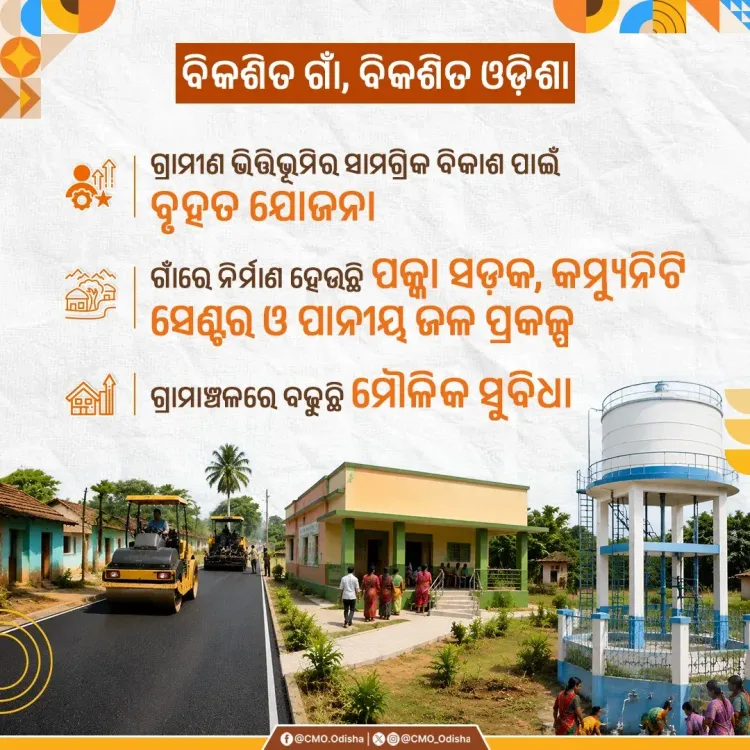
The Chief Minister's Office of Odisha on 22 June 2026 marked a two-year milestone by pointing to pucca roads, community centres, and drinking water projects as evidence of holistic rural development, framing village progress as the foundation of a developed Odisha.
Key Takeaways
The Chief Minister's Office of Odisha posted on 22 June 2026 to mark two years of its current administration.
The post highlighted pucca roads, community centres, and drinking water schemes as the key rural infrastructure achievements.
The government stated that 'the development of villages is the very foundation of a developed Odisha.' The hashtag #2YearsofLokankaSarakar frames the milestone as a people-centric governance anniversary.
Rural infrastructure delivery in Odisha draws on both central programmes like PMGSY and state-level execution through village panchayats.
Next state budget allocations and legislative reviews of rural works will be key indicators of whether the momentum continues.
The Chief Minister's Office of Odisha on Monday, 22 June 2026 highlighted the visible progress of large-scale rural development initiatives undertaken by the state government, pointing to pucca roads, community centres, and drinking water projects as proof of transformation in village life.
The post, shared under the hashtags #2YearsofLokankaSarakar and #BikasharaDharaOdishaSara, stated in Odia: 'ଗ୍ରାମୀଣ ସର୍ବାଙ୍ଗୀନ ବିକାଶ ପାଇଁ ନିଆଯାଇଥିବା ବୃହତ ପଦକ୍ଷେପ ଆଜି ଦୃଶ୍ୟମାନ ହେଉଛି' — translated: 'The major steps taken for holistic rural development are visible today.' It further noted that 'the development of villages is the very foundation of a developed Odisha.'
Context
The post marks what the state government is framing as a two-year milestone of its current administration, referred to in the hashtag as Lokanka Sarkar (the people's government). The messaging centres on rural infrastructure as the defining achievement of this period.
Specifically, the government cited pucca (paved) roads, community centres, and drinking water schemes as the three pillars making village life 'easier and more prosperous,' to use the official framing. These categories represent the most tangible, everyday-visible indicators of state delivery at the grassroots level.
Policy Backdrop
Rural road connectivity in Odisha, as across India, has long been anchored by the Pradhan Mantri Gram Sadak Yojana (PMGSY), launched nationally in 2000, which provided all-weather road access to unconnected habitations. State governments, including Odisha's, have supplemented this with their own schemes targeting intra-village roads and last-mile connectivity.
Drinking water supply in rural Odisha has similarly been driven by a combination of central programmes and state-level execution through village panchayats. Community centres serve as focal points for local governance, self-help group meetings, and public health activities, making them a high-visibility infrastructure investment for any state administration.
Stakeholders and Impact
Rural households and village panchayats across Odisha are the primary beneficiaries of the infrastructure push being highlighted. Paved roads reduce transport costs and improve access to markets, schools, and hospitals, while reliable drinking water reduces the burden — disproportionately borne by women — of fetching water from distant sources.
Community centres, when functional, give panchayats a permanent venue for public services and meetings, strengthening local self-governance. The cumulative effect of these three categories of investment, if sustained, can meaningfully narrow the quality-of-life gap between Odisha's rural and urban populations.
What's Next
The government's framing of this two-year marker as a moment of visible results signals that rural infrastructure will remain a centrepiece of its political and policy narrative in the near term. Attention will now turn to the next state budget and any mid-term legislative review of ongoing rural works projects.
Whether the momentum translates into measurable outcomes — such as the number of villages connected, households receiving piped water, or community centres made operational — will determine how the administration's rural development record is ultimately assessed.
Point of View
Using tangible infrastructure — roads, water, community halls — rather than welfare transfers to anchor its credibility. This reflects a broader shift in Indian state politics where physical infrastructure is increasingly the preferred metric of developmental legitimacy. The choice to post in Odia and use the hashtag 'Lokanka Sarkar' (people's government) signals that the messaging is aimed squarely at a rural, vernacular-language audience ahead of future electoral cycles. The proof of the claim, however, will lie in independently verifiable data on project completion and coverage, which the post does not provide.
NationPress
20 Sept 2026
Frequently Asked Questions
What is the 2 years of Lokanka Sarkar in Odisha?
'2 Years of Lokanka Sarkar' refers to the two-year anniversary of the current Odisha state government, which is marking the occasion by highlighting rural infrastructure achievements such as pucca roads, community centres, and drinking water projects.
What rural development projects has the Odisha government completed?
The Chief Minister's Office of Odisha has cited pucca (paved) roads, community centres, and drinking water schemes as the main rural infrastructure projects delivered under its current administration.
What is PMGSY and how does it relate to Odisha villages?
PMGSY, or Pradhan Mantri Gram Sadak Yojana, is a national rural roads programme launched in 2000 to provide all-weather connectivity to unconnected habitations. Odisha has implemented this alongside state schemes to improve last-mile road access in villages.
What does Bikashara Dhara Odisha Sara mean?
'Bikashara Dhara Odisha Sara' translates roughly to 'the stream of development across all of Odisha,' and is a campaign hashtag used by the state government to communicate its rural and urban development narrative.
How does rural infrastructure help Odisha villages?
Paved roads reduce transport costs and improve access to markets, schools, and hospitals; drinking water schemes ease the burden on households; and community centres strengthen local panchayat governance — together narrowing the rural-urban quality-of-life gap.