Odisha Govt Signs MoU With Buddhist Mahavihara to Boost Heritage Tourism
Synopsis
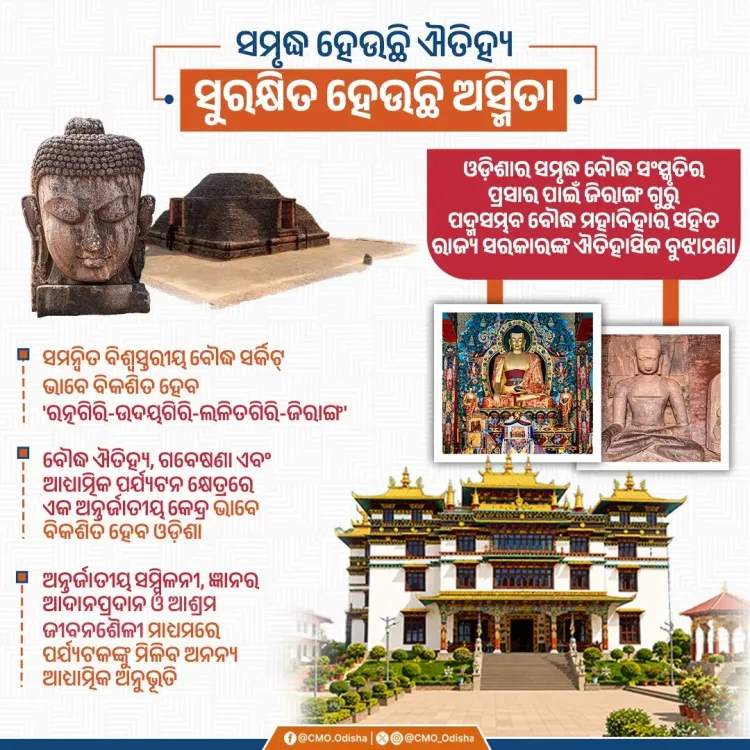
The Odisha government has signed a landmark MoU with the Guru Padmasambhava Buddhist Mahavihara in Jirang to preserve Buddhist heritage and develop the Ratnagiri-Udayagiri-Lalitgiri-Jirang Circuit as a world-class spiritual tourism destination, the Chief Minister's Office announced on 20 July 2026.
Key Takeaways
The Odisha government signed a landmark MoU with the Guru Padmasambhava Buddhist Mahavihara, Jirang on 20 July 2026 .
The partnership aims to make Odisha an international hub of Buddhist culture, research and heritage tourism .
The MoU integrates Jirang into the existing Ratnagiri-Udayagiri-Lalitgiri Buddhist Circuit, expanding the state's 'Diamond Triangle' cluster.
Odisha's Buddhist sites date from the 1st to 13th centuries CE , with Ratnagiri, Udayagiri and Lalitgiri already central to state and national tourism plans since the 2010s.
The move aligns with India's broader strategy of using Buddhist heritage as cultural soft power toward Southeast and East Asian nations.
Implementation focus will be on infrastructure, research facilities and international collaborations under the new agreement.
The Chief Minister's Office of Odisha announced on Monday, 20 July 2026 that the Odisha government has signed a landmark Memorandum of Understanding with the Guru Padmasambhava Buddhist Mahavihara in Jirang, aimed at preserving the state's Buddhist heritage and developing world-class spiritual tourism.
Context
The official post, shared in Odia, states that the partnership is intended to transform Odisha into an 'international hub of Buddhist culture, research and heritage tourism.' The MoU also aims to strengthen the integrated development of the 'Ratnagiri-Udayagiri-Lalitgiri-Jirang' Buddhist Circuit, adding a new institutional node at Jirang to the state's established cluster of ancient sites.
The Guru Padmasambhava Buddhist Mahavihara is named after the 8th-century Indian tantric master widely revered across Himalayan and Southeast Asian Buddhist traditions. Its inclusion in the state circuit marks a significant expansion of Odisha's spiritual tourism footprint.
Policy Backdrop
Odisha's Buddhist heritage sites have featured in central and state tourism planning for well over a decade. The Union government's Swadesh Darshan scheme, launched in 2014-15, identified Buddhist circuits — including those in Odisha — as priority development corridors. State tourism policy documents from the 2010s had already prioritised linking Ratnagiri, Udayagiri, and Lalitgiri to attract pilgrims and researchers.
Ratnagiri hosts a major excavated monastery complex dating from the 5th to 13th centuries CE. Udayagiri features large monasteries and stupas excavated in phases since the 1980s, while Lalitgiri is among Odisha's earliest Buddhist sites, with relics and monastic remains spanning the 1st to 10th centuries CE. Together, these three sites have long been marketed as Odisha's 'Diamond Triangle' of Buddhist archaeology.
The current MoU extends this approach by formally integrating Jirang into the circuit, broadening the geographic and institutional scope of the state's Buddhist tourism strategy.
Stakeholders and Impact
The agreement is expected to benefit Buddhist pilgrims from across India and abroad, particularly from Southeast and East Asian countries with deep historical ties to Indian Buddhism. Local communities near Jirang stand to gain from increased footfall, while heritage researchers and academic institutions may benefit from improved research infrastructure envisaged under the partnership.
India has increasingly pursued Buddhist heritage development as an instrument of cultural soft power, deepening its outreach to nations such as Sri Lanka, Thailand, Japan, South Korea, and others where Buddhism remains a living tradition. Odisha's expanded circuit fits squarely within this national strategy of diversifying religious tourism beyond the established Bodh Gaya-Sarnath-Kushinagar belt.
What's Next
Attention will now turn to the on-ground implementation of the MoU — including physical infrastructure upgrades, multilingual signage, research facilities, and any international collaborations or joint cultural events planned for the expanded Ratnagiri-Udayagiri-Lalitgiri-Jirang Circuit. The state's ability to attract foreign Buddhist pilgrims and scholars will depend heavily on how swiftly these facilities are operationalised. If executed well, the partnership could position Odisha as a credible rival to better-known Buddhist pilgrimage destinations in Uttar Pradesh and Bihar on the international spiritual tourism map.
Point of View
Odisha is signalling that its Buddhist tourism ambitions now extend beyond archaeology into living institutional practice. This carries strategic weight at a time when India is actively competing with Nepal and Sri Lanka for Buddhist pilgrimage traffic from East Asia. The real test, however, will be whether the MoU translates into tangible infrastructure and research output rather than remaining a ceremonial declaration.
NationPress
21 Jul 2026
Frequently Asked Questions
What is the MoU signed by the Odisha government with Guru Padmasambhava Buddhist Mahavihara?
The Odisha government signed a Memorandum of Understanding with the Guru Padmasambhava Buddhist Mahavihara in Jirang on 20 July 2026 to preserve Buddhist heritage and develop world-class spiritual tourism, including the integrated Ratnagiri-Udayagiri-Lalitgiri-Jirang Buddhist Circuit.
Where is the Guru Padmasambhava Buddhist Mahavihara located?
The Guru Padmasambhava Buddhist Mahavihara is located in Jirang, Odisha. It is named after the 8th-century Indian tantric master revered in Himalayan and Southeast Asian Buddhist traditions.
What are the Buddhist sites in Odisha's Diamond Triangle?
Odisha's Buddhist Diamond Triangle comprises Ratnagiri, Udayagiri, and Lalitgiri — ancient monastery complexes dating from the 1st to 13th centuries CE. The new MoU adds Jirang as a fourth node, forming an expanded circuit.
How does this MoU help Odisha's tourism sector?
The MoU is designed to position Odisha as an international hub for Buddhist culture, research and heritage tourism, attracting pilgrims and scholars from Southeast and East Asian countries and diversifying the state's tourism beyond coastal and temple circuits.
What is the Swadesh Darshan scheme and how is it related to Odisha's Buddhist sites?
Swadesh Darshan is a Union government scheme launched in 2014-15 to develop thematic tourism circuits across India. It identified Buddhist circuits, including sites in Odisha, as priority corridors, laying the policy groundwork for the kind of institutional partnerships Odisha is now pursuing.