CM Majhi grants 12-day menstrual leave to Odisha govt women staff
Synopsis
Odisha Chief Minister Mohan Charan Majhi announced 12 additional days of annual menstrual leave for female state government employees, positioning the BJP-led state government as a leader on gender-responsive workplace policy. The move follows similar steps in Bihar and Kerala and reflects the administration's broader women-welfare agenda since taking office in June 2024.
Key Takeaways
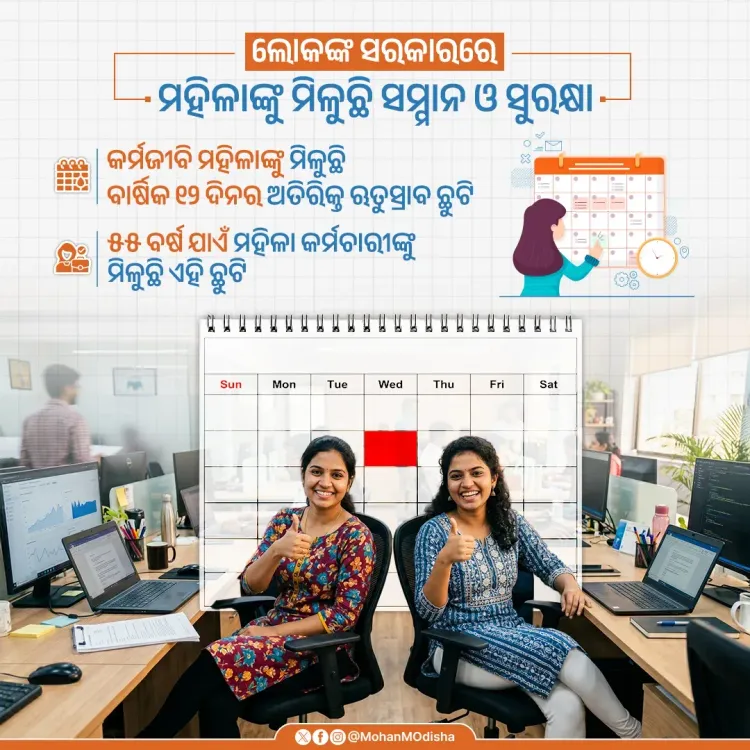
Odisha CM Mohan Charan Majhi announced 12 days of additional annual menstrual leave for female state government employees on 29 May 2026 .
The leave is intended to supplement — not replace — existing casual or medical leave entitlements.
Odisha joins Bihar and Kerala among Indian states that have introduced formal menstrual leave provisions.
The policy aligns with the BJP -led government's stated priority of women's dignity, safety, and health since coming to power in June 2024 .
The national Maternity Benefit (Amendment) Act, 2017 provides the broader legislative backdrop for state-level women's health provisions.
Official government orders detailing eligibility and implementation guidelines are awaited.
Odisha Chief Minister Mohan Charan Majhi announced on Friday, 29 May 2026 that female government employees in Odisha will receive 12 additional days of menstrual leave per year, framing the measure as a step toward strengthening the dignity, safety, and health of women in the state.
Posting in Odia on X, the Chief Minister wrote: 'ଲୋକଙ୍କ ସରକାରରେ ମହିଳାଙ୍କ ସମ୍ମାନ, ସୁରକ୍ଷା ଓ ସ୍ୱାସ୍ଥ୍ୟକୁ ମିଳୁଛି ପ୍ରାଥମିକତା' ('In the people's government, priority is being given to the honour, safety, and health of women'). He added that women who balance responsibilities at home and at the workplace equally are being further empowered through this step.
Context
The announcement positions Odisha among a small but growing group of Indian states that have introduced menstrual leave as a formal employee benefit. Bihar and Kerala have previously taken similar steps, and Odisha's move extends that pattern to its own state government workforce. The provision is framed not merely as a health measure but as a recognition of the dual burden women carry across domestic and professional spheres.
The BJP-led government in Odisha, in power since June 2024, has consistently highlighted women-focused welfare as a policy priority. Chief Minister Majhi has used women's empowerment themes — captured in hashtags such as #NariShakti and #WomenEmpowerment — as a recurring thread in state communications since taking office.
Policy Backdrop
At the national level, the Maternity Benefit (Amendment) Act, 2017 expanded paid leave and mandated workplace facilities for women employees, providing a legislative foundation on which states have since built additional health-related provisions. Odisha's menstrual leave benefit operates within that broader statutory framework, though it is a state-level administrative decision directed at government employees.
Menstrual hygiene and health in the workplace have gained legislative attention across India in recent years, with advocates arguing that such provisions reduce absenteeism, improve productivity, and signal institutional respect for women's health. The 12-day annual entitlement — roughly one day per month — reflects the standard formulation adopted by other states that have introduced similar policies.
Stakeholders and Impact
The direct beneficiaries are female government employees across Odisha's state services. The government has indicated that the leave is intended to allow women to manage menstrual health without drawing on their existing casual or medical leave balances, reducing a quiet but persistent source of workplace disadvantage. Women's rights groups and public health advocates have broadly welcomed such measures as a step toward gender-responsive employment policy.
The policy also carries symbolic weight for the BJP in Odisha, where the party is keen to consolidate its 2024 electoral gains by demonstrating tangible delivery on welfare promises to women voters, who constitute a significant share of the electorate.
What's Next
Attention will now turn to the official government order detailing eligibility criteria, the implementation timeline, and reporting mechanisms for the new leave entitlement. Questions remain about whether the provision will be extended to employees of aided institutions or whether the government will consider encouraging the private sector to adopt a comparable standard. The announcement sets a benchmark that other states — and the central government — may face pressure to match.
Point of View
Odisha moves from the language of welfare to the language of rights — framing women's health as an institutional responsibility rather than a personal matter. The move fits a national pattern where state governments are competing on gender-responsive policy to consolidate women voters, a demographic that proved decisive in several recent assembly elections. Whether the benefit translates into meaningful workplace change will depend on implementation orders and the cultural willingness of departments to honour the entitlement without stigma.
NationPress
24 Sept 2026
Frequently Asked Questions
What is the Odisha menstrual leave policy announced by CM Majhi?
Odisha Chief Minister Mohan Charan Majhi announced that female state government employees will receive 12 additional days of paid menstrual leave per year, over and above their existing leave entitlements.
Who is eligible for the 12-day menstrual leave in Odisha?
The benefit as announced applies to female government employees in Odisha. Official orders detailing precise eligibility criteria, including whether contract or aided-institution staff are covered, are yet to be released.
Which other Indian states have menstrual leave policies?
Bihar and Kerala are among the Indian states that have previously introduced menstrual leave provisions for women employees. Odisha's announcement places it in this group.
When did the BJP come to power in Odisha?
The BJP formed the Odisha state government in June 2024 after winning the state assembly elections, ending a long period of BJD rule in the state.
Does India have a national menstrual leave law?
India does not currently have a central law mandating menstrual leave. The Maternity Benefit (Amendment) Act, 2017 covers maternity-related provisions, but menstrual leave remains a state-level or employer-level decision.