Odisha's OUAT Wildlife Lab Becomes India's First NABL-Accredited Forensics Unit
Synopsis
The Centre for Wildlife Health at OUAT, Bhubaneswar has become India's first NABL-accredited laboratory under ISO/IEC 17025:2017 for wildlife forensics and veterinary testing, announced by the Odisha CMO on 4 July 2026. The milestone strengthens the state's wildlife health surveillance and forensic capacity under CM Mohan Charan Majhi.
Key Takeaways
The Centre for Wildlife Health at OUAT, Bhubaneswar is now India's first NABL-accredited laboratory for wildlife forensics and veterinary testing.
The accreditation is under the internationally recognised ISO/IEC 17025:2017 standard, granted by the National Accreditation Board for Testing and Calibration Laboratories .
The achievement was announced by the Chief Minister's Office of Odisha on 4 July 2026 , crediting CM Mohan Charan Majhi's leadership.
The lab enhances Odisha's capacity in wildlife health surveillance, disease diagnostics, and forensic support for enforcement under the Wildlife Protection Act.
The development aligns with India's National Wildlife Action Plan (2017–2031) , which prioritised building scientific wildlife health infrastructure.
The Odisha Forest Department is a key institutional partner, and the accreditation could position OUAT as a national reference laboratory for wildlife forensics.
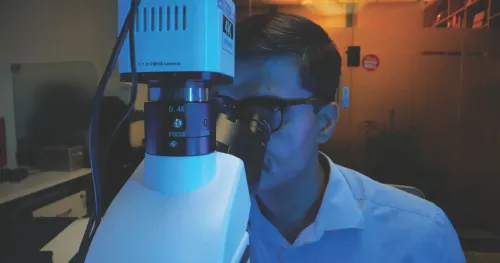
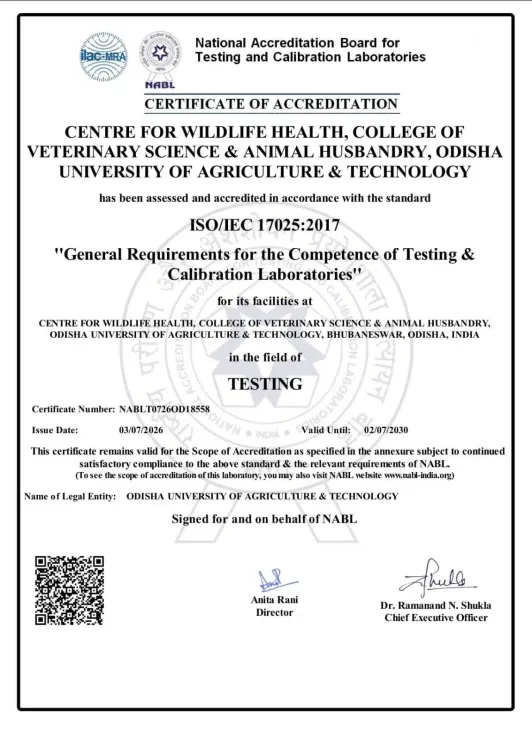
The Chief Minister's Office of Odisha announced on Saturday, 4 July 2026 that the Centre for Wildlife Health at the College of Veterinary Science and Animal Husbandry, Odisha University of Agriculture and Technology (OUAT), Bhubaneswar, has become the first laboratory in India to receive NABL Accreditation (ISO/IEC 17025:2017) for wildlife forensics and veterinary testing — a milestone credited to the leadership of Chief Minister Shri Mohan Charan Majhi.
Context
The accreditation from the National Accreditation Board for Testing and Calibration Laboratories (NABL) — an autonomous body under India's Department of Science and Technology — certifies that the Centre for Wildlife Health meets the globally recognised ISO/IEC 17025:2017 standard for laboratory competence. No other laboratory in the country had previously received this certification specifically for wildlife forensics and veterinary testing, making OUAT's achievement a national first. The CMO described it as 'a proud moment for Odisha,' stating it 'strengthens Odisha's capacity in wildlife health surveillance, disease diagnostics and forensic support.'
Policy Backdrop
The accreditation sits within a long arc of Indian conservation policy. The Wildlife (Protection) Act, 1972 established the legal framework requiring credible scientific and forensic evidence in wildlife crime prosecutions — a standard that has historically been difficult to meet without accredited laboratories. NABL, set up in 1988, has progressively extended its accreditation scope to veterinary and forensic facilities, and India's National Wildlife Action Plan (2017–2031) explicitly prioritised strengthening wildlife health infrastructure and diagnostic networks across states. The Centre for Wildlife Health's new status directly answers that national mandate.
Eastern Indian states with significant elephant and tiger habitats have been at the forefront of forensic capacity building, recognising that habitat protection alone is insufficient without robust evidence chains for prosecuting wildlife crime. An accredited laboratory can produce findings that withstand judicial scrutiny, improving conviction rates under the Wildlife Protection Act.
Stakeholders and Impact
The immediate beneficiaries include the Odisha Forest Department, wildlife enforcement officers, and veterinary scientists who will now have access to forensic test results carrying internationally recognised credibility. Wildlife researchers studying disease transmission — particularly in species such as elephants and tigers that move across Odisha's forest corridors — will gain a reliable diagnostic partner. For forest enforcement agencies, accredited forensic evidence can be decisive in court proceedings against poaching and illegal wildlife trade networks.
The development also signals a shift in how Indian states approach conservation governance: from primarily habitat-centric measures toward evidence-based, science-led frameworks that integrate health surveillance with law enforcement. The Odisha Forest Department and OUAT are tagged as institutional partners in the CMO's announcement, underlining the inter-agency character of the achievement.
What's Next
Conservationists and policy observers will watch whether other states — particularly those with high wildlife crime incidence or significant forest cover — move to establish similarly accredited laboratories, potentially linking them with the national Wildlife Crime Control Bureau database. For Odisha, the next step is likely to expand the operational capacity of the Centre for Wildlife Health and integrate its diagnostic outputs into real-time disease surveillance networks. The accreditation also positions OUAT as a potential national reference laboratory for wildlife forensics, which could attract central government funding and collaborative research mandates.
Point of View
Odisha moves from relying on informal or non-accredited testing to a court-ready scientific framework. For CM Mohan Majhi's government, the announcement also serves a political function: demonstrating governance competence on environment and science in a state with one of India's largest elephant and tiger populations. If other states follow, this could mark a quiet but consequential shift in India's conservation enforcement architecture — from habitat management to evidence-based legal accountability.
NationPress
4 Jul 2026
Frequently Asked Questions
What is NABL accreditation and why does it matter for wildlife labs?
NABL accreditation under ISO/IEC 17025:2017 certifies that a laboratory meets international standards for technical competence and produces reliable, unbiased test results. For wildlife labs, it means forensic findings can withstand judicial scrutiny in court, strengthening prosecutions under the Wildlife (Protection) Act, 1972.
Which is India's first NABL-accredited wildlife forensics laboratory?
The Centre for Wildlife Health at the College of Veterinary Science and Animal Husbandry, Odisha University of Agriculture and Technology (OUAT) in Bhubaneswar is India's first laboratory to receive NABL accreditation specifically for wildlife forensics and veterinary testing.
What does the Centre for Wildlife Health at OUAT do?
The Centre for Wildlife Health focuses on disease diagnostics, health surveillance, and forensic analysis for wildlife species. It supports the Odisha Forest Department in detecting wildlife diseases and providing scientific evidence in wildlife crime investigations.
How does this accreditation help Odisha's conservation efforts?
The accreditation enables Odisha to produce internationally credible forensic and diagnostic evidence, improving both wildlife disease management and the legal prosecution of poaching and illegal wildlife trade. It also positions the state as a leader in evidence-based conservation governance.
What is India's National Wildlife Action Plan and how does this fit in?
India's National Wildlife Action Plan (2017–2031) is a policy framework that, among other priorities, calls for strengthening wildlife health infrastructure and diagnostic networks across states. OUAT's NABL accreditation directly fulfils one of that plan's key objectives.