India-US economic ties: Om Birla invokes shared democracy at 23rd Indo-US Summit
Synopsis
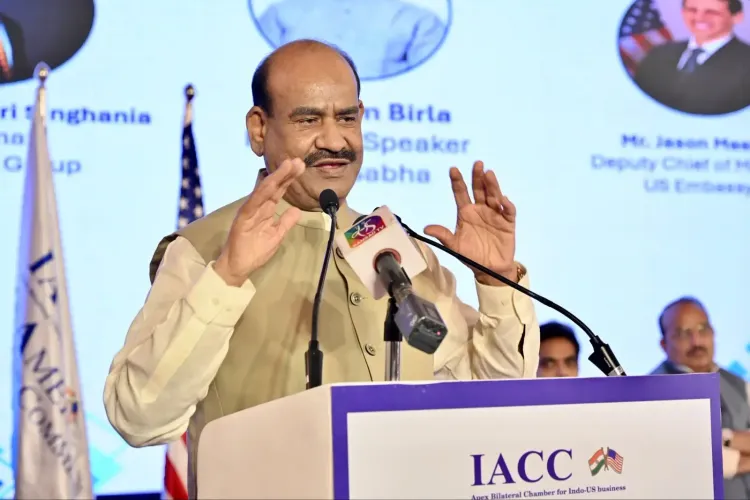
At the 23rd Indo-US Economic Summit 2026, Lok Sabha Speaker Om Birla framed democracy itself as an economic advantage — arguing that shared democratic values, judicial independence, and stable policymaking are what make India and the US natural investment partners. The address ranged from pharma-university research tie-ups to defence exports and clean energy, mapping a broad agenda for the bilateral relationship.
Key Takeaways
Lok Sabha Speaker Om Birla addressed the 23rd Indo-US Economic Summit 2026 in New Delhi on 19 November 2026 .
He argued that shared democratic institutions — including an independent judiciary and stable taxation policy — strengthen investor confidence in both countries.
Birla called for deeper industry-academia partnerships involving IITs , IIITs , and engineering colleges to drive research and innovation.
India's pharmaceutical sector , defence manufacturing , MSMEs , and startup ecosystem were cited as priority areas for India-US collaboration.
The Indo-American Chamber of Commerce , founded in 1968 , was acknowledged for nearly six decades of facilitating bilateral economic engagement.
Lok Sabha Speaker Om Birla on Thursday, 19 November 2026, underscored that the shared democratic values binding India and the United States form a durable foundation for deepening bilateral trade, investment, and technological cooperation. Speaking at the 23rd Indo-US Economic Summit 2026 in New Delhi, Birla argued that democratic governance is itself an economic asset — one that boosts investor confidence and enables responsive policymaking.
Democracy as an Economic Framework
Birla described India and the United States as two of the world's largest democracies, stressing that robust democratic institutions produce stable and predictable policy environments. He pointed to individual liberty, freedom of expression, equality before the law, and an independent judiciary as pillars that make a country investable. Predictable taxation policies and structured engagement between industry and policymakers, he noted, further encourage cross-border capital flows.
Industry-Academia Collaboration and Innovation
A recurring theme in Birla's address was the need to bridge the gap between business and higher education. He called on companies to partner with IITs, IIITs, engineering colleges, and other technical institutions to drive research and innovation, noting that industry investment in research has historically been a primary engine of global technological progress. Stronger such partnerships, he said, would sharpen India's competitiveness and position the country as a leader in emerging sectors.
On the pharmaceutical sector, Birla highlighted India's well-established international reputation — particularly across African nations — and urged pharma companies and universities to pursue joint research addressing evolving healthcare needs. He added that advances in artificial intelligence and medical technology present significant avenues for innovation in this space.
Defence, MSMEs, and the Startup Ecosystem
Birla also pointed to India's accelerating push toward defence self-reliance under Prime Minister Narendra Modi, citing the country's growing defence manufacturing capacity and rising exports. He described India's large and youthful population as a strategic strength, noting that the ideas and skills of young Indians are actively shaping the country's development trajectory. India's expanding startup ecosystem, he added, has already generated solutions to several global challenges.
Micro, Small and Medium Enterprises (MSMEs) were highlighted as offering significant scope for investment, technological cooperation, and job creation. Birla encouraged businesses from both countries to build partnerships that leverage their complementary strengths in international markets.
Clean Energy and Sustainable Growth
Birla stressed that industrial development must proceed in tandem with environmental responsibility. He pointed to India's ongoing efforts to scale clean and green energy, arguing that deeper collaboration among industry, scientists, and researchers could accelerate energy technology innovation and support long-term sustainable growth.
Indo-American Chamber of Commerce
Birla acknowledged the role of the Indo-American Chamber of Commerce, established in 1968, in sustaining economic engagement between the two nations over nearly six decades. The Summit itself serves as a platform where policymakers, industry leaders, and academics chart a forward course for one of the world's most consequential bilateral economic relationships. With both nations navigating a complex global trade landscape, the emphasis on institutional trust and shared values signals a longer-term strategic framing beyond transactional deals.
Point of View
Regulatory unpredictability, and MSME credit access remain live counterpoints that such summits rarely surface. Birla's breadth of sectors — pharma, defence, clean energy, startups — reflects genuine diversification in the bilateral agenda but also risks diluting focus. The real measure of this Summit will be whether any specific cooperation frameworks or investment commitments emerge, or whether the shared-values rhetoric stays at the level of diplomatic ritual.
NationPress
19 Nov 2026
Frequently Asked Questions
What is the Indo-US Economic Summit 2026?
The Indo-US Economic Summit is an annual forum that brings together policymakers, business leaders, and academics from India and the United States to advance bilateral trade, investment, and technological cooperation. The 2026 edition was the 23rd in the series and was held in New Delhi on 19 November 2026.
What did Lok Sabha Speaker Om Birla say at the Summit?
Om Birla emphasised that shared democratic values — including an independent judiciary, stable policymaking, and freedom of expression — form the foundation for stronger India-US economic ties. He also called for greater industry-academia collaboration, highlighted India's pharmaceutical and defence sectors, and urged both countries to build partnerships across MSMEs and emerging technologies.
Why does Om Birla link democracy to economic growth?
Birla argued that democratic institutions create predictable policy environments, independent judiciaries, and structured stakeholder engagement — all of which reduce investment risk and attract long-term capital. He presented this as a structural advantage that India and the US share over non-democratic economies.
What role does the Indo-American Chamber of Commerce play?
The Indo-American Chamber of Commerce, established in 1968, has been a key institutional vehicle for promoting economic engagement between India and the United States for nearly six decades. Birla acknowledged its contributions at the Summit.
Which sectors did Birla highlight for India-US collaboration?
Birla flagged pharmaceuticals, defence manufacturing, MSMEs, the startup ecosystem, clean energy, and industry-academia research partnerships as priority areas for deeper India-US collaboration and investment.