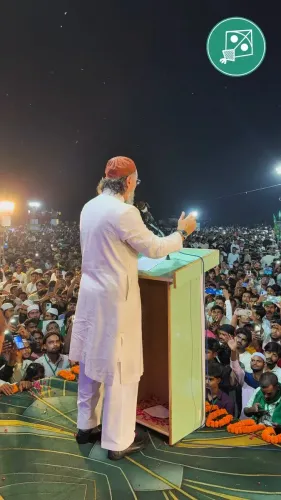
Owaisi Calls Out SP's Selective Outrage Over Detentions
Synopsis
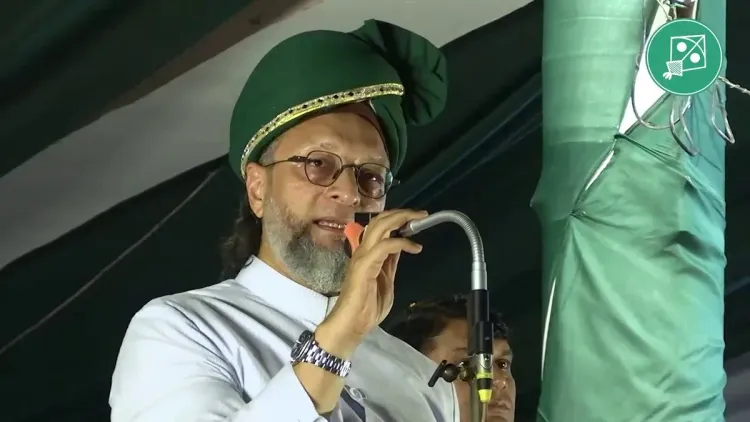
AIMIM president Asaduddin Owaisi accused the Samajwadi Party of double standards on 19 October 2026, charging that it shuts down Lucknow for jailed Yadavs but stays silent when a Muslim named Abdul languishes behind bars — a pointed challenge to UP's caste-indexed opposition politics.
Key Takeaways
AIMIM president Asaduddin Owaisi posted a sharp Hindi-language critique on 19 October 2026 targeting the Samajwadi Party's selective protest politics.
He contrasted the party's readiness to organise a chakka jam in Lucknow for a jailed Yadav from Saifai with its silence over a jailed Muslim, referred to as 'Abdul.' Saifai in Etawah district is the ancestral home of the Yadav political dynasty and a symbol of SP's social base.
The post fits Owaisi's long-running argument that mainstream opposition parties treat Muslim voters as guaranteed but do not reciprocate with political risk-taking on Muslim causes.
UP's Muslim community constitutes roughly 19 percent of the state electorate, making their political alignment a key variable in assembly and Lok Sabha contests.
The use of a generic name 'Abdul' rather than a named individual frames the critique as structural, not episodic.
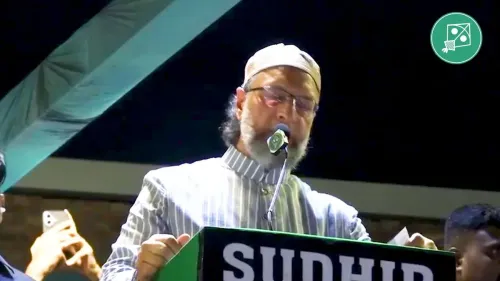
One rule for the Yadav community, another for everyone else — that is the charge AIMIM president Asaduddin Owaisi levelled on Monday, 19 October 2026, in a sharp, pointed post that cut straight to the fault lines of Uttar Pradesh politics.
Writing in Hindi, Owaisi drew a stark contrast: 'अगर सैफई का कोई यादव जेल चला जाए, तो भैया लखनऊ में चक्का जाम कर देंगे, लेकिन जेल में बंद अब्दुल की रिहाई के लिए आवाज़ नहीं उठाएंगे।' ('If a Yadav from Saifai goes to jail, the brothers will shut down Lucknow — but they will not raise their voice for the release of Abdul, who sits in prison.') The target, unmistakably, is the Samajwadi Party.
Saifai, Lucknow, and the Mathematics of Political Mobilisation
Saifai, a village in Etawah district, Uttar Pradesh, is more than a dot on the map — it is the ancestral stronghold of the Yadav political dynasty, synonymous with the family that built the Samajwadi Party into one of the state's dominant forces. A 'chakka jam' — a road blockade protest — in Lucknow, the state capital, is among the most visible tools of opposition pressure in UP politics. Owaisi's point is surgical: that the same organisational muscle capable of paralysing the capital on caste grounds goes silent when the person behind bars is a Muslim named Abdul.
The Hyderabad MP is not making a novel argument — he has consistently accused mainstream opposition parties of treating Muslim voters as a captive constituency while declining to go to the mat for Muslim detainees or causes. But the framing here is unusually direct, naming a specific geography (Saifai), a specific action (chakka jam), and a specific unnamed prisoner (Abdul) to make the abstraction concrete and the contrast impossible to dismiss.
A Pattern Owaisi Has Long Highlighted
Uttar Pradesh, India's most populous state, has a long history of caste-based political mobilisation around arrests. Parties routinely take to the streets when their own community members face detention, framing it as persecution. Owaisi's critique is that this energy is caste-indexed, not justice-indexed — that it activates for political kin and switches off for religious minorities who vote for the same parties but cannot count on the same solidarity.
The post arrives in a political environment where UP's Muslim voters — roughly 19 percent of the electorate — have historically leaned toward the Samajwadi Party in the absence of a viable Muslim-first alternative at scale. AIMIM has sought repeatedly to position itself as that alternative, with Owaisi arguing that alliances built on asymmetric loyalty do not serve minority interests.
The Unnamed 'Abdul' and What It Signals
The deliberate use of a generic Muslim name — Abdul — rather than a specific individual's name is rhetorically significant. It universalises the claim: this is not about one case but a structural pattern. It also insulates the argument from being fact-checked into a single incident. Whether a specific detention is the prompt for this post or whether it is a broader indictment, the political challenge is the same: will any UP opposition leader respond, and if so, how?
Owaisi's post plants a question that has no comfortable answer for parties simultaneously dependent on Yadav consolidation and Muslim votes. The silence that follows — if it comes — will be the loudest reply of all.
Point of View
Both of which carry electoral costs. The chakka jam comparison is not incidental; it invokes the most visible form of UP political muscle to highlight its selective deployment. This feeds directly into AIMIM's foundational pitch: that Muslims need their own political voice rather than dependence on caste-first parties. The absence of a named individual makes the charge harder to rebut and easier to universalise — a sign of tactical messaging maturity.
NationPress
19 Oct 2026
Frequently Asked Questions
What did Asaduddin Owaisi say about the Samajwadi Party on 19 October 2026?
Owaisi accused the Samajwadi Party of mobilising road-blockade protests in Lucknow when a Yadav from Saifai is jailed, while refusing to raise its voice for a Muslim prisoner named Abdul — highlighting what he called a double standard in UP opposition politics.
What is a 'chakka jam' in Indian politics?
A chakka jam is a protest tactic where supporters block roads and shut down traffic to force attention on a political demand. It is a common form of agitation used by parties across Uttar Pradesh and other states.
Why is Saifai significant in UP politics?
Saifai is a village in Etawah district and the ancestral hometown of the Yadav political dynasty that founded the Samajwadi Party. It is a symbolic reference point for SP's core social base.
Who is Owaisi and why does he criticise parties like SP on Muslim issues?
Asaduddin Owaisi is the president of AIMIM and Lok Sabha MP from Hyderabad. He consistently argues that mainstream opposition parties take Muslim votes for granted without genuinely advocating for Muslim community interests, using such incidents to make the case for AIMIM as an independent political voice.
What share of UP's electorate is Muslim?
Muslims constitute roughly 19 percent of Uttar Pradesh's electorate, making them a significant but not dominant vote bloc whose alignment can be decisive in closely contested constituencies.