Owaisi slams Modi over tariff blow to Azamgarh saree trade
Synopsis
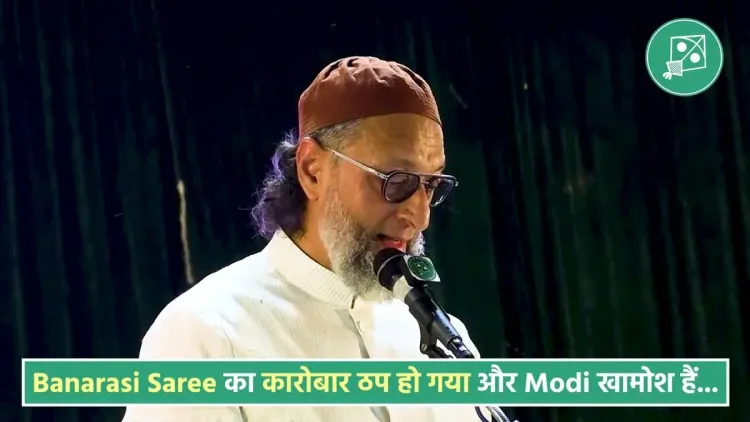
AIMIM president Asaduddin Owaisi charged on 13 October 2026 that tariffs have ground the Banarasi saree trade in Azamgarh to a halt, while PM Narendra Modi has stayed conspicuously silent. The post targets both economic distress among UP weavers and the government's perceived indifference.
Key Takeaways
AIMIM president Asaduddin Owaisi posted on 13 October 2026 alleging that tariffs have stalled the Banarasi saree trade in Azamgarh, Uttar Pradesh .
Owaisi directly accused PM Narendra Modi of not speaking publicly on the issue — framing the attack around silence, not just policy.
Azamgarh hosts a significant concentration of handloom and powerloom weavers whose livelihoods depend on the saree and textile trade.
The specific tariff cited by Owaisi has not been officially identified or publicly detailed by the government.
The Banarasi saree sector has a history of vulnerability to import competition, tax changes, and export market fluctuations.
The post is part of a wider pattern of opposition criticism targeting the impact of central trade policies on UP's handloom clusters.
A trade that has clothed generations in silk is now falling silent — and AIMIM president Asaduddin Owaisi wants to know why Prime Minister Narendra Modi has said nothing about it. On Tuesday, 13 October 2026, Owaisi posted a sharp political charge on X, alleging that tariff pressures have brought the Banarasi saree business in Azamgarh, Uttar Pradesh, to a standstill — and that the Prime Minister has not uttered a word in response.
In his post, Owaisi wrote: 'Tariff ki wajah se Azamgarh mein Banarasi Saree ka karobaar thap ho gaya, lekin Narendra Modi ne apna munh tak nahin khola' — meaning, 'Because of tariffs, the Banarasi saree trade in Azamgarh has come to a halt, but Narendra Modi has not even opened his mouth.'
Azamgarh's weavers and the weight of a stalled trade
Azamgarh is a district in eastern Uttar Pradesh with a dense concentration of handloom and powerloom weavers who produce sarees and textiles, including varieties closely linked to the broader Banarasi weaving cluster. The livelihoods of thousands of weavers and textile traders are tethered to this trade. When the business slows — or stops — the pain is immediate and household-level.
The Banarasi saree sector has historically faced pressure from multiple directions: import competition, domestic tax restructuring, and volatile export markets. Opposition politicians have long used disruptions in Uttar Pradesh's handloom clusters as a lens through which to critique central government trade and tariff policy. Owaisi's post fits that pattern squarely — but carries the added political edge of a direct silence charge against the Prime Minister himself.
The silence charge — and what it means politically
Owaisi's sharpest line is not about the tariff. It is about the non-response. By framing the post around Modi's silence, the AIMIM chief escalates a trade grievance into a political accountability argument: that a constituency whose craft is synonymous with Indian cultural identity is being left without a champion at the top. That is a pointed message in a state — Uttar Pradesh — that sends the largest bloc of Lok Sabha seats to Parliament.
The specific tariff Owaisi references has not been officially detailed, and the Commerce Ministry has not issued any public statement in response. Whether this becomes the basis for a parliamentary question or a broader opposition push on textile policy will be worth watching in the coming sessions.
For now, the looms of Azamgarh wait — and the political pressure on New Delhi to respond has just been turned up a notch.
Point of View
Maximising political exposure. The choice of Azamgarh — a Muslim-majority weaving district in the electorally decisive state of Uttar Pradesh — is not incidental; it targets a community that AIMIM has sought to mobilise around economic-rights messaging. The 'silence' charge is harder for the government to deflect than a policy debate, because it demands a public response rather than a technical rebuttal. If the specific tariff remains unaddressed in Parliament, the opposition has a ready-made thread to pull in the next session.
NationPress
13 Oct 2026
Frequently Asked Questions
What did Asaduddin Owaisi say about the Banarasi saree trade in Azamgarh?
Owaisi alleged on 13 October 2026 that tariffs have brought the Banarasi saree business in Azamgarh to a complete halt, and charged PM Modi with not making any public statement on the crisis.
Why is Azamgarh important for the Banarasi saree industry?
Azamgarh is a district in eastern Uttar Pradesh with a large community of handloom and powerloom weavers who produce sarees and textiles linked to the Banarasi weaving tradition, making it a key hub for the craft.
Which tariff is affecting the Banarasi saree trade in Azamgarh?
The specific tariff referenced by Owaisi has not been officially identified or detailed publicly; neither the government nor the Commerce Ministry has issued a statement in response to the claim.
Has PM Modi responded to Owaisi's charge about the saree trade?
As of 13 October 2026, PM Modi has not publicly responded to Owaisi's post or the underlying allegation about disruption to the Azamgarh saree trade.
What broader issues does the Banarasi saree sector face?
The sector has historically faced pressure from import competition, domestic tax changes, and export market volatility, making it sensitive to any shifts in tariff or trade policy.