Pilot demands Dharmendra Pradhan's ouster over paper leaks
Synopsis
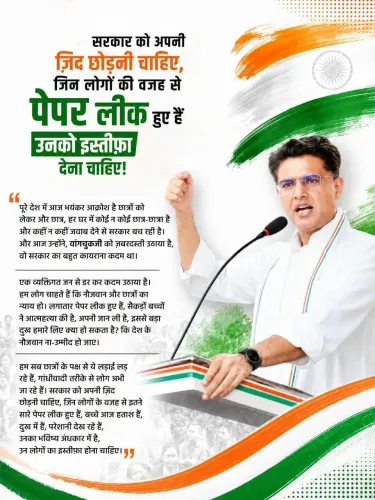
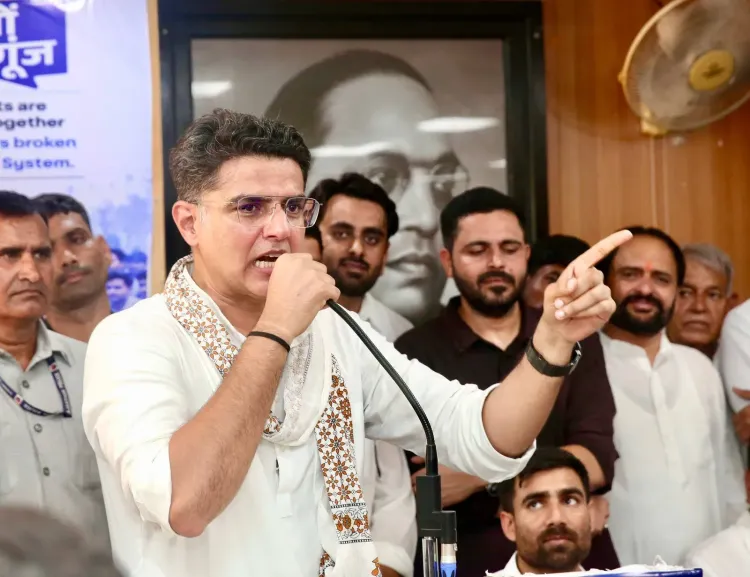
Congress general secretary Sachin Pilot addressed students at a Jaipur event on July 22, 2026, demanding that the Modi government sack Education Minister Dharmendra Pradhan, prosecute paper leak culprits, and open dialogue with aggrieved exam aspirants.
Key Takeaways
Sachin Pilot addressed the Chhatra Yuva Nyay — Badlav Goonj student event in Jaipur on July 22, 2026 .
He demanded the removal of Union Education Minister Dharmendra Pradhan over paper leak failures.
Pilot called on the Modi government to hold direct dialogue with students and take strict action against paper leak perpetrators.
He invoked the phrase Mann Ki Baat to reframe students' collective demands as the real national conversation.
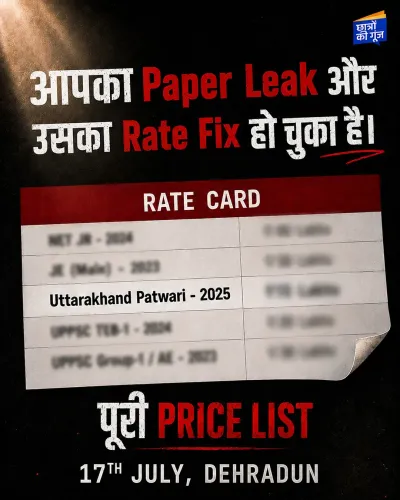
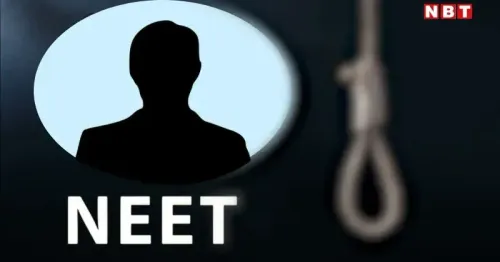
The event follows sustained opposition pressure since the 2024 NEET-UG paper leak controversy and nationwide student protests.
The National Testing Agency (NTA) and centralised exam integrity remain at the centre of the political dispute.
Congress leader and party general secretary Sachin Pilot on Wednesday, July 22, 2026, addressed a student gathering in Jaipur, demanding that the Modi government dismiss Union Education Minister Dharmendra Pradhan and take strict action against those responsible for paper leaks in national competitive examinations.
Context
Speaking at a Congress-organised event titled 'Chhatra Yuva Nyay — Badlav Goonj' ('Student Youth Justice — Echo of Change'), Pilot invoked the political power of India's youth, declaring that 'jab-jab yuvaon ne apni awaaz buland ki hai, tab-tab itihas ne ek naya adhyay likha hai' ('every time youth have raised their voice, history has written a new chapter'). He framed paper leaks not merely as administrative failures but as a systemic injustice robbing talented students of years of hard work and legitimate aspirations.
Pilot directly addressed students' frustrations, saying the Modi government must abandon its 'stubbornness' and open a dialogue with students. In a pointed rhetorical turn, he called students' collective demand their own 'Mann Ki Baat' — borrowing the phrase associated with Prime Minister Narendra Modi's radio programme — to signal that it is now the students, not the government, setting the national conversation.
Policy Backdrop
The controversy over paper leaks in national examinations escalated sharply following the 2024 NEET-UG paper leak allegations, which triggered widespread student protests across India and renewed scrutiny of the National Testing Agency (NTA), the central body responsible for conducting major entrance examinations. Opposition parties, including the Indian National Congress, have consistently cited these incidents as evidence of institutional decay under the current central government.
Dharmendra Pradhan, who has served as Union Education Minister since 2021, has been a focal point of opposition criticism over exam integrity. Congress and other opposition leaders have repeatedly demanded his removal, arguing that ministerial accountability must follow institutional failure. The broader pattern intersects with concerns over youth unemployment and the high stakes attached to centralized competitive testing in India.
Stakeholders and Impact
The primary stakeholders are millions of examination aspirants — from medical and engineering entrance candidates to civil services hopefuls — whose futures hinge on the integrity of centrally administered tests. Gen Z students, many of whom invest multiple years and significant financial resources in exam preparation, have emerged as a politically active constituency that both ruling and opposition parties are courting ahead of electoral cycles.
For the Congress party, events such as 'Chhatra Yuva Nyay — Badlav Goonj' in Jaipur serve a dual purpose: channelling genuine student grievances into organised political momentum while reinforcing the party's positioning as a champion of youth rights. Rajasthan, where Congress has a significant organisational presence, remains a key state for such outreach efforts.
What's Next
Pilot's three-point demand — government dialogue with students, criminal accountability for paper leak perpetrators, and the removal of Education Minister Dharmendra Pradhan — is likely to be echoed in parliamentary proceedings and state-level student mobilisations. The NTA's reform process and any review committee outcomes in the coming parliamentary session will be closely watched by student groups and opposition benches alike.
If the Modi government does not respond substantively, Congress is expected to escalate its student outreach nationally, using events like the Jaipur gathering as a template. The intersection of exam integrity, youth unemployment, and institutional accountability is shaping up as a defining political battleground in the run-up to future electoral contests.
Point of View
The party is sharpening its accountability narrative and giving student protesters a concrete political ask. The borrowed 'Mann Ki Baat' framing is a calculated rhetorical device designed to put the ruling establishment on the defensive on its own symbolic terrain. Whether this translates into durable youth mobilisation will depend on whether the government responds with substantive NTA reforms or continues to deflect opposition pressure.
NationPress
21 Oct 2026
Frequently Asked Questions
What did Sachin Pilot say about paper leaks at the Jaipur event?
Sachin Pilot said the Modi government must take strict action against paper leak culprits, open dialogue with students, and remove Union Education Minister Dharmendra Pradhan from office. He called paper leaks a systemic injustice that has destroyed the dreams of countless hardworking students.
What is the 'Chhatra Yuva Nyay — Badlav Goonj' event?
'Chhatra Yuva Nyay — Badlav Goonj' (Student Youth Justice — Echo of Change) is a Congress-organised student outreach event held in Jaipur on July 22, 2026, where Sachin Pilot addressed exam aspirants on paper leak grievances and institutional accountability.
Why is Congress demanding Dharmendra Pradhan's removal?
Congress holds Dharmendra Pradhan, the Union Education Minister since 2021, ministerially accountable for repeated paper leak incidents in national competitive examinations, arguing that institutional failure under his watch warrants his resignation or dismissal.
What is the NEET paper leak controversy?
The NEET-UG paper leak controversy refers to allegations in 2024 that question papers for India's national medical entrance examination were leaked before the test, triggering nationwide student protests and demands for reform of the National Testing Agency (NTA).
What is Sachin Pilot's current political role?
Sachin Pilot is the general secretary of the Indian National Congress and the party's Chhattisgarh in-charge. He previously served as Deputy Chief Minister of Rajasthan and is a prominent face of the party's youth outreach efforts.