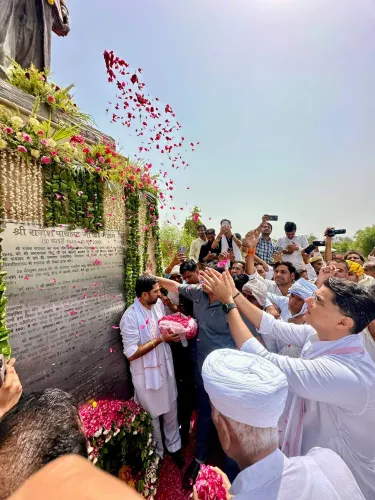
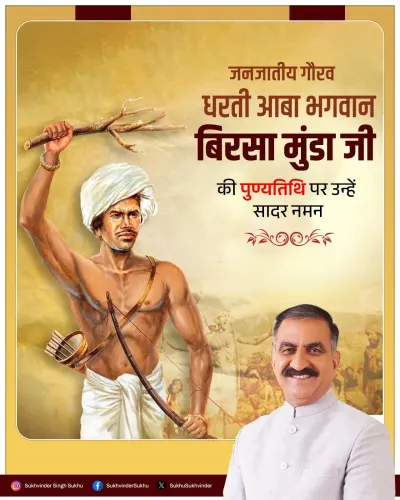
Sachin Pilot pays tribute to Birsa Munda on his birth anniversary
Synopsis
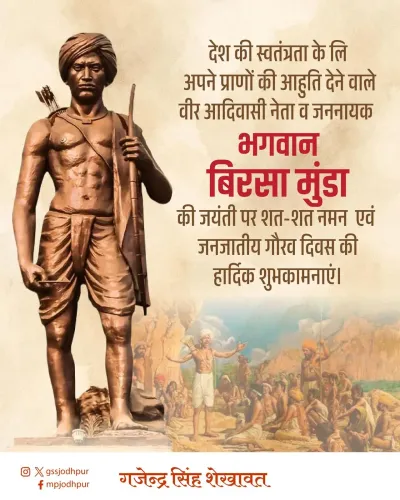
Congress leader Sachin Pilot paid respectful homage to Birsa Munda on his birth anniversary, honouring the Adivasi freedom fighter's rebellion against British colonial land and forest policies and his enduring legacy of tribal rights advocacy.
Key Takeaways
Congress leader Sachin Pilot paid tribute to Birsa Munda on his birth anniversary, November 15, 2026 .
Birsa Munda (1875–1900) led the Ulgulan rebellion against British land and forest laws in the Chotanagpur region.
Pilot's post invoked the jal-jungle-zameen framework — water, forest, and land — central to Adivasi rights movements.
November 15 is observed as Janjatiya Gaurav Divas (Tribal Pride Day) across India.
The tribute carries particular resonance given Pilot's role as Congress in-charge of Chhattisgarh , a key tribal-belt state.
On the 125th birth anniversary of Birsa Munda, Congress leader and Chhattisgarh in-charge Sachin Pilot paid solemn tribute to the Adivasi freedom fighter who defied the British Empire in the name of land, forest, and tribal dignity.
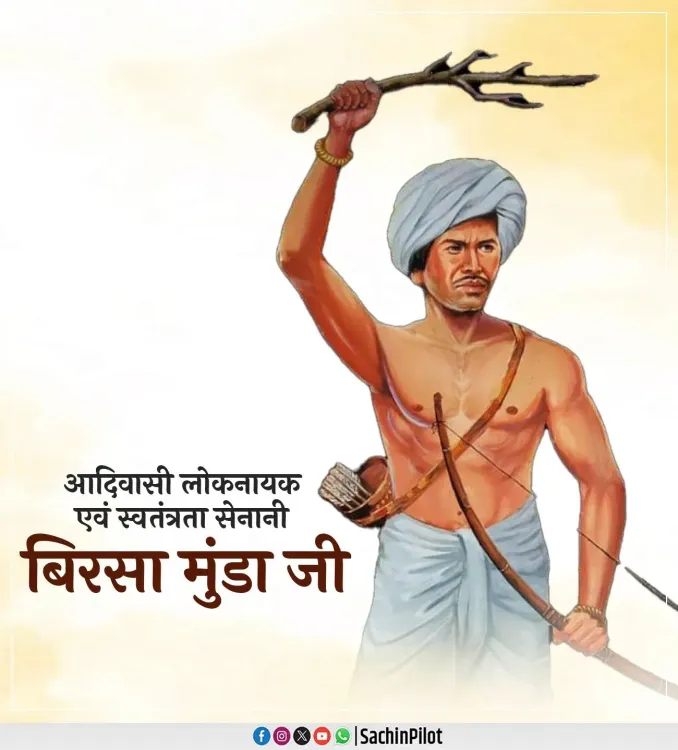
Pilot's post, shared on Sunday, November 15, 2026, offered sadar naman — a respectful salute — to Munda, calling him a 'mahan Adivasi loknayak' (great Adivasi people's hero) and a freedom fighter who raised his voice against colonial rule and awakened tribal communities to their rights over jal-jungle-zameen: water, forest, and land.
Who was Birsa Munda — and why November 15 still reverberates
Birsa Munda was born on November 15, 1875, into the Munda tribe of the Chotanagpur plateau, in what is today Jharkhand. By his mid-twenties he had become the central force behind the Ulgulan — meaning 'the great tumult' — a rebellion that shook British administrative control over tribal lands between 1899 and 1900. His targets were the colonial land-acquisition and forest laws that had dispossessed Adivasi communities of ancestral territory, turning independent cultivators into indebted tenants.
Munda died in Ranchi jail on June 9, 1900, aged just 25, yet his legacy endures as one of the most potent symbols of indigenous resistance in Indian history. The jal-jungle-zameen triad he championed remains the defining slogan of Adivasi mobilisation across Jharkhand, Odisha, and Chhattisgarh to this day.
November 15 as a day of national reckoning on tribal rights
India designated November 15 as Janjatiya Gaurav Divas — Tribal Pride Day — in formal recognition of Munda's contribution and the broader history of tribal resistance to colonial resource extraction. The day prompts political leaders across the spectrum to acknowledge that history and, frequently, to invoke it in the context of present-day forest and land rights.
That context is live and contested. The Forest Rights Act of 2006 remains partially implemented across tribal belts, and displacement linked to mining, infrastructure, and conservation projects continues to draw protests from Adivasi communities — particularly in Chhattisgarh, the state Pilot oversees for the Congress party.
His tribute, brief but pointed, threads the past to the present: by invoking Munda's fight for Adivasi civilisation and culture alongside land and forest, Pilot signals that the Congress views tribal rights as an unfinished constitutional and moral obligation — not merely a historical footnote.
Point of View
But they carry real policy subtext — especially from leaders with jurisdiction over tribal-belt states. Sachin Pilot's invocation of jal-jungle-zameen is not incidental: it is precisely the language used by Adivasi rights groups opposing mining and forest-clearance projects in Chhattisgarh, a state where the Congress is in power. For the opposition Congress, amplifying Munda's legacy serves a dual purpose — historical legitimacy with tribal constituencies and a quiet critique of land-acquisition pressures on Adivasi communities. As Janjatiya Gaurav Divas becomes a bigger political moment each year, the gap between ceremonial tribute and policy delivery will face sharper scrutiny.
NationPress
15 Nov 2026
Frequently Asked Questions
Why is November 15 celebrated as Janjatiya Gaurav Divas?
November 15 is Janjatiya Gaurav Divas (Tribal Pride Day) because it marks the birth anniversary of Birsa Munda , the Adivasi freedom fighter who led the Ulgulan rebellion against British colonial rule in the Chotanagpur region.
Who was Birsa Munda and what did he fight for?
Birsa Munda (1875–1900) was an Adivasi leader from the Munda tribe who led the Ulgulan movement between 1899 and 1900, resisting British land-acquisition and forest laws that dispossessed tribal communities, and championing the cause of jal-jungle-zameen — water, forest, and land.
What is the Ulgulan movement?
The Ulgulan , meaning 'the great tumult,' was a tribal rebellion led by Birsa Munda in the Chotanagpur plateau (present-day Jharkhand) during 1899–1900 , challenging British policies that stripped Adivasi communities of their ancestral lands and forests.
Why did Sachin Pilot pay tribute to Birsa Munda?
Congress leader Sachin Pilot posted his tribute on November 15, 2026 — Birsa Munda's birth anniversary and Janjatiya Gaurav Divas — to honour the Adivasi freedom fighter's legacy of resistance against colonial rule and his role in awakening tribal communities to their rights.
What does jal-jungle-zameen mean in the context of Adivasi rights?
Jal-jungle-zameen — meaning water, forest, and land — is the foundational slogan of Adivasi rights movements across Jharkhand, Odisha, and Chhattisgarh , rooted in Birsa Munda's resistance to British colonial dispossession and still invoked in contemporary debates over the Forest Rights Act and tribal land protection.