PM Modi Approves National Urea Investment Policy-2026
Synopsis
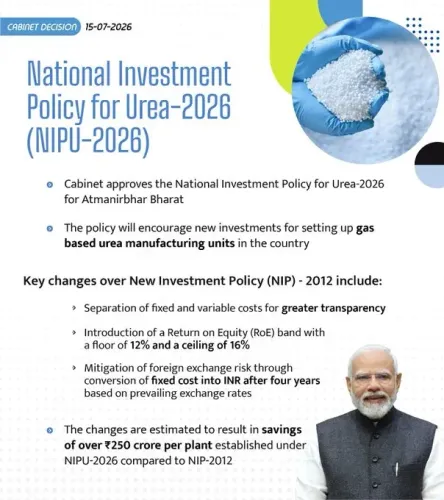
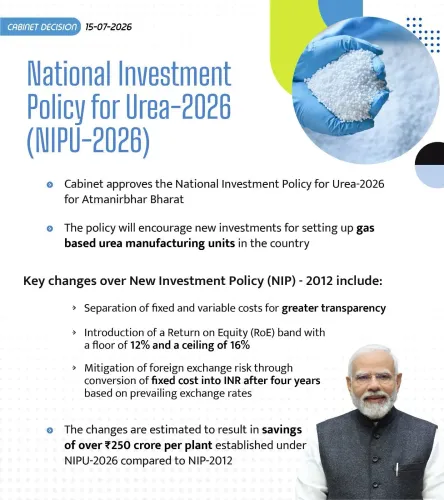
PM Modi announced on 15 July 2026 that the government has approved the National Urea Investment Policy-2026, aimed at incentivising new gas-based urea plants and reducing India's import dependence, directly benefiting farmers across the country.
Key Takeaways
The National Urea Investment Policy-2026 was approved on 15 July 2026 .
The policy is designed to incentivise investment in new gas-based urea production plants .
India currently imports 30–40 per cent of its urea requirement, which the policy aims to reduce.
The move follows the New Urea Policy 2015 and revival of five closed public-sector urea plants between 2016 and 2019.
The policy aligns with the Atmanirbhar Bharat goal of domestic fertilizer self-sufficiency.
Indian farmers and urea manufacturers are the primary stakeholders expected to benefit.
Prime Minister Narendra Modi announced on Wednesday, 15 July 2026 that the government has approved the proposal for the National Urea Investment Policy-2026, describing it as a step toward the welfare of farmers across the country. The policy is designed to incentivise investment in new gas-based urea production plants and is expected to reduce India's dependence on imported urea.
Context
Posting in Hindi on X, PM Modi stated: 'देशभर के अपने किसान भाई-बहनों के कल्याण के लिए हमारी सरकार कोई कोर-कसर नहीं छोड़ रही है' ('Our government is leaving no stone unturned for the welfare of our farmer brothers and sisters across the country'). He added that the approval of the National Urea Investment Policy-2026 would not only encourage investment for setting up new gas-based urea production plants but would also benefit the broader urea sector. The post was shared shortly after the Cabinet-level approval was granted.
Policy Backdrop
India has historically relied on imports to meet 30–40 per cent of its urea demand, making domestic capacity expansion a long-standing policy priority. The government had earlier notified the New Urea Policy 2015, which offered guaranteed buy-back arrangements and fiscal support to attract private and public investment into gas-based urea manufacturing. Between 2016 and 2019, the Cabinet approved the revival of five closed public-sector urea plants at Gorakhpur, Sindri, Barauni, Talcher and Ramagundam, all to be run on natural gas feedstock.
The National Urea Investment Policy-2026 is the next step in this lineage, extending the framework of incentives to draw fresh capital into gas-based production. The Department of Fertilizers under the Ministry of Chemicals and Fertilizers is the nodal body responsible for implementing such investment frameworks and administering the fertilizer subsidy regime.
Stakeholders and Impact
Indian farmers are the primary beneficiaries, as higher domestic urea output is expected to stabilise availability and support the government's policy of keeping urea prices subsidised. Urea manufacturers — both public-sector undertakings and prospective private investors — stand to gain from the investment incentives that the new policy is intended to provide.
Expanded domestic production also aligns with the Atmanirbhar Bharat objective of substituting imported fertilizers with indigenously manufactured alternatives, which could help contain the government's annual fertilizer subsidy expenditure over the medium term.
What's Next
Detailed Cabinet or CCEA notes outlining the specific incentive structure, capital subsidy provisions, and gas pooling arrangements under the National Urea Investment Policy-2026 are expected to be released by the Department of Fertilizers in the coming days. Analysts and industry stakeholders will watch for any new plant proposals or timelines that emerge alongside the formal policy notification. Budget provisions in subsequent Union Budgets will be a key indicator of the government's commitment to scaling up domestic urea capacity under this framework.
Point of View
The government reinforces its political messaging around agricultural support ahead of ongoing rural economic pressures. The policy also fits into the broader Atmanirbhar Bharat industrial narrative, positioning fertilizer self-sufficiency alongside initiatives in defence, semiconductors and electronics. The real test will be whether the incentive architecture is compelling enough to attract meaningful private investment beyond the public-sector plant revivals already under way.
NationPress
15 Jul 2026
Frequently Asked Questions
What is the National Urea Investment Policy-2026?
The National Urea Investment Policy-2026 is a government-approved framework announced on 15 July 2026 that provides incentives for setting up new gas-based urea production plants in India, with the aim of reducing import dependence and benefiting farmers.
Why did the Modi government approve a new urea investment policy?
India imports 30–40 per cent of its urea demand, and the government has been working to expand domestic production capacity since 2015. The new policy extends that framework to attract fresh investment into gas-based urea manufacturing.
How will the National Urea Investment Policy-2026 benefit farmers?
By boosting domestic urea production, the policy is expected to stabilise urea availability across the country and support the government's subsidised pricing regime, making fertilizer more accessible to Indian farmers.
What was India's previous urea production policy?
The New Urea Policy 2015 offered guaranteed buy-back and fiscal support for gas-based urea plants. Between 2016 and 2019, the Cabinet also approved revival of five closed public-sector plants at Gorakhpur, Sindri, Barauni, Talcher and Ramagundam.
Which ministry oversees urea investment policy in India?
The Department of Fertilizers under the Ministry of Chemicals and Fertilizers is the nodal body responsible for formulating urea production policies, investment frameworks and the fertilizer subsidy regime.