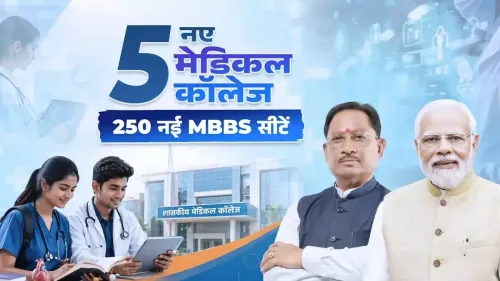
CM Sai's Chhattisgarh gets 250 new MBBS seats across 5 medical colleges
Synopsis
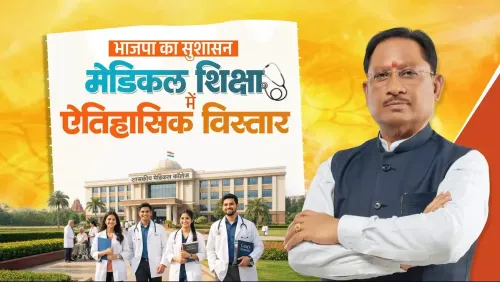
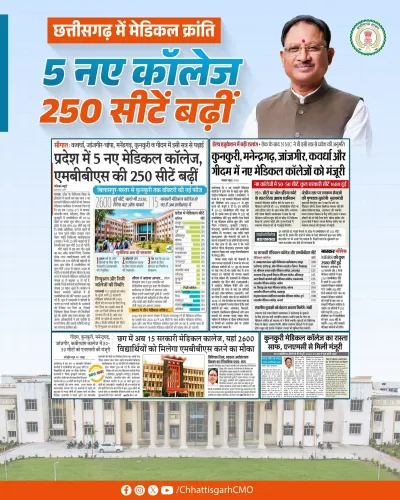
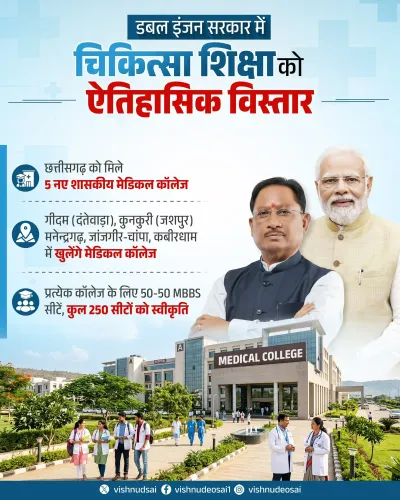
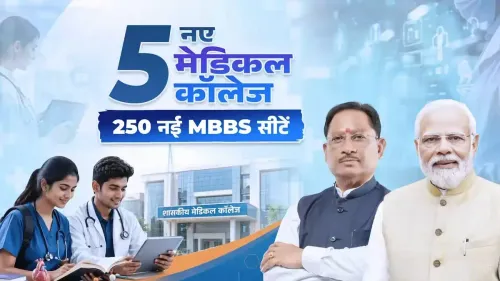
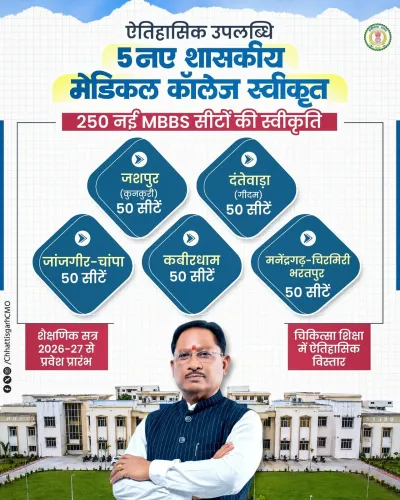
Chhattisgarh has secured NMC approval for 50 MBBS seats each in five new government medical colleges across underserved districts including Dantewada and Jashpur, adding 250 seats in total under CM Vishnu Deo Sai's BJP government.
Key Takeaways
250 new MBBS seats approved across five new government medical colleges in Chhattisgarh.
Each college receives 50 MBBS seats under the National Medical Commission's streamlined approval framework.
Colleges are located in Kabirdham, Janjgir-Champa, Manendragarh-Chirmiri-Bharatpur, Jashpur , and Dantewada — all underserved or tribal districts.
The approvals align with a national pattern of expanding government medical colleges in states with BJP governments at both the state and Centre.
Operationalisation depends on construction progress, faculty recruitment, and functional teaching hospitals before NEET-UG admissions can begin.
Chief Minister Vishnu Deo Sai has positioned healthcare expansion as a flagship priority since taking office in December 2023 .
The Chief Minister's Office of Chhattisgarh announced on Wednesday, 15 July 2026 that the state has received approval for 50 MBBS seats each in five new government medical colleges, a move the office attributed to the sustained efforts of the 'double engine' government led by Chief Minister Vishnu Deo Sai. The approvals span districts including Kabirdham, Janjgir-Champa, Manendragarh-Chirmiri-Bharatpur, Jashpur, and Dantewada, collectively adding 250 MBBS seats to the state's medical education capacity.
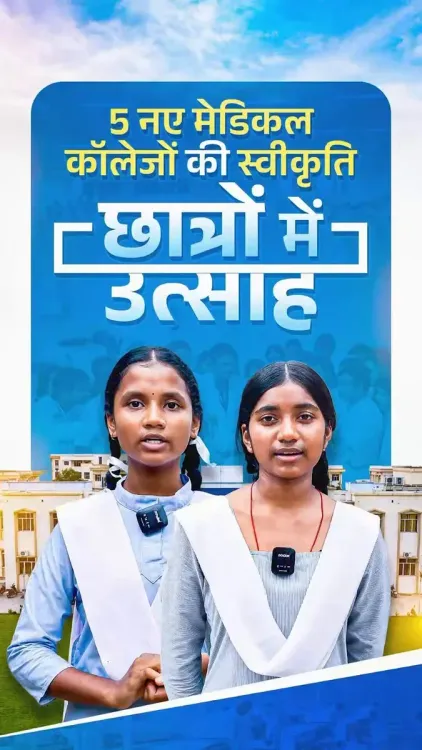
The official post stated: 'Shiksha, swasthya aur yuva sashaktikaran ko mili nayi udaan' — ('Education, health and youth empowerment have taken a new flight') — crediting the approvals with generating widespread enthusiasm among students across the state.
Context
Chhattisgarh has historically lagged in medical infrastructure relative to more urbanised Indian states. Districts such as Dantewada in the Bastar division — long affected by left-wing extremism — and Jashpur in northern Chhattisgarh, which has a significant tribal population, have faced acute shortages of trained doctors and healthcare facilities. The inclusion of these districts in the latest round of approvals signals a deliberate push toward correcting regional imbalances.
Policy Backdrop
The approvals fall under the post-2019 regulatory framework established by the National Medical Commission (NMC), which streamlined the process for states to set up new government medical colleges with either 50 or 100 MBBS seats. Between 2014 and 2023, the Union Health Ministry oversaw a near-doubling of MBBS seats nationally through a centrally sponsored scheme that pairs central funding with state commitments on land and infrastructure. Chhattisgarh's latest approvals follow a similar pattern seen in Madhya Pradesh, Rajasthan, and Jharkhand, where regulatory clearances have been secured alongside state-level groundwork.
Chief Minister Vishnu Deo Sai, who assumed office in December 2023 after the BJP's victory in the state assembly elections, has positioned healthcare expansion as a flagship priority. The phrase 'double engine government' — referring to the alignment of the state BJP government with the BJP-led Union government — underscores the political framing of these approvals as a product of Centre-state coordination.
Stakeholders and Impact
The most direct beneficiaries are MBBS aspirants from Chhattisgarh, particularly those from rural and tribal backgrounds who face stiff competition for seats in existing colleges concentrated in larger cities. Each new 50-seat college will also require the development of an attached teaching hospital, which, once operational, will expand outpatient and inpatient care for surrounding communities. Tribal communities in districts like Dantewada and Jashpur stand to gain both from increased local healthcare access and from a potential pipeline of locally trained doctors who are more likely to serve in their home regions.
Medical educators and public health advocates have long argued that government medical colleges in underserved districts are a more sustainable solution to rural doctor shortages than incentive-based postings alone. The 250 additional MBBS seats represent a meaningful increment, though analysts note that the long-term impact depends heavily on the speed of construction, faculty recruitment, and the quality of the attached hospitals.
What's Next
The immediate milestones to watch are construction timelines, faculty appointments, and the establishment of functional teaching hospitals at each of the five sites — all prerequisites before the colleges can admit students under the NEET-UG cycle. The state government is also expected to address funding allocations in its next budget, and observers will monitor whether additional seat enhancements or larger institutions such as AIIMS-type projects are announced. The pace at which these colleges become operational will ultimately determine whether the approval translates into a measurable improvement in healthcare access for Chhattisgarh's underserved districts.
Point of View
The Sai government is simultaneously addressing a genuine public health deficit and building political capital in constituencies that have historically been contested. The 'double engine government' framing is deliberate — it credits Centre-state alignment as the mechanism of delivery, reinforcing a narrative that will likely feature prominently ahead of future elections. Whether the colleges move from approval to functional institutions at pace will be the real test of this policy's substance over symbolism.
NationPress
15 Jul 2026
Frequently Asked Questions
How many new MBBS seats has Chhattisgarh been approved for?
Chhattisgarh has received approval for 250 new MBBS seats in total — 50 seats each across five new government medical colleges.
Which districts will get the new government medical colleges in Chhattisgarh?
The five districts are Kabirdham, Janjgir-Champa, Manendragarh-Chirmiri-Bharatpur, Jashpur , and Dantewada , all of which are underserved or have significant tribal populations.
Who approved the new medical colleges in Chhattisgarh?
The approvals were granted under the framework of the National Medical Commission (NMC) , the central regulatory body for medical education in India, in coordination with the state government led by CM Vishnu Deo Sai .
When will the new medical colleges in Chhattisgarh start admitting students?
No specific start date has been announced. Admissions can only begin after construction is complete, faculty are recruited, and teaching hospitals are made functional — all of which will be monitored ahead of future NEET-UG cycles.
What is the 'double engine government' referred to in the Chhattisgarh CMO post?
'Double engine government' is a phrase used by the BJP to describe states where the party is in power both at the state level and at the Centre, implying smoother coordination on policy approvals and funding — as cited in the context of these medical college approvals.