Varanasi elevated corridor: CCEA clears ₹11,000 crore, 43 km Varuna link
Synopsis
The Centre has greenlit a ₹11,000 crore, 43 km elevated corridor hugging Varanasi's Varuna River — slashing the NH-31 to Kashi Railway Station commute by half and connecting the city's ghats, airport, and port in one sweep. For a city that handles millions of pilgrims annually, this is the most significant infrastructure intervention in years.
Key Takeaways
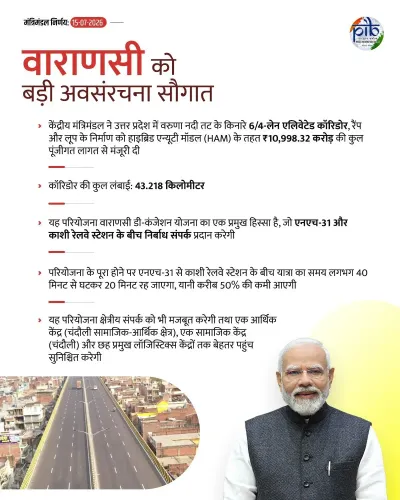
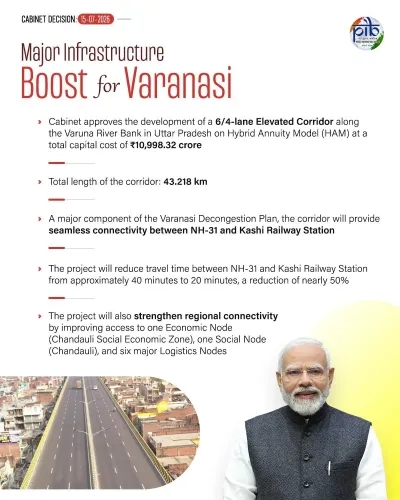
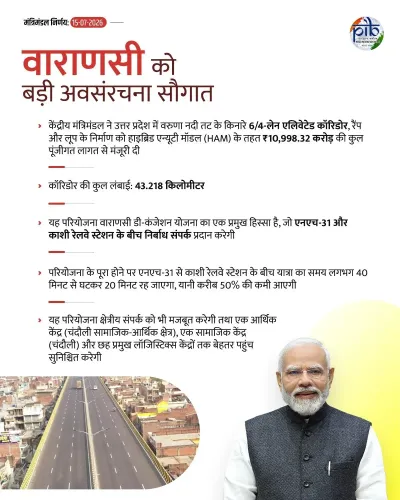
The CCEA approved a ₹10,998.32 crore elevated corridor in Varanasi on 15 July .
The project spans 43.218 km along the Varuna River , connecting NH-31 to the Varanasi Ring Road .
Travel time between NH-31 and Kashi Railway Station will be cut from 40 minutes to 20 minutes .
NHAI will implement the project under the Hybrid Annuity Model (HAM) ; civil construction costs stand at ₹4,565.33 crore .
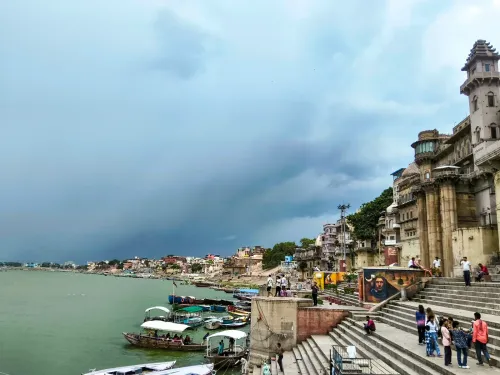
The corridor connects key nodes including Varanasi Airport , Ramnagar Port , the city's ghats, and Chandauli region.
The project aligns with the PM Gati Shakti National Master Plan and is expected to boost tourism and logistics in eastern Uttar Pradesh .
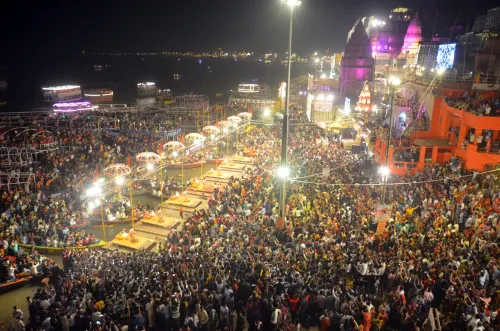
The Cabinet Committee on Economic Affairs (CCEA), chaired by Prime Minister Narendra Modi, on Wednesday, 15 July approved a ₹10,998.32 crore elevated corridor project in Varanasi, spanning 43.218 km along the banks of the Varuna River. The project is designed to ease chronic traffic congestion in the holy city and improve access for pilgrims travelling to the Kashi Vishwanath Temple.
Project Scope and Key Features
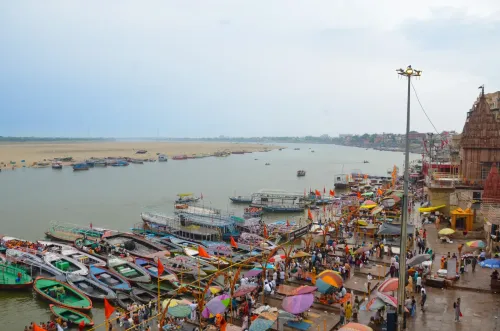
The corridor will be a predominantly elevated 6/4-lane facility comprising a main carriageway, flyovers, loops, ramps, and service roads. It will link NH-31 to the Varanasi Ring Road, providing direct connectivity to Kashi Railway Station, Varanasi Airport, Varanasi Junction, Ramnagar Port, Sampurnanand Sanskrit University, the city's famous ghats, and the Chandauli region.
Designed for an operating speed of 80–100 km/hour, the corridor is expected to cut travel time between NH-31 and Kashi Railway Station from 40 minutes to 20 minutes — a reduction of nearly 50 per cent.
Financial Breakdown and Implementation
Of the total outlay, ₹4,565.33 crore is earmarked for civil construction and ₹934.91 crore for land acquisition. The project will be implemented by the National Highways Authority of India (NHAI) under the Hybrid Annuity Model (HAM), a public-private partnership structure that spreads financial risk between the government and private contractors.
What the Government Said
Prime Minister Modi, in a post on social media platform X, said the government was committed to expanding connectivity and making pilgrimages to Baba Vishwanath in Varanasi easier and more convenient. He added that the elevated corridor would serve as a model for other culturally significant cities while improving the daily lives of residents.
Strategic Significance and Broader Impact
The corridor forms a central component of Varanasi's decongestion plan and aligns with the PM Gati Shakti National Master Plan, which seeks to integrate road, rail, port, and air infrastructure under a unified logistics framework. Notably, Varanasi is Prime Minister Modi's parliamentary constituency, lending the project additional political visibility.
Beyond pilgrimage access, the project is expected to strengthen multi-modal connectivity and stimulate economic activity by improving links to agricultural, industrial, and logistics nodes across eastern Uttar Pradesh. Authorities say the corridor will also enhance road safety and reduce vehicle operating costs once operational. Once complete, it is anticipated to significantly boost tourism and support sustainable economic growth in the region.
Point of View
Riverfront development, and now a ₹11,000 crore elevated highway — reflecting both genuine urban need and the political weight of the Prime Minister's own constituency. The HAM model limits upfront fiscal exposure, but NHAI's track record on elevated urban corridors includes significant cost and time overruns. The real test is whether this project delivers on its 50% travel-time promise and whether the pilgrim-economy gains are distributed broadly or concentrated in the formal tourism sector. Varanasi's congestion problem is also partly a land-use and last-mile problem that no elevated corridor alone can solve.
NationPress
16 Jul 2026
Frequently Asked Questions
What is the Varanasi elevated corridor project approved by the CCEA?
It is a ₹10,998.32 crore, 43.218 km elevated road corridor along the Varuna River in Varanasi, approved by the Cabinet Committee on Economic Affairs on 15 July. The project will connect NH-31 to the Varanasi Ring Road, improving access to the Kashi Vishwanath Temple, the city's ghats, airport, railway stations, and Ramnagar Port.
Who will build the Varanasi elevated corridor and how will it be funded?
The National Highways Authority of India (NHAI) will implement the project under the Hybrid Annuity Model (HAM), a public-private partnership structure. Civil construction is budgeted at ₹4,565.33 crore and land acquisition at ₹934.91 crore, as part of the total ₹10,998.32 crore outlay.
How much will the corridor reduce travel time in Varanasi?
The corridor is expected to cut travel time between NH-31 and Kashi Railway Station from 40 minutes to 20 minutes — a reduction of nearly 50 per cent. The facility is designed for an operating speed of 80–100 km/hour.
Which locations will the Varanasi corridor connect?
The corridor will link NH-31 to the Varanasi Ring Road, with connectivity to Kashi Railway Station, Varanasi Airport, Varanasi Junction, Ramnagar Port, Sampurnanand Sanskrit University, the famous ghats, and the Chandauli region.
How does this project fit into the PM Gati Shakti plan?
The corridor is aligned with the PM Gati Shakti National Master Plan, which aims to integrate road, rail, port, and air infrastructure for seamless multi-modal logistics. It is also part of Varanasi's broader decongestion strategy and is expected to improve access to agricultural, industrial, and logistics nodes in eastern Uttar Pradesh.