Will PM Modi Strengthen Bilateral Ties with Ethiopia?
Click to start listening
Synopsis
In a significant dialogue, Prime Minister Narendra Modi assured Ethiopia of India's commitment to strengthen bilateral ties in crucial sectors like Digital Public Infrastructure, agriculture, and clean energy. The two leaders discussed enhancing trade and signed multiple MoUs to foster cooperation and development. This partnership aims to address global issues and elevate economic collaboration.
Key Takeaways
- Strengthened bilateral ties between India and Ethiopia.
- Investment exceeding $5 billion in Ethiopia's economy.
- Focus on clean energy and agriculture.
- Eight strategic MoUs signed to enhance cooperation.
- India's role as a key partner in the Global South.
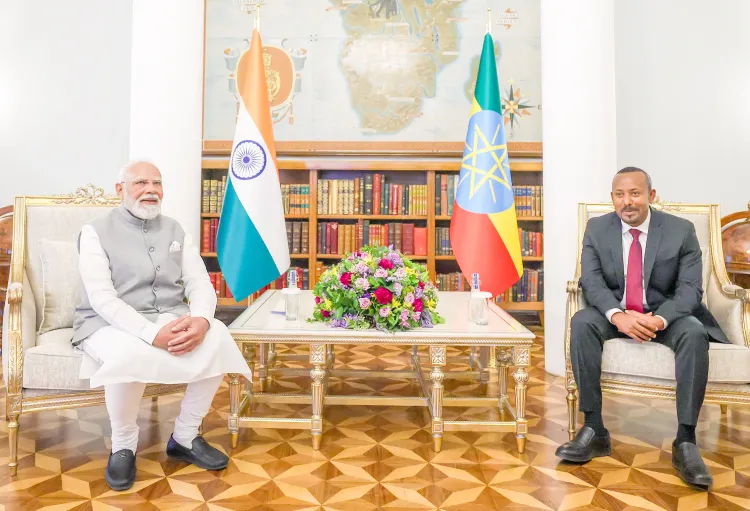
Addis Ababa, Dec 17 (NationPress) Prime Minister Narendra Modi, during his meeting with Ethiopian Prime Minister Dr. Abiy Ahmed on Wednesday, expressed India's commitment to enhancing cooperation in key areas such as Digital Public Infrastructure, mining, critical minerals, clean energy, along with food security and agriculture.
The two leaders assessed advancements in trade and investment, innovation, technology, education, and capacity building.
Prime Minister Modi highlighted that Indian firms, regarded as reliable partners, have invested more than $5 billion in Ethiopia, primarily in critical sectors like manufacturing and pharmaceuticals, generating over 75,000 local jobs.
This year alone, 11 Indian companies have made investments in Ethiopia across diverse fields including agriculture, automobiles, iron and steel, and ICT. Furthermore, Indian investments in the textile sector have emerged as a leader in terms of FDI, positioning India among the top investors in the pharmaceutical sector.
The total trade between India and Ethiopia for the fiscal year 2024-25 reached $550.19 million, with Indian exports totaling $476.81 million and imports at $73.38 million, highlighting a strong export-driven relationship.
Ethiopia benefits from the Duty-Free Tariff Preference (DFTP) scheme for least developed countries. Both nations are eager to bolster bilateral trade and technical collaboration.
Additionally, the two nations signed eight MoUs, including the elevation of ties to a ‘Strategic Partnership’, customs cooperation, the establishment of a data center at the Ethiopian Foreign Ministry, UN Peacekeeping training collaboration, debt restructuring under G20, increased ICCR scholarships, and AI short courses for Ethiopians.
Both Prime Ministers reiterated their resolve to collaborate in amplifying the voices of the Global South. They deliberated on cooperation in international forums, including the United Nations.
They emphasized the necessity for enhanced collaboration on climate change, renewable energy, and disaster risk reduction, welcoming the roles of international organizations such as the International Big Cat Alliance, the Coalition for Disaster Resilient Infrastructure, the Global Biofuel Alliance, and the International Solar Alliance (ISA).
Prime Minister Modi expressed anticipation for further cooperation with Ethiopia as BRICS partners during its presidency and in the forthcoming India-Africa Forum Summit.
Point of View
It is vital to recognize the importance of Prime Minister Modi's discussions with Ethiopia. This partnership not only signifies economic growth but also represents a commitment to global cooperation, especially in addressing pressing issues like climate change and food security. By fostering these ties, India demonstrates its dedication to being a pivotal player on the international stage.
NationPress
18/12/2025
Frequently Asked Questions
What sectors are India and Ethiopia focusing on for collaboration?
India and Ethiopia are focusing on Digital Public Infrastructure, mining, critical minerals, clean energy, food security, and agriculture for collaboration.
How much has India invested in Ethiopia?
Indian companies have invested over $5 billion in the Ethiopian economy, particularly in manufacturing and pharmaceuticals.
What is the total trade between India and Ethiopia for FY 2024-25?
The total trade between India and Ethiopia for FY 2024-25 is $550.19 million.
What are some of the agreements signed between India and Ethiopia?
Eight MoUs were signed, including customs cooperation, establishing a data center, and increasing ICCR scholarships for Ethiopians.
What is the significance of the Duty-Free Tariff Preference (DFTP) for Ethiopia?
Ethiopia benefits from the DFTP scheme for least developed countries, which enhances trade opportunities.