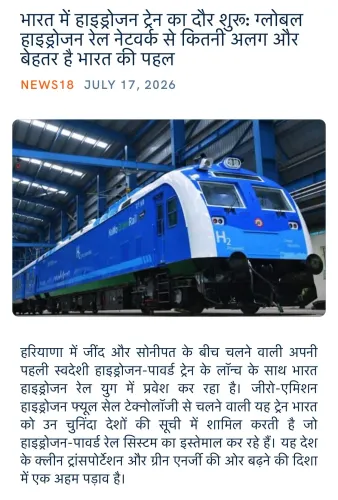
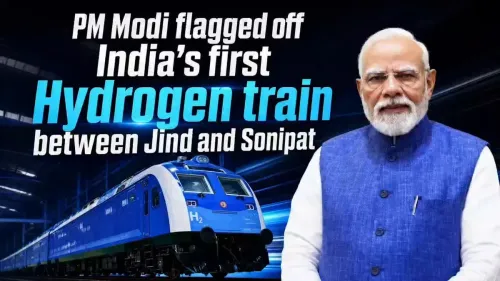
PM Modi flags off India's first hydrogen train in Haryana's Jind

Synopsis
Prime Minister Narendra Modi flagged off India's first hydrogen-powered train at Jind, Haryana on 17 July 2026, marking a milestone under the National Green Hydrogen Mission and the Atmanirbhar Bharat initiative. The project signals India's push toward zero-emission rail technology and positions the country as a global reference point for clean mobility.
Key Takeaways
India's first hydrogen train was flagged off by Prime Minister Narendra Modi at Jind, Haryana on 17 July 2026 .
The train uses cutting-edge hydrogen fuel-cell technology and emits only water vapour, making it a zero-emission mode of transport.
The project is backed by the National Green Hydrogen Mission , approved in January 2023 with an outlay of Rs 19,744 crore .
Indian Railways is driving the initiative as part of its decarbonisation programme aligned with India's 2070 net-zero target.
The Jind trial is expected to inform decisions on scaling hydrogen trains to additional routes and building refuelling infrastructure.
The achievement also advances the Atmanirbhar Bharat goal of developing advanced rail technology indigenously.
Prime Minister Narendra Modi on Friday, 17 July 2026, flagged off India's first hydrogen-powered train at Jind, Haryana, calling it a landmark step toward a clean, green, and self-reliant India. The Prime Minister shared the moment on X, describing the achievement as an example not only of India's technological capability but also as a model for the world.
In his post, Modi wrote: 'Harit, swachh aur Atmanirbhar Bharat ke nirmaan ki disha mein yeh ek badi uplabdhi hai' — 'This is a major achievement in the direction of building a clean, green, and self-reliant India.' He added that the train, built with cutting-edge technology, is 'not only a symbol of India's technological prowess but also an example for the entire world.'
Context
Jind, a district in Haryana, has been selected as the site for the country's first hydrogen train trial — a project spearheaded by Indian Railways as part of its broader decarbonisation programme. Hydrogen fuel-cell technology generates electricity through a chemical reaction between hydrogen and oxygen, emitting only water vapour, making it one of the cleanest alternatives to diesel traction.
The flagging-off marks a visible milestone in Indian Railways' effort to move away from fossil-fuel-dependent operations and toward zero-emission mobility on its vast network.
Policy Backdrop
The hydrogen train initiative is closely tied to the National Green Hydrogen Mission, approved by the Union Cabinet in January 2023 with an outlay of Rs 19,744 crore. The mission aims to scale up indigenous green hydrogen production and accelerate its use across transport, industry, and energy sectors.
Prime Minister Modi has consistently framed green hydrogen as central to India's 2070 net-zero emissions commitment. The Atmanirbhar Bharat dimension of the project — developing the technology domestically rather than importing it — reflects a deliberate policy choice to build indigenous capacity in advanced rail engineering.
Stakeholders and Impact
Railway passengers stand to benefit from quieter, cleaner journeys if hydrogen trains are scaled beyond the trial phase. The renewable energy sector is also a key stakeholder, since green hydrogen production depends on surplus solar and wind power — a supply chain that India is rapidly building out.
For Indian Railways, which operates one of the world's largest rail networks, successful hydrogen train deployment could significantly reduce its carbon footprint and fuel import bill. The project also signals export potential for indigenously developed hydrogen rail technology.
What's Next
Attention will now turn to the expansion of hydrogen train services to additional routes and the development of hydrogen refuelling infrastructure linked to state renewable energy parks. Indian Railways is expected to assess performance data from the Jind trial before committing to a wider rollout.
If the technology proves operationally viable at scale, India could join a small group of nations — including Germany and Japan — that have moved hydrogen rail beyond the prototype stage, lending credibility to Modi's claim that the project sets a global example.
Point of View
The National Green Hydrogen Mission, and the Atmanirbhar Bharat industrial strategy. By choosing Jind in Haryana as the launch site, the government also signals intent to spread high-visibility infrastructure milestones beyond traditional metro corridors. The project's credibility will ultimately rest on whether the trial translates into commercial deployment, but the political messaging is unambiguous: India is positioning itself as a first-mover in hydrogen rail among large emerging economies. Sustained investment in refuelling infrastructure and domestic electrolyser manufacturing will be the real test of whether this launch is a turning point or a showcase.
NationPress
17 Jul 2026
Frequently Asked Questions
What is India's first hydrogen train and where was it launched?
India's first hydrogen-powered train was flagged off by Prime Minister Narendra Modi at Jind in Haryana on 17 July 2026. The train runs on hydrogen fuel-cell technology and emits only water vapour.
What is the National Green Hydrogen Mission?
The National Green Hydrogen Mission is a central government scheme approved in January 2023 with an outlay of Rs 19,744 crore. It aims to scale up green hydrogen production and accelerate its use in transport, industry, and energy sectors.
How does a hydrogen train work?
A hydrogen fuel-cell train generates electricity through a chemical reaction between hydrogen and oxygen. This electricity powers the train's motors, and the only by-product is water vapour, making it a zero-emission technology.
What is India's net-zero target and how does the hydrogen train relate to it?
India has committed to achieving net-zero carbon emissions by 2070. The hydrogen train project is part of Indian Railways' decarbonisation programme, which seeks to reduce the network's dependence on diesel traction and cut its overall carbon footprint.
Will hydrogen trains be expanded to other routes in India?
A wider rollout will depend on performance data from the Jind trial. Indian Railways is expected to assess operational viability before committing to additional routes, with hydrogen refuelling infrastructure linked to renewable energy parks also needing to be developed.