PM Modi Greets West Bengal on West Bengal Day

Synopsis
Prime Minister Narendra Modi posted warm greetings in Bengali on West Bengal Day, June 20, 2026, celebrating the state's historic contributions to literature, music, art, spirituality, science, commerce, and social reform, reflecting his consistent practice of regional-language outreach on state cultural occasions.
Key Takeaways
Prime Minister Narendra Modi posted in Bengali on June 20, 2026 to mark West Bengal Day .
He greeted 'sisters and brothers of West Bengal' and highlighted the state's contributions to literature, music, art, spirituality, science, commerce, and social reform.
The message aligns with the Ek Bharat Shreshtha Bharat programme launched in 2015 to promote India's cultural diversity.
Modi has a consistent practice of posting in regional languages on state identity-related occasions, including in opposition-governed states.
West Bengal is governed by the Trinamool Congress , making the outreach notable amid ongoing political competition with the BJP.
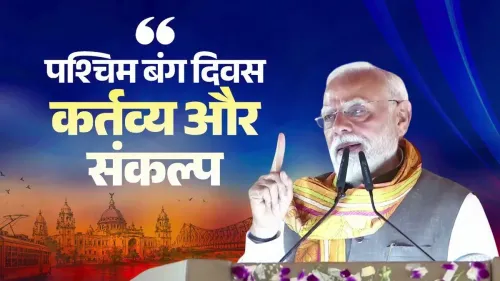
Prime Minister Narendra Modi on Saturday, June 20, 2026, extended warm greetings to the people of West Bengal on the occasion of West Bengal Day, posting a heartfelt message in Bengali on X to honour the state's far-reaching contributions to Indian civilisation.
In his post, the Prime Minister wrote in Bengali: 'পশ্চিমবঙ্গ দিবস উপলক্ষে পশ্চিমবঙ্গের আমার বোন ও ভাইদের জানাই আন্তরিক শুভেচ্ছা' — translated as, 'On the occasion of West Bengal Day, I extend my heartfelt greetings to my sisters and brothers of West Bengal.' He noted that the day celebrates a state that has shaped India's history through its contributions to literature, music, art, spirituality, science, commerce and trade, social reform, and many other diverse fields.
Context
West Bengal is an eastern Indian state with a storied legacy in India's intellectual and cultural history. The region gave rise to the Bengal Renaissance — a 19th-century social and cultural reform movement that produced towering figures in literature, philosophy, and public life, leaving a permanent imprint on modern India's identity.
Modi's choice to post in Bengali is consistent with his established practice of communicating in regional languages on dates associated with state identities, signalling respect for linguistic and cultural diversity across the country.
Policy Backdrop
The Prime Minister's message aligns with the spirit of the Ek Bharat Shreshtha Bharat programme, launched in 2015, which promotes awareness of cultural diversity and shared heritage among Indian states. The initiative encourages citizens to appreciate the distinct contributions each state makes to India's composite civilisation.
Modi has maintained a consistent pattern of issuing such greetings across state formation days and cultural observances, including for states governed by opposition parties. West Bengal is currently governed by the Trinamool Congress, making the outreach also notable in the context of ongoing political competition between the BJP and the ruling state government.
Stakeholders and Impact
The message is addressed directly to the residents of West Bengal, a state of over 9 crore people. Cultural organisations, educational institutions, and civil society groups in the state observe such days with events celebrating the region's heritage in arts, letters, and reform.
The Prime Minister's acknowledgment of West Bengal's contributions to science, commerce, spirituality, and social reform resonates with a state that takes deep pride in its intellectual and artistic traditions, from classical music and visual arts to pioneering social movements.
What's Next
Cultural events and public programmes marking West Bengal Day are expected across the state. Responses from the West Bengal state government and coordinated initiatives around the observance will indicate how the occasion is institutionally recognised going forward.
For the Centre, such outreach is part of a broader strategy of cultural engagement with all states, reinforcing the idea of national unity through the celebration of regional distinctiveness.
Point of View
Long-running strategy of cultural nationalism — using regional languages and state observances to project an inclusive national identity while maintaining political presence in opposition-held territories. West Bengal, a state the BJP has aggressively contested, is a particularly significant audience for such outreach. The reference to the state's contributions to social reform and science also implicitly frames the Centre's relationship with Bengal as one of civilisational respect rather than political rivalry. Over time, these gestures form a soft-power layer of engagement that operates independently of electoral cycles.
NationPress
18 Sept 2026
Frequently Asked Questions
What is West Bengal Day and when is it celebrated?
West Bengal Day is observed on June 20 to mark and celebrate the state's identity, heritage, and contributions to India. The exact institutional origin of the observance on this date is a matter of ongoing public discussion.
Why did PM Modi post in Bengali on West Bengal Day?
Prime Minister Narendra Modi regularly posts in regional languages on dates associated with state identities. Posting in Bengali on West Bengal Day reflects his practice of honouring linguistic diversity and connecting directly with regional audiences.
What contributions of West Bengal did PM Modi highlight?
Modi highlighted West Bengal's contributions to literature, music, art, spirituality, science, commerce and trade, and social reform , calling them defining elements of India's history.
What is the Ek Bharat Shreshtha Bharat programme?
Ek Bharat Shreshtha Bharat is a programme launched by the Central government in 2015 to promote awareness of India's cultural diversity and foster a sense of shared heritage among the country's states and union territories.
What is the political significance of Modi's West Bengal Day message?
West Bengal is governed by the Trinamool Congress , a key political rival of the BJP . Modi's outreach on cultural occasions in the state is seen as part of a broader strategy to maintain a positive presence and connect with voters beyond formal political campaigns.