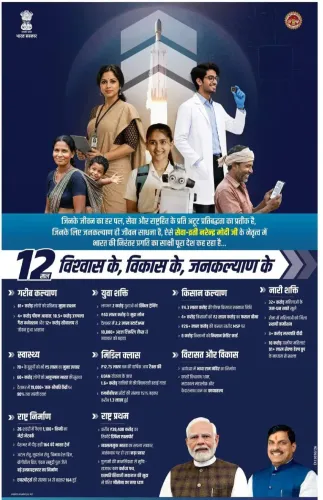
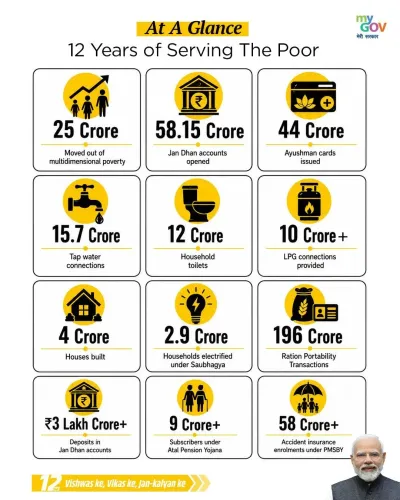
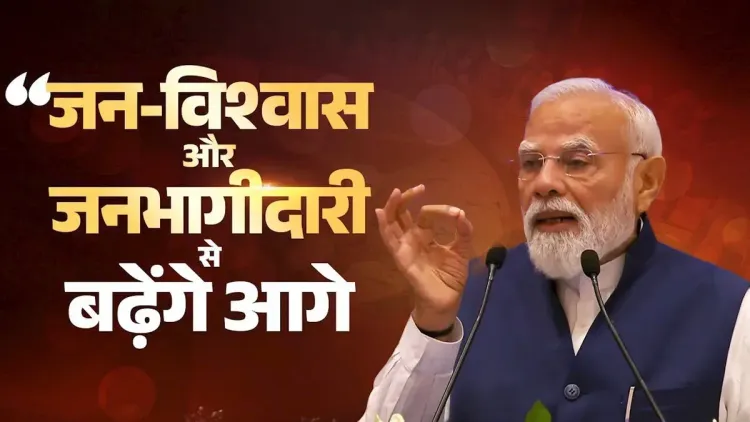
PM Modi marks 12 years of governance with Jan Bhagidari call
Synopsis
Prime Minister Narendra Modi marked 12 years of BJP-led central governance on 10 June 2026, calling the period a celebration of government-society partnership and urging citizens to sustain the collective strength of Jan Vishwas and Jan Bhagidari in the years ahead.
Key Takeaways
Prime Minister Narendra Modi posted on X on 10 June 2026 marking 12 years of the BJP-led central government.
He described the period as a celebration of government-society partnership ( sarkar aur samaj ki sahbhagita ).
Modi called for continued reliance on Jan Vishwas (public trust) and Jan Bhagidari (citizen participation) going forward.
The post was accompanied by a video , indicating a deliberate commemorative communication.
The Jan Bhagidari framework has underpinned flagship programmes including Swachh Bharat Mission (2014) and the COVID-19 Jan Andolan (2020).
The message signals policy continuity in the citizen-partnership governance model ahead of the 2029 general elections .
Prime Minister Narendra Modi on Wednesday, 10 June 2026 reflected on 12 years of the BJP-led central government, framing the period as a celebration of partnership between the state and society, and called on citizens to carry forward the collective strength of public trust and participation in the years ahead.
In a post on X in Hindi, Modi wrote: 'Beete 12 varsh sarkar aur samaj ki sahbhagita ka utsav manaane waale rahe hain' — 'The past 12 years have been a celebration of the partnership between government and society.' He added that going forward, the same collective strength of Jan Vishwas (public trust) and Jan Bhagidari (citizen participation) must continue to guide the nation.
Context
The post marks a rhetorical milestone as the Narendra Modi government completes 12 years in office, having first assumed power in May 2014. The message was accompanied by a video, signalling a deliberate commemorative communication rather than a routine update. The framing centres on a partnership narrative — positioning citizens not as beneficiaries of governance but as co-authors of it.
This language of 'sahbhagita' (partnership) and 'janbhagidari' has been a consistent thread through the government's public communication since its first term, deployed across sanitation, health, and digital-inclusion campaigns.
Policy Backdrop
The concept of Jan Bhagidari — citizen participation as a governance tool — was institutionalised early in the Modi government's tenure. The Swachh Bharat Mission, launched in October 2014, was explicitly framed as a mass movement dependent on public behaviour change rather than government action alone. During the COVID-19 pandemic in 2020, the government invoked the idea of a 'Jan Andolan' to mobilise citizens alongside state machinery for vaccination and containment efforts.
Across infrastructure, digital inclusion, and welfare delivery, the Bharatiya Janata Party-led administration has consistently situated its programmes within a narrative of sustained public trust, arguing that scheme outcomes reflect collective societal will rather than purely top-down implementation.
Stakeholders and Impact
The message is directed broadly at Indian citizens and civil society groups who have been positioned as partners in national programmes over the past decade. For the BJP as an organisation, the communication reinforces a brand identity built around participatory governance ahead of what political observers expect to be an active policy period leading toward the 2029 general elections.
State governments — both BJP-ruled and opposition-led — that have adopted or adapted the Jan Bhagidari model in local schemes are also implicitly addressed, as the Centre signals continuity in this governance philosophy.
What's Next
The post's forward-looking close — 'aane waale samay mein bhi', meaning 'in the times ahead too' — suggests the government intends to deepen rather than recalibrate its citizen-partnership approach. Analysts will watch for new participatory components being layered into existing flagship schemes, as well as any formal policy announcements that operationalise this renewed emphasis on Jan Bhagidari at the national or state level.
As the government enters what it frames as a new phase beyond its 12-year mark, the degree to which this rhetorical commitment translates into measurable citizen-engagement mechanisms will define how the partnership narrative holds up to scrutiny.
Point of View
The BJP insulates itself from performance-based critiques — if the people are co-authors of governance, credit and responsibility are shared. The invocation of Jan Bhagidari at this juncture also signals to party machinery and state units that participatory programme design will remain the preferred template for scheme rollouts. Historically, such rhetorical resets ahead of election cycles have preceded the launch of new citizen-facing components in flagship welfare and infrastructure programmes.
NationPress
21 Sept 2026
Frequently Asked Questions
Why is PM Modi talking about 12 years of governance in June 2026?
The BJP-led central government under Narendra Modi first assumed office in May 2014 , making June 2026 a point at which the administration has completed 12 years in power. Modi's post marks this milestone by reflecting on the government-society partnership that has characterised the period.
What is Jan Bhagidari and why does Modi keep mentioning it?
Jan Bhagidari means citizen participation in governance. The Modi government has used this concept as a core framing device since 2014, applying it to programmes like the Swachh Bharat Mission and the COVID-19 vaccination drive , arguing that public involvement is as important as state delivery.
What did PM Modi say in his 10 June 2026 post on X?
Modi wrote in Hindi that 'the past 12 years have been a celebration of the partnership between government and society' and called on citizens to carry forward the collective strength of Jan Vishwas (public trust) and Jan Bhagidari (citizen participation) in the times ahead.
What is Jan Vishwas in Indian governance?
Jan Vishwas , or public trust, is a term the Modi government uses to describe the confidence citizens place in government programmes and institutions. It is paired with Jan Bhagidari to argue that effective governance requires both state action and an engaged, trusting citizenry.
What comes next after Modi's 12-year governance milestone message?
Observers will watch for new citizen-participation components in existing flagship schemes and possible policy announcements that operationalise the Jan Bhagidari model more formally, particularly as the government looks ahead to the 2029 general elections .