PM Modi hails India's youth building rockets, chips and drones
Synopsis
Prime Minister Narendra Modi on 8 August 2026 amplified a generational moment, sharing that young Indians are proudly claiming to be the first in their families to build rockets, semiconductors and drones — a signal of the human dividend from India's decade-long push for technological self-reliance.
Key Takeaways
PM Modi on 8 August 2026 shared on X that youngsters are calling themselves the 'first in their bloodline' to build a rocket, a chip and a drone.
ISRO leads India's indigenous launch vehicle programme; the India Semiconductor Mission (2021) targets domestic chip fabrication; Drone Rules 2021 opened a civilian UAV industry.
The policy foundation spans Make in India (2014) , Atmanirbhar Bharat (2020) , and PLI schemes (2021-22) for electronics and drones.
The post reflects a shift: advanced manufacturing and deep-tech R&D are reaching first-generation engineers beyond elite institutions.
Key milestones ahead include approved semiconductor fabrication units and ISRO's Gaganyaan human spaceflight programme.
A new generation of Indian engineers is rewriting family history — and Prime Minister Narendra Modi is taking note. On Saturday, 8 August 2026, the Prime Minister shared a striking observation on X: that young Indians across the country are proudly declaring themselves the first in their bloodlines to build a rocket, a chip, and a drone.
Quoting what he described as a groundswell of voices from youngsters, Modi wrote: 'First in my bloodline to build a rocket, a chip and a drone!' — three technologies that sit at the very heart of India's strategic self-reliance agenda. The remark is casual in tone but carries considerable political and economic weight.
Three industries, one generational shift
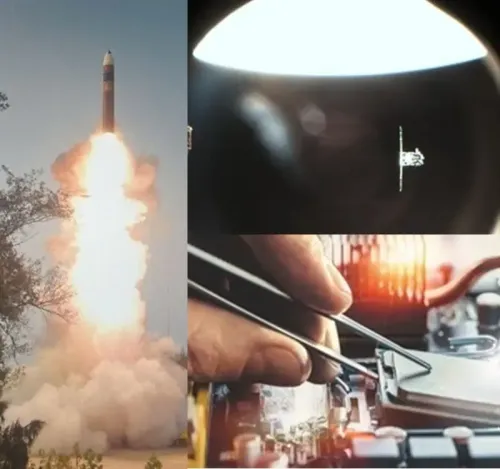
Rockets, semiconductors, and drones are not random choices. Each represents a sector where India has, over the past decade, made deliberate policy bets to reduce dependence on foreign supply chains. ISRO, India's national space agency, has steadily expanded its indigenous launch vehicle programme, while the India Semiconductor Mission — approved in 2021 — is working to build domestic chip design and fabrication capacity from near-zero. The Drone Rules 2021 liberalised an entire civilian and commercial UAV ecosystem almost overnight.
Behind all three sits a policy architecture assembled since 2014: the Make in India programme, the Atmanirbhar Bharat initiative announced in 2020, and the Production Linked Incentive (PLI) schemes for electronics and drones expanded in 2021-22. The cumulative intent has always been the same — move India up the value chain, from assembler to inventor.
Why 'first in my bloodline' is the telling phrase
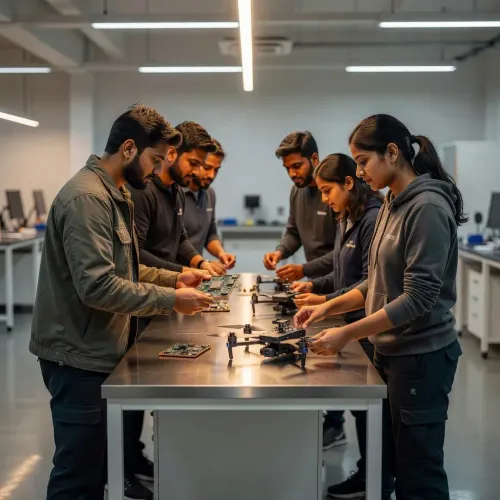
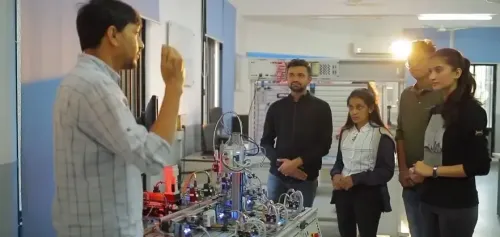
The phrase Modi amplifies is not a government slogan — it is the language of first-generation engineers and founders. It signals that advanced manufacturing and deep-tech R&D are no longer the exclusive preserve of elite institutions or inherited professional networks. Young engineers from smaller cities and towns are finding pathways into space startups, fabless chip design firms, and drone manufacturers that simply did not exist a generation ago.
Two near-term milestones will test whether this momentum holds: the rollout of approved semiconductor fabrication units and ISRO's Gaganyaan human spaceflight programme — both of which will demand exactly the kind of homegrown engineering talent the Prime Minister is spotlighting today.
India's ambition has always been large. The question now is whether the pipeline of first-generation rocket-builders, chip designers, and drone engineers is wide enough to deliver it.
Point of View
He ties Atmanirbhar Bharat to an aspirational, upwardly mobile constituency of young STEM workers and founders. The political subtext is clear: self-reliance in strategic sectors is being presented as a social mobility story, not just an industrial one. Whether the semiconductor and space pipelines can sustain that narrative will be the real test of the decade.
NationPress
9 Aug 2026
Frequently Asked Questions
What did PM Modi say about Indian youth and technology on 8 August 2026?
PM Modi shared on X that many young Indians are declaring themselves the first in their families to build a rocket, a chip and a drone, highlighting a generational shift in India's deep-tech workforce.
What is the India Semiconductor Mission?
The India Semiconductor Mission is a government initiative approved in 2021 to develop domestic semiconductor design and fabrication capabilities and reduce India's dependence on chip imports.
How has India's drone sector grown under government policy?
The Drone Rules 2021 liberalised civilian and commercial drone manufacturing and operations in India, and Production Linked Incentive schemes expanded in 2021-22 attracted investment into domestic drone production.
What is Atmanirbhar Bharat and how does it relate to technology?
Atmanirbhar Bharat, announced in 2020, is India's self-reliance initiative with a strong emphasis on defence, space and electronics manufacturing to reduce import dependence in strategic sectors.
What are the next big milestones for India's technology ambitions?
Key milestones include the rollout of approved semiconductor fabrication units under the India Semiconductor Mission and ISRO's Gaganyaan human spaceflight programme, both requiring large pools of homegrown engineering talent.