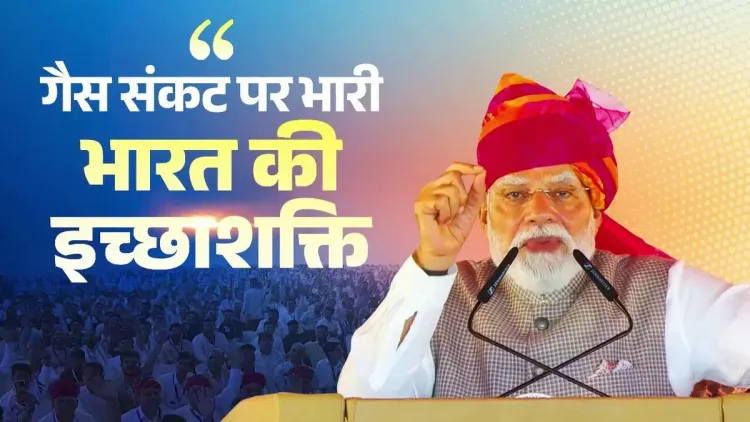
PM Modi: India's energy willpower beat 21st century's biggest crisis
Synopsis
Prime Minister Narendra Modi on 4 July 2026 said unprecedented efforts over the past decade to build India's energy capacity have enabled the country to withstand the 21st century's biggest energy crisis. India's installed renewable capacity grew nearly five-fold since 2014, underpinning his claim of a resilient, self-reliant energy posture.
Key Takeaways
PM Narendra Modi on 4 July 2026 stated that India's energy willpower has prevailed over the biggest energy crisis of the 21st century.
India's installed renewable energy capacity grew from roughly 35 GW in 2014 to over 170 GW by 2024 .
India has set a target of 500 GW of non-fossil energy capacity by 2030 , first announced at the 2015 Paris Climate Conference .
The International Solar Alliance , co-founded by India and France in 2015 , extends India's solar push to more than 120 countries .
India's Panchamrit strategy, presented at COP26 in Glasgow , targets net-zero emissions by 2070 .
Energy self-reliance under the Atmanirbhar Bharat agenda has driven domestic manufacturing of solar modules and storage equipment.
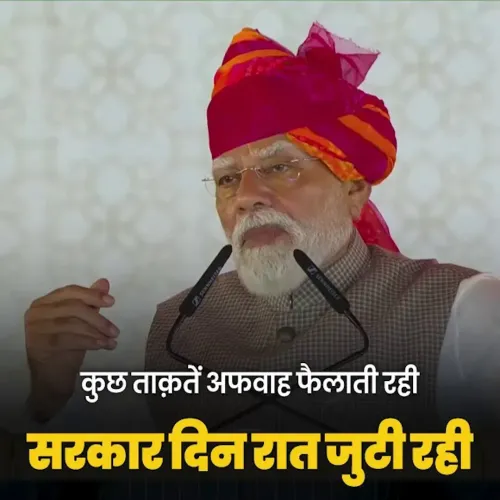
Prime Minister Narendra Modi on Saturday, 4 July 2026, credited a decade of sustained efforts to expand India's energy capacity with enabling the country to overcome what he described as the 21st century's biggest energy crisis. The statement, posted on X, frames domestic energy buildout as a strategic shield against global supply disruptions.
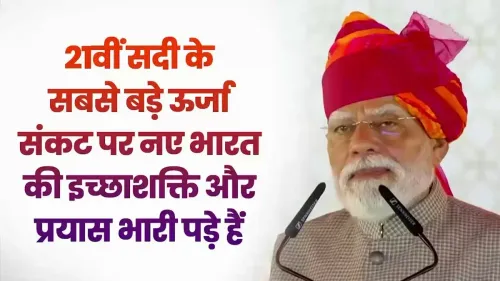
In Hindi, the Prime Minister wrote: 'बीते एक दशक में हमने देश की ऊर्जा क्षमता को बढ़ाने के अभूतपूर्व प्रयास किए हैं।' ['In the past decade, we have made unprecedented efforts to expand the country's energy capacity.'] He added that it is precisely these efforts whose result is that today, the willpower of a new India has prevailed over the biggest energy crisis of the 21st century.
Context
The post comes against the backdrop of global energy markets that have remained volatile since the 2022 supply shocks triggered by geopolitical conflict in Europe, which drove fuel prices sharply higher and strained import-dependent economies. India, the world's third-largest energy consumer, was exposed to those pressures through elevated crude and LNG import bills. Modi's framing positions domestic capacity expansion as the decisive buffer that insulated Indian consumers and industry.
The claim of 'unprecedented efforts' over a decade points to the period since 2014, when the BJP-led government took office and began scaling up renewable energy auctions, transmission infrastructure, and energy-efficiency schemes.
Policy Backdrop
India's installed renewable energy capacity stood at roughly 35 GW in 2014 and grew to over 170 GW by 2024 through competitive auctions, production-linked incentives, and grid upgrades — a nearly five-fold increase in a decade. The country had committed at the 2015 Paris Climate Conference to a 175 GW renewable target by 2022, and later raised its ambition to 500 GW of non-fossil capacity by 2030.
At COP26 in Glasgow in 2021, India presented its Panchamrit strategy, which includes achieving net-zero emissions by 2070. The International Solar Alliance, co-launched by India and France in 2015, extended this domestic push into a multilateral framework spanning more than 120 countries. Together, these commitments form the policy lineage behind Modi's assertion of a strengthened energy posture.
Stakeholders and Impact
The renewable energy sector — comprising solar developers, wind equipment manufacturers, transmission utilities, and storage technology firms — is the primary beneficiary of the capacity push. Competitive auctions have driven tariffs down, making solar and wind power among the cheapest sources of electricity for industrial and household consumers.
Power consumers across India's 28 states and 8 union territories stand to gain from reduced dependence on imported fossil fuels, which directly affects retail electricity tariffs and inflation. The Atmanirbhar Bharat energy security agenda, which underpins this push, also has industrial-policy dimensions: domestic manufacturing of solar modules, inverters, and batteries has been incentivised to reduce import reliance from China.
What's Next
Attention now turns to India's renewable capacity auction pipeline for 2025-26 and any new policy announcements on grid-scale battery storage and interstate transmission corridors ahead of COP31. Analysts will watch whether the 500 GW non-fossil target by 2030 remains on track, given the infrastructure and financing demands of the final stretch. The Prime Minister's post signals that energy self-reliance will remain a central political and policy narrative for the ruling dispensation.
Point of View
' the framing elevates an infrastructure milestone into a civilisational narrative, consistent with the BJP's broader Atmanirbhar Bharat positioning. The reference to the '21st century's biggest energy crisis' is notable: it implicitly benchmarks India's performance against import-dependent peers who struggled more visibly after the 2022 supply disruptions. Politically, this consolidates the government's claim that long-term capacity planning, rather than short-term subsidy relief, is the correct response to energy vulnerability.
NationPress
3 Oct 2026
Frequently Asked Questions
What did PM Modi say about India's energy crisis?
PM Modi said that unprecedented efforts over the past decade to expand India's energy capacity have enabled the country to overcome what he called the biggest energy crisis of the 21st century.
How much renewable energy capacity has India added since 2014?
India's installed renewable energy capacity grew from roughly 35 GW in 2014 to over 170 GW by 2024, nearly a five-fold increase driven by competitive auctions and government incentives.
What is India's renewable energy target for 2030?
India has set a target of 500 GW of non-fossil energy capacity by 2030, a commitment made at the 2015 Paris Climate Conference and reinforced through the Panchamrit strategy at COP26.
What is the International Solar Alliance?
The International Solar Alliance is a treaty-based multilateral organisation co-launched by India and France in 2015 to promote solar energy adoption across more than 120 member countries.
What is India's net-zero target year?
India has committed to achieving net-zero emissions by 2070, as announced through the Panchamrit strategy presented at the COP26 summit in Glasgow in 2021.