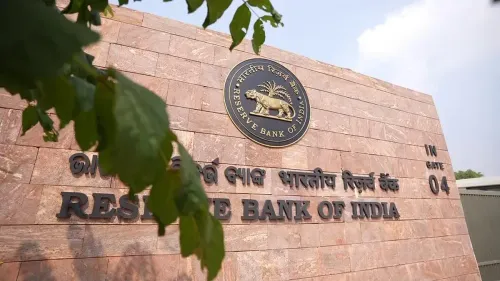
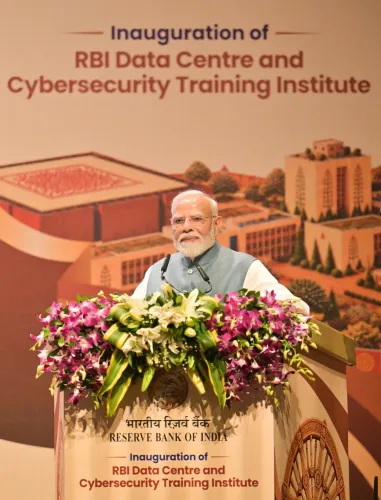
PM Modi Inaugurates ₹169-Cr RBI Data Centre in Odisha

Synopsis
Prime Minister Narendra Modi inaugurated the ₹169-crore RBI Data Centre and Cybersecurity Training Institute in Odisha on 26 October 2026, reinforcing India's digital payment security and decentralising critical financial technology infrastructure beyond major metros.
Key Takeaways
Prime Minister Narendra Modi inaugurated the RBI Data Centre and Cybersecurity Training Institute in Odisha on 26 October 2026 .
The project carries a price tag of ₹169 crore , making it one of the largest RBI infrastructure investments in eastern India.
The facility has a dual mandate: securing India's critical payment systems and running cybersecurity training and research programmes.
The initiative aligns with the RBI's 2018 data localisation directive requiring all payment data to be stored within India.
Odisha's selection fits a national pattern of decentralising strategic technology institutions beyond traditional metro hubs.
Training programme rollout timelines and eligibility criteria remain to be announced by the Reserve Bank of India .
A ₹169-crore investment in India's financial nervous system landed in Odisha on Monday, 26 October 2026 — as Prime Minister Narendra Modi inaugurated the Reserve Bank of India Data Centre and Cybersecurity Training Institute, marking a significant expansion of the country's digital financial backbone beyond its traditional metro strongholds.
The Chief Minister's Office of Odisha called the inauguration 'a major leap in strengthening India's digital financial infrastructure,' highlighting the facility's dual mandate: securing critical payment systems and advancing cybersecurity training and research. For a state better known for steel, mining, and temples than server farms, this is a pointed signal of where Odisha is heading.
Why an RBI Cybersecurity Hub Belongs in Odisha Now
The Reserve Bank of India has spent years hardening the architecture beneath India's payments explosion. A landmark 2018 RBI directive mandated that all payment system data be stored exclusively within Indian borders — a policy that put pressure on every bank and fintech operating in the country to rethink their infrastructure. A dedicated data centre reinforces exactly that mandate at the institutional level.
India processed billions of digital transactions in the years following the 2015 Digital India launch, and the velocity has only climbed. The more payments flow, the larger the attack surface. A purpose-built cybersecurity training institute attached to the data centre means the RBI is not just building walls — it is training the people who will defend them.
Decentralising India's Tech Muscle
There is a deliberate pattern here. For decades, India's critical technology and financial infrastructure was clustered in Mumbai, Bengaluru, Hyderabad, and Delhi. The placement of a central-bank-grade data facility in Odisha fits a broader government push to distribute strategic institutions — reducing single-point-of-failure risk and seeding technology ecosystems in states that have historically been left on the periphery of the digital economy.
The banking sector and Odisha's growing IT firms stand to benefit most immediately. Proximity to a national-level cybersecurity institute creates a talent pipeline that local industry has lacked. Training programmes run by the RBI carry credibility that few regional institutions can match, and the certifications that emerge from this facility will carry weight across the financial sector nationwide.
What the CMO Called a 'Digitally Empowered India'
The Chief Minister's Office framed the project in explicitly national terms — 'contributing to a digitally empowered India' — rather than purely local ones. That framing is deliberate: Odisha is positioning itself as a contributor to national digital resilience, not merely a recipient of central largesse. The distinction matters for how the state markets itself to future technology investors.
The immediate question is timeline. When do the institute's training programmes go live, who gets first access — government employees, bank staff, or private-sector cybersecurity professionals — and will the RBI announce similar facilities in other states? The infrastructure is in the ground. Now the real work begins.
Point of View
Reducing concentration risk in the banking system's digital layer. For the BJP-led government, co-badging a central-bank project with the Prime Minister's inauguration in an eastern state carries clear political optics ahead of any regional electoral cycle. More structurally, the RBI's move to pair data storage with a training institute signals a shift from passive compliance with data localisation rules toward active capability-building — the kind of institutional depth that a ₹1-trillion digital payments economy genuinely needs.
NationPress
26 Oct 2026
Frequently Asked Questions
What is the RBI Data Centre inaugurated in Odisha?
It is a ₹169-crore Reserve Bank of India facility combining a data centre for securing critical payment systems with a Cybersecurity Training Institute for advancing financial cybersecurity research and workforce development in India.
Who inaugurated the RBI Data Centre in Odisha?
Prime Minister Narendra Modi inaugurated the RBI Data Centre and Cybersecurity Training Institute in Odisha on 26 October 2026 .
Why was the RBI cybersecurity institute built in Odisha?
The placement in Odisha is part of a broader national push to decentralise India's critical technology and financial infrastructure beyond traditional hubs like Mumbai and Bengaluru, seeding technology ecosystems in states like Odisha.
What is India's data localisation policy for payments?
The Reserve Bank of India issued guidelines in 2018 mandating that all payment system data be stored exclusively within India, a policy this new data centre directly reinforces.
How does the RBI Data Centre connect to Digital India?
The facility extends the Digital India programme launched in 2015 by building the secure infrastructure needed to support India's rapidly expanding digital payments ecosystem and protect it from cybersecurity threats.