PM Modi on Patience as National Strength, Cites Sanskrit Verse
Synopsis
Prime Minister Narendra Modi on 8 July 2026 shared a Sanskrit shloka and Hindi reflection on X, calling patience a nation's greatest strength and linking it to unity, progress, and self-reliance — consistent with his long-running practice of pairing ancient Indian philosophy with governance themes.
Key Takeaways
Prime Minister Narendra Modi posted on X on 8 July 2026 , calling patience the greatest strength of any nation.
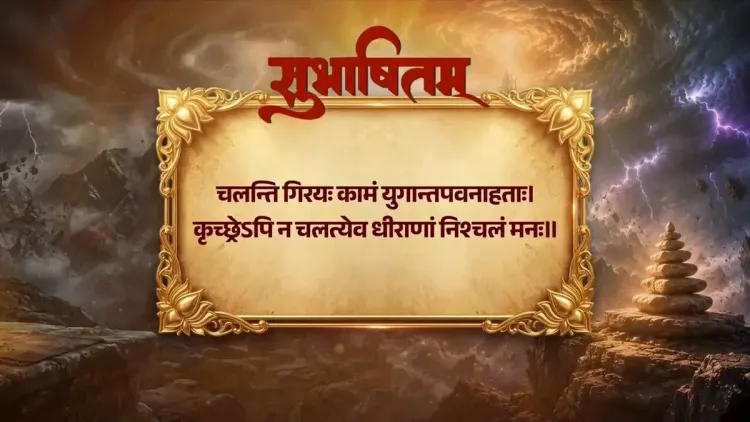
He shared a Sanskrit shloka meaning that while mountains may be moved by great winds, the resolute mind of the steadfast never wavers even in adversity.
The post explicitly links patience to national unity, progress, prosperity, and self-reliance ( atmanirbharta ).
The reference to self-reliance connects to the government's Atmanirbhar Bharat Abhiyan , launched in May 2020 .
Modi has followed this practice of pairing Sanskrit verses with governance themes consistently since 2014 .
No specific event or policy announcement was cited in the post; it functions as a broad motivational address to Indian citizens .
Prime Minister Narendra Modi on Wednesday, 8 July 2026, shared a philosophical reflection on patience as a nation's greatest strength, pairing a Hindi message with a Sanskrit shloka to underscore the values of unity, progress, prosperity, and self-reliance in the face of difficult challenges.
In his post on X, the Prime Minister wrote — translated from Hindi — 'Dhairy kisi rashtra ki sabse badi shakti hai' ('Patience is the greatest strength of any nation'). He added that this quality inspires a country to remain united even amid severe challenges, while continuously moving forward on the path of progress, prosperity, and self-reliance.
He accompanied this with a Sanskrit verse: 'Chalanti girayah kamam yugantapavanahataih. Krichchhre'pi na chalatyeva dhiranam nishchalam manah.' — meaning, 'Mountains may be moved by the winds at the end of an age; yet even in adversity, the resolute mind of the steadfast never wavers.'
Context
Modi has consistently used his social media presence to share Sanskrit verses and philosophical reflections that connect ancient Indian thought to contemporary governance priorities. This practice, sustained since he took office in 2014, typically pairs cultural and civilisational references with policy themes — particularly during periods of domestic or global stress.
The invocation of patience, unity, and self-reliance in a single message signals a deliberate alignment of cultural philosophy with the government's stated development agenda. The post carries no reference to a specific event, functioning instead as a broader motivational address to Indian citizens.
Policy Backdrop
The value of atmanirbharta (self-reliance) referenced in the post connects directly to the Atmanirbhar Bharat Abhiyan, the flagship self-reliance initiative launched in May 2020 to address pandemic-induced economic disruption while advancing long-term domestic manufacturing and reduced import dependence.
Over subsequent years, the scheme has been extended across sectors including defence, electronics, agriculture, and energy. Modi's repeated invocation of self-reliance — both in policy announcements and philosophical posts — reflects a consistent ideological thread running through the government's economic and strategic posture.
The pairing of 'progress' (pragati), 'prosperity' (samridhi), and 'self-reliance' (atmanirbharta) in a single message echoes the three-pillar framing the government has used in budget speeches and national addresses to describe its development vision.
Stakeholders and Impact
The post is addressed implicitly to Indian citizens at large, functioning as a motivational message rather than a policy directive. Such posts from the Prime Minister typically reach tens of millions of followers on X and are widely shared across digital platforms, amplifying the government's cultural and ideological messaging.
The use of Sanskrit — India's classical language — alongside Hindi reinforces the government's broader cultural positioning, which emphasises the continuity between ancient Indian civilisational values and modern national ambitions. For citizens navigating economic pressures or global uncertainties, the message frames patience and steadfastness as civic virtues.
What's Next
Posts of this nature from Prime Minister Modi often precede or accompany major policy announcements, parliamentary sessions, or national addresses, where similar themes of resilience and self-reliance are elaborated in concrete programmatic terms. Observers will watch for any government statements, budget allocations, or legislative moves in subsequent weeks that give institutional expression to the values articulated here.
The consistent pattern of linking ancient philosophical frameworks to present-day governance suggests that themes of national patience, unity, and atmanirbharta will continue to anchor the government's public communication as India navigates its development priorities in the years ahead.
Point of View
The post performs ideological continuity at low political cost. Such messaging tends to surface when the government wants to project calm authority during periods of uncertainty, domestic or external, without specifying the stressor. The deeper pattern is one of civilisational branding: framing contemporary India's development ambitions as the natural expression of an ancient, unbroken cultural character.
NationPress
6 Oct 2026
Frequently Asked Questions
What did PM Modi post on X on 8 July 2026?
Prime Minister Narendra Modi posted a Hindi reflection calling patience the greatest strength of a nation, paired with a Sanskrit shloka emphasising that the resolute mind never wavers even in adversity.
What is the meaning of the Sanskrit verse Modi shared?
The shloka translates as: 'Mountains may be moved by the winds at the end of an age; yet even in adversity, the resolute mind of the steadfast never wavers.' It is a classical verse on mental steadfastness.
What is Atmanirbhar Bharat and how does it relate to Modi's post?
Atmanirbhar Bharat Abhiyan is the government's self-reliance initiative launched in May 2020 to promote domestic manufacturing and reduce import dependence. Modi's post explicitly mentions self-reliance alongside progress and prosperity, echoing the scheme's core values.
Why does PM Modi frequently share Sanskrit verses on social media?
Since 2014, Modi has consistently used Sanskrit shlokas and philosophical reflections on social media to connect ancient Indian civilisational values with contemporary governance priorities such as national unity, economic self-reliance, and resilience.
Is Modi's 8 July post linked to a specific government policy announcement?
No specific policy announcement or event was cited in the post. It is a philosophical and motivational message addressed broadly to Indian citizens, though such posts often precede or accompany major government communications.