PM Modi Vows to Accelerate 'Nation First' Decisions
Synopsis
Prime Minister Narendra Modi on June 10, 2026 invoked the 'Nation First' principle to reaffirm his government's record of bold, high-stakes decisions — from demonetisation and GST to Article 370 — and pledged the pace of such reforms will accelerate.
Key Takeaways
PM Modi posted on June 10, 2026 reaffirming the 'Rashtra Pratham' (Nation First) principle as the cornerstone of his government's decision-making.
He described past major decisions as 'considered impossible' but taken in a 'very measured manner' in the national interest.
Key reforms cited in this governance pattern include demonetisation (November 2016) , GST rollout (July 2017) , and abrogation of Article 370 (August 2019) .
Modi explicitly pledged that the pace of such national-interest decisions will 'move forward even faster' going forward.
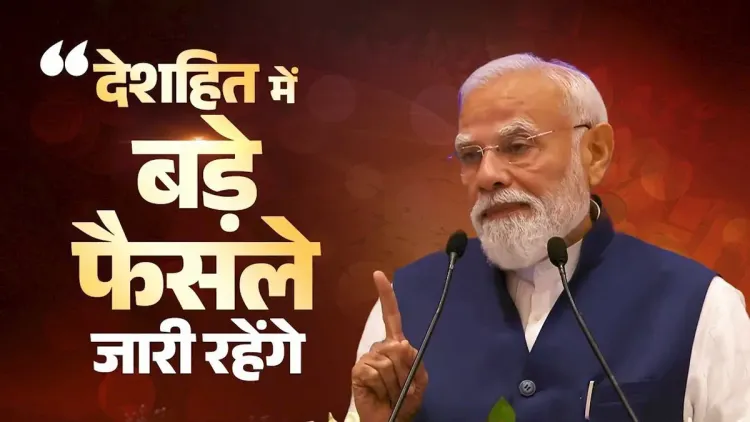
The post included a video, signalling a broader communication push around this governance narrative.
The statement is seen as a signal to both the BJP base and the broader public of renewed executive ambition in the current phase of government.
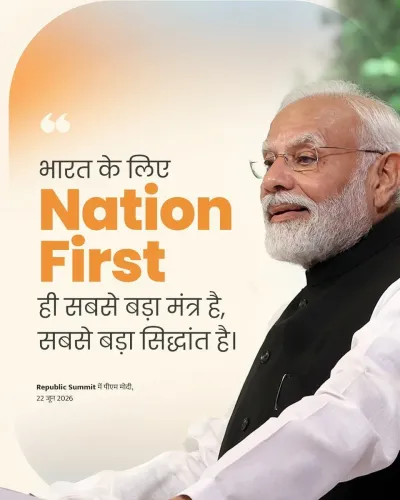
Prime Minister Narendra Modi on Wednesday, June 10, 2026, reaffirmed that the principle of 'Rashtra Pratham' ('Nation First') has guided his government's most consequential decisions, and pledged that the pace of such national-interest reforms would only increase going forward.
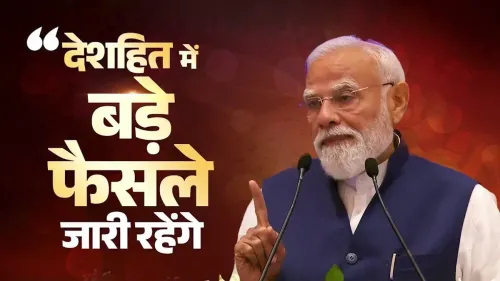
In a post on X, Modi wrote: 'Rashtra Pratham ki bhavna hamare liye sarvopari rahi hai, isliye hum behad sadhe tarike se asambhav samjhe jaane wale kai nirnay bhi le paye hain.' — 'The spirit of Nation First has been paramount for us, which is why we have been able to take, in a very measured manner, several decisions that were considered impossible. This chain of major decisions in the national interest will move forward at an even faster pace.'
Context
Modi's post arrives as his government enters what observers read as a phase of renewed legislative and executive ambition. The statement is a direct callback to a governing philosophy that the Bharatiya Janata Party (BJP) has articulated since 2014 — that durable national progress sometimes demands decisions that carry short-term political costs. The accompanying video, shared in the post, is expected to elaborate on this theme, though its specific content could not be independently verified at the time of publication.
Policy Backdrop
Three decisions in particular are widely cited as emblematic of this 'impossible-made-possible' framing. In November 2016, the government announced demonetisation, invalidating high-denomination currency notes to target black money and the parallel economy. In July 2017, a unified Goods and Services Tax (GST) replaced a complex web of central and state levies, restructuring the country's indirect tax architecture in one sweep.
The most politically charged of these was the abrogation of Article 370 in August 2019, which revoked Jammu and Kashmir's special constitutional status and reorganised the region into two union territories. Each of these moves was presented by the government as a long-pending assertion of national sovereignty and interest, executed with limited prior public consultation.
Stakeholders and Impact
The statement carries implications for Indian citizens broadly, as well as for state governments that must align with or respond to major executive and legislative shifts from the Centre. Opposition parties have historically contested the 'Nation First' framing, arguing that several of these decisions bypassed federal consensus and democratic deliberation. Civil society groups and economists have offered mixed assessments of the long-term outcomes of reforms like demonetisation and GST implementation.
For the BJP's political base, however, the rhetoric of decisive, nationally-oriented governance remains a powerful electoral and ideological signal — one that the Prime Minister has returned to consistently across his tenure.
What's Next
The explicit pledge that the 'chain of major decisions will move forward at an even faster pace' is being read as a signal of forthcoming legislative or executive action. While no specific policy was named in the post, the language mirrors the framing that has preceded several of Modi's most significant governance moves. Analysts and parliamentary observers will watch closely for new bills, ordinances, or executive orders in the coming weeks that may be presented under this 'Rashtra Pratham' banner.
Point of View
GST, demonetisation) to whatever comes next, framing future disruption as continuity rather than novelty. For the BJP, this language also serves an electoral function: it reinforces the party's core brand of decisive, sovereignty-first leadership. The open-ended pledge to accelerate such decisions invites both anticipation from supporters and heightened scrutiny from opposition and federal stakeholders.
NationPress
26 Oct 2026
Frequently Asked Questions
What did PM Modi mean by 'Nation First' in his June 2026 post?
Modi used the Hindi phrase 'Rashtra Pratham' to mean that national interest has been the overriding principle behind his government's most consequential decisions, including those considered politically or practically impossible at the time.
Which decisions is Modi referring to as 'impossible' reforms?
The governance pattern most associated with this framing includes demonetisation in November 2016 , the nationwide GST rollout in July 2017 , and the abrogation of Article 370 in August 2019 that ended Jammu and Kashmir's special status.
What is PM Modi promising to do faster in 2026?
Modi pledged that the 'chain of major decisions in the national interest' will move forward at an even faster pace, though no specific policy or legislation was named in the post.
What is the significance of Modi invoking 'Rashtra Pratham' now?
The invocation signals renewed executive ambition and is widely read as a precursor to further high-stakes legislative or policy action, consistent with the pattern seen before previous landmark decisions.
How have opposition parties responded to Modi's 'Nation First' governance approach?
Opposition parties have historically argued that decisions made under this framing — such as demonetisation and Article 370 abrogation — bypassed federal consensus and democratic deliberation, even as the BJP has defended them as necessary for long-term national interest.