Pradhan Echoes Modi's 'Nation First' as India's Core Governing Mantra
Synopsis
Union Education Minister Dharmendra Pradhan on June 23 amplified Prime Minister Narendra Modi's declaration that 'Nation First' is India's greatest governing mantra, linking the BJP's core philosophy to ongoing educational reform under NEP 2020.
Key Takeaways
Dharmendra Pradhan posted on X on June 23, 2026 , quoting PM Narendra Modi on the 'Nation First' principle.
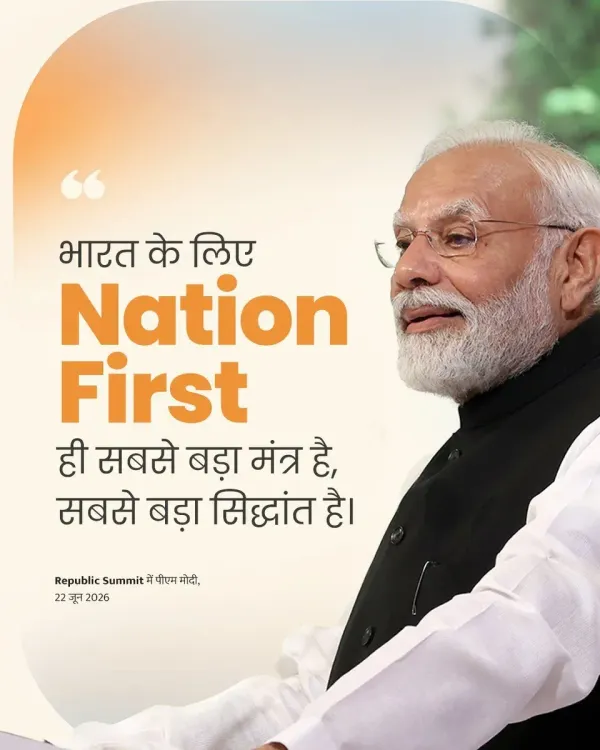
Modi described 'Nation First' as 'सबसे बड़ा मंत्र और सबसे बड़ा सिद्धांत' — the greatest mantra and greatest principle for India today.
The 'Nation First' philosophy has underpinned BJP governance since 2014 , recurring across policy, party communication, and Mann Ki Baat .
The National Education Policy 2020 institutionalises this value through civic and value-education modules targeting over 250 million students.
The upcoming monsoon session of Parliament is expected to include debate on NEP 2020 curriculum frameworks and value-education rollout.
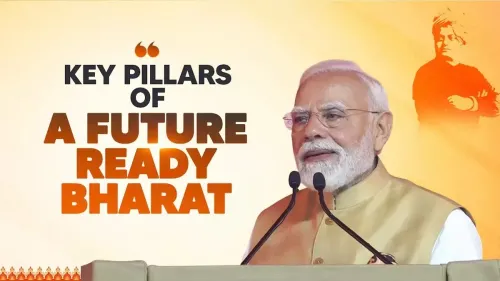
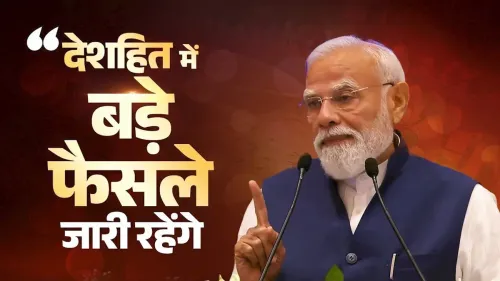
Union Education Minister Dharmendra Pradhan on Tuesday, June 23, 2026, amplified Prime Minister Narendra Modi's governing philosophy, stating that 'Nation First' is the single greatest mantra and principle for India today — attributing the sentiment directly to the Prime Minister in a post on X.
Pradhan quoted Modi in Hindi: 'आज के भारत के लिए Nation First ही सबसे बड़ा मंत्र और सबसे बड़ा सिद्धांत है' — translated: 'For India today, Nation First is the greatest mantra and the greatest principle.' The post, accompanied by an image, was shared in the early morning hours from the minister's official X account @dpradhanbjp.
Context
The phrase 'Nation First' — and its Hindi-English hybrid usage — has been a defining rhetorical pillar of the BJP-led government since Narendra Modi first articulated an 'India First' governing philosophy during his 2014 election campaign. The slogan has since recurred across ministerial addresses, party communications, and the Prime Minister's monthly radio programme Mann Ki Baat.
Pradhan's amplification of the statement places it squarely within the government's broader effort to frame all policy decisions — from foreign affairs to domestic welfare — through the lens of national interest above sectional or partisan considerations.
Policy Backdrop
The 'Nation First' philosophy has found institutional expression most visibly in the National Education Policy (NEP) 2020, which Pradhan has championed as Education Minister. The policy integrates Indian knowledge systems, civic values, and a sense of national identity into curricula at every level — from foundational schooling to higher education.
Value education modules under NEP 2020 explicitly draw on the principle that students must develop a sense of duty toward the nation. Pradhan has repeatedly linked educational reform to the broader goal of producing citizens who place national welfare at the centre of their ambitions.
Stakeholders and Impact
The primary audience for this philosophy, as articulated by both Modi and Pradhan, is India's vast student and youth population — the demographic that NEP 2020 most directly shapes. With over 250 million students enrolled across school and higher education institutions, the ideological framing embedded in curricula carries significant long-term social weight.
Political observers note that reiterating 'Nation First' at the ministerial level also serves to consolidate the BJP's core voter base, which responds strongly to nationalism as a governing value. The statement comes as the government prepares for the upcoming monsoon session of Parliament, where curriculum frameworks and NEP implementation are expected to feature in legislative discussions.
What's Next
Attention will now turn to whether Pradhan's post signals a fresh policy announcement or precedes a major address by Prime Minister Modi on education or national governance. The monsoon parliamentary session is expected to see debate on the further rollout of NEP 2020 value-education modules, and any new curriculum directives will be watched closely by educators, civil society, and opposition benches alike.
As the government continues to embed 'Nation First' as an organising principle across ministries, the Education Ministry's role in institutionalising that value through formal schooling is likely to remain a focal point of both policy and political discourse in the months ahead.
Point of View
The Education Minister signals alignment between the party's political philosophy and the formal curriculum being delivered to hundreds of millions of students. This pattern — senior ministers echoing the PM's rhetoric on governance values — has been a consistent feature of BJP communications strategy since 2014, designed to project unity of purpose across the cabinet. The timing, ahead of the monsoon session, suggests the government may be laying rhetorical groundwork for legislative or policy moves on education and national values.
NationPress
21 Sept 2026
Frequently Asked Questions
What did Dharmendra Pradhan say about 'Nation First'?
Dharmendra Pradhan quoted Prime Minister Narendra Modi on June 23, 2026, stating that 'Nation First is the greatest mantra and the greatest principle for India today.'
What is the 'Nation First' philosophy in Indian politics?
'Nation First' is a governing philosophy articulated by PM Narendra Modi since his 2014 election campaign, placing national interest above sectional considerations. It has since been embedded in BJP policy communications and formal education through NEP 2020.
How does 'Nation First' connect to NEP 2020?
The National Education Policy 2020, championed by Education Minister Dharmendra Pradhan, integrates Indian knowledge systems and civic nationalism into curricula, reflecting the 'Nation First' principle in formal education for over 250 million students.
Why did Dharmendra Pradhan post this on X?
Pradhan shared the quote to amplify Prime Minister Modi's governing philosophy on his official X account, a practice consistent with the BJP's broader strategy of reinforcing national-interest messaging across ministerial communications.
What comes next after this 'Nation First' statement?
The upcoming monsoon session of Parliament is expected to include discussions on NEP 2020 curriculum frameworks and value-education modules, where the 'Nation First' principle is likely to feature prominently in policy debate.