Tamil Nadu crop loan waiver: PMK's Ramadoss welcomes move, demands wider farm relief

Synopsis
PMK's Ramadoss welcomed Tamil Nadu's cooperative crop loan waiver — but his endorsement came with a list of demands: broader relief beyond small farmers, subsidised inputs, and fresh credit with no bureaucratic delays. The waiver covers loans up to ₹50,000, but farmers outside the cooperative network and those with larger loans get little or nothing, exposing the scheme's limits.
Key Takeaways
Ramadoss welcomed Tamil Nadu's crop loan waiver order on 26 May 2025 .
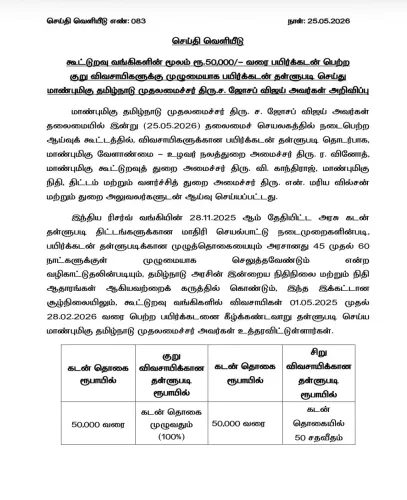
The waiver covers crop loans up to ₹50,000 availed through cooperative societies since May last year .
Farmers with loans between ₹50,000 and ₹1 lakh receive partial relief of ₹5,000 to ₹40,000 .
Ramadoss urged the state to extend partial relief to farmers beyond the small and marginal category .
He called for subsidised seeds and fertilisers through cooperatives and fresh loans for waiver beneficiaries without administrative delays.
Farmers outside the cooperative lending network remain unaffected by the current order.
Pattali Makkal Katchi (PMK) founder Dr S. Ramadoss on Tuesday, 26 May welcomed the Tamil Nadu government's decision to waive crop loans for small and marginal farmers through cooperative societies, while pressing the state for a more comprehensive relief package to address the deepening distress in the agricultural sector.
What the Waiver Covers
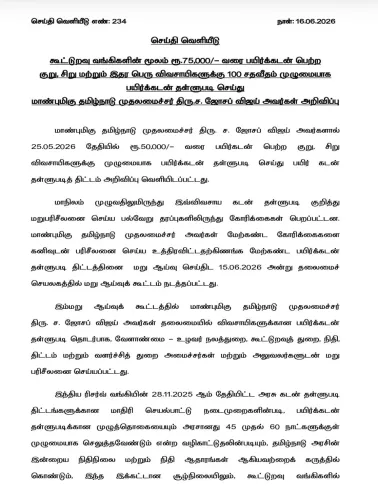
The state government's order writes off crop loans of up to ₹50,000 availed through cooperative societies since May last year. Farmers carrying loans between ₹50,000 and ₹1 lakh are eligible for partial relief ranging from ₹5,000 to ₹40,000, depending on their outstanding balance.
Ramadoss described the decision as 'a positive and much-needed step,' acknowledging that while it may not eliminate the burden on every farmer, it signals the government's intent to provide support and restore confidence to the agricultural community under difficult economic conditions.
Ramadoss's Key Demands
The PMK leader stopped well short of full endorsement, outlining a series of additional measures he wants the state to adopt. He called for subsidised agricultural inputs — seeds, fertilisers, and allied materials — to be made available through cooperative societies on a timely basis, arguing that reducing input costs is as critical as loan relief.
Ramadoss also urged the government to ensure that farmers who benefit from the waiver are immediately extended fresh crop loans through cooperative societies, so that cultivation cycles are not disrupted. He warned against administrative bottlenecks that could delay such credit access.
Additionally, he pushed for the partial relief framework to be extended beyond the small and marginal category to cover a wider section of the farming population.
The Broader Farm Crisis
Ramadoss pointed to a convergence of pressures battering Tamil Nadu's farming community: recurring natural disasters, rising production costs, and inadequate market returns for agricultural produce. This comes amid a wider national debate over farm income support, with several states rolling out loan waivers ahead of election cycles — though Tamil Nadu's move is framed as a welfare measure rather than a poll-driven one.
Notably, cooperative society-routed credit forms a significant share of formal agricultural lending in Tamil Nadu, making the waiver's channel as important as its quantum. Farmers outside the cooperative network remain unaffected by this particular order.
What the PMK Wants Next
Beyond immediate relief, Ramadoss stressed the need for sustained, farmer-friendly policies that protect livelihoods over the long term. He described agriculture as 'the backbone of Tamil Nadu' and said safeguarding it is one of the government's foremost responsibilities.
The state government has not yet responded to the PMK's expanded demands. Whether it moves toward a broader relief package — covering non-cooperative borrowers and larger loan categories — will determine how much of the farming community actually benefits from this round of intervention.
Point of View
000 — which means a large chunk of indebted farmers, particularly those who borrowed from private or nationalised banks, are left out entirely. Ramadoss's welcome is politically calibrated: praising enough to stay constructive, demanding enough to keep pressure on the DMK government. The real test is whether the state follows the waiver with the fresh credit and input subsidies Ramadoss is asking for — without those, relieved farmers may simply re-enter the debt cycle within a season. Loan waivers without structural input-cost reform have a poor track record across Indian states.
NationPress
10 Oct 2026
Frequently Asked Questions
What is the Tamil Nadu crop loan waiver announced in May 2025?
The Tamil Nadu government has ordered the write-off of crop loans up to ₹50,000 availed through cooperative societies since May last year, targeting small and marginal farmers. Farmers with loans between ₹50,000 and ₹1 lakh are eligible for partial relief ranging from ₹5,000 to ₹40,000.
Why did PMK's Ramadoss welcome the waiver but also criticise it?
Ramadoss called the waiver a positive step but noted it does not fully address the burden on all farmers. He argued the scheme must be complemented by broader relief, subsidised inputs, and fresh credit access to be truly effective for the farming community.
Who is not covered by the Tamil Nadu crop loan waiver?
Farmers who borrowed outside the cooperative society network — from nationalised or private banks — are not covered by this order. Additionally, those with loans above ₹1 lakh receive no relief under the current scheme.
What additional measures has PMK demanded from the Tamil Nadu government?
PMK has urged the state to provide subsidised seeds and fertilisers through cooperatives, extend fresh crop loans to waiver beneficiaries without administrative delays, and expand partial relief to farmers beyond the small and marginal category.
Why are Tamil Nadu farmers under financial stress?
According to Ramadoss, farmers face a combination of recurring natural disasters, rising production costs, and inadequate returns for their produce. These overlapping pressures have deepened financial distress across multiple agricultural sectors in the state.