CM Vijay announces full crop loan waiver for Tamil Nadu small farmers
Synopsis
Chief Minister C. Joseph Vijay has announced a full waiver of cooperative bank crop loans up to Rs. 50,000 for marginal farmers in Tamil Nadu, providing direct debt relief to the state's most vulnerable cultivators through the cooperative credit network.
Key Takeaways
Joseph Vijay announced a complete crop loan waiver for marginal farmers in Tamil Nadu on 25 May 2026 .
The waiver covers crop loans up to Rs.
50,000 taken through cooperative banks .
Only small and marginal farmers ('குறு விவசாயிகள்') who borrowed via the cooperative banking channel are eligible.
Tamil Nadu has a precedent for this measure, with a similar waiver announced in 2016 under the same Rs.
The Registrar of Cooperative Societies is expected to issue operational guidelines on account crediting and eligibility verification.
State budget allocation and disbursement timelines remain to be formally announced.
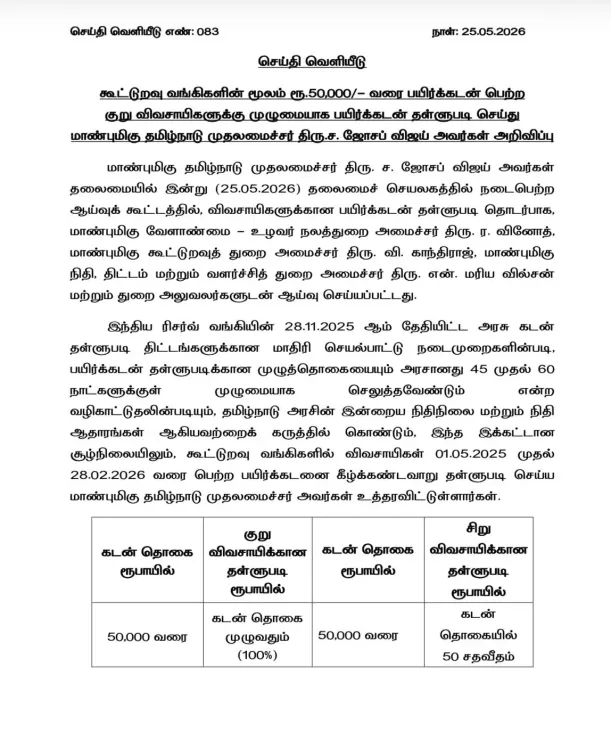
The Chief Minister's Office of Tamil Nadu announced on Monday, 25 May 2026 that Chief Minister C. Joseph Vijay has declared a complete waiver of crop loans up to Rs. 50,000 for marginal farmers who borrowed through cooperative banks in the state.
Context
The announcement, shared in Tamil, states that 'குறு விவசாயிகளுக்கு முழுமையாக பயிர்க்கடன் தள்ளுபடி' — a 'complete crop loan waiver for marginal farmers' — will cover all borrowers who took crop loans of up to Rs. 50,000 through cooperative banks. The relief applies specifically to small and marginal cultivators, who form the backbone of Tamil Nadu's agrarian economy.
Cooperative banks in the state have long served as the primary channel for short-term agricultural credit to smallholders, making them the natural conduit for implementing such debt-relief measures.
Policy Backdrop
Agricultural loan waivers are a recurring instrument of agrarian policy in Tamil Nadu. A comparable waiver covering cooperative and commercial-bank crop loans up to Rs. 50,000 for small farmers was announced in 2016, establishing a precedent for using the cooperative credit structure as the implementation backbone.
At the central level, an interest-subvention scheme for short-term crop loans has been operational since 2006-07, reducing the effective interest burden for farmers borrowing through cooperatives. State-level waivers build on this architecture by eliminating the principal liability entirely for eligible borrowers.
Such measures typically coincide with fiscal-year budget cycles or pre-harvest periods when farmer indebtedness peaks due to input costs and weather-related uncertainty.
Stakeholders and Impact
Tamil Nadu has a large population of marginal cultivators — those owning less than one hectare of land — who depend almost entirely on cooperative bank credit for seasonal farming inputs such as seeds, fertilisers, and irrigation. A full waiver on loans up to Rs. 50,000 directly eliminates the outstanding liability for this segment.
Cooperative banks, which carry these loans on their books, will look to the state government for reimbursement through a budgetary allocation. The schedule for crediting individual accounts and any supplementary eligibility norms are expected to be issued by the Registrar of Cooperative Societies.
What's Next
The state government is expected to announce a specific budgetary provision to fund the waiver, along with an operational timeline for account-level credit. Farmers and cooperative bank branches will await formal circulars detailing the verification process, cut-off dates for eligible loans, and the disbursement mechanism.
How swiftly the relief reaches accounts — and whether the waiver is extended to loans above Rs. 50,000 in subsequent phases — will determine its broader impact on rural credit health and farmer sentiment across Tamil Nadu.
Point of View
A constituency that carries significant electoral weight in the state. By capping the waiver at Rs. 50,000, the government limits fiscal exposure while covering the vast majority of small-farmer loan accounts, which rarely exceed that threshold. The move fits a broader pan-Indian pattern of state governments deploying loan waivers as both a welfare instrument and a political signal ahead of or during budget seasons. The real test will be the speed and completeness of implementation — past waivers in Tamil Nadu have faced delays in account-level crediting that diluted their on-ground impact.
NationPress
24 Sept 2026
Frequently Asked Questions
Who is eligible for the Tamil Nadu crop loan waiver announced by CM Vijay?
Marginal and small farmers ('குறு விவசாயிகள்') who took crop loans of up to Rs. 50,000 through cooperative banks in Tamil Nadu are eligible for the complete waiver announced by Chief Minister C. Joseph Vijay.
What is the maximum loan amount covered under the Tamil Nadu crop loan waiver 2026?
The waiver covers crop loans up to Rs. 50,000. Loans above this ceiling are not included in the current announcement.
Through which banks will the Tamil Nadu crop loan waiver be implemented?
The waiver applies specifically to loans taken through cooperative banks, which are the primary source of short-term agricultural credit for small farmers in Tamil Nadu.
Has Tamil Nadu announced a crop loan waiver before?
Yes. A comparable crop loan waiver covering loans up to Rs. 50,000 for small farmers through cooperative and commercial banks was announced in 2016, establishing a policy precedent.
When will the crop loan waiver amount be credited to farmers' accounts?
The government has not yet announced a specific disbursement date. Operational guidelines on the crediting schedule and eligibility verification are expected from the Registrar of Cooperative Societies.