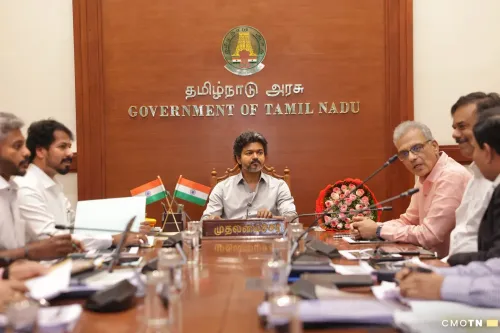
CM Joseph Vijay Announces Full Crop Loan Waiver Up to Rs 75,000

Synopsis
Tamil Nadu Chief Minister C. Joseph Vijay has announced a complete 100 per cent waiver of crop loans up to Rs 75,000 availed by marginal, small, and other farmers through cooperative banks, offering direct debt relief to the state's most vulnerable agricultural communities.
Key Takeaways
Joseph Vijay announced a 100 per cent crop loan waiver on 16 June 2026 .
The waiver covers loans up to Rs 75,000 taken through cooperative banks in Tamil Nadu.
Beneficiaries include marginal, small, and other farmers across the state.
The waiver is described as complete, with no residual liability left on the farmer.
Cooperative banks are expected to be reimbursed by the state government from the budget.
Budgetary allocation details and implementation timelines are yet to be announced.
The Chief Minister's Office of Tamil Nadu announced on Tuesday, 16 June 2026 that Chief Minister C. Joseph Vijay has declared a 100 per cent crop loan waiver for marginal, small, and other farmers who availed loans up to Rs 75,000 through cooperative banks in the state.
Context
The announcement, shared on the official CMO Tamil Nadu account, states in Tamil: crop loans taken through cooperative banks up to Rs 75,000 will be completely waived for குறு, சிறு மற்றும் இதர பெரு விவசாயிகள் (marginal, small, and other large farmers). The waiver is described as 100 per cent and complete in its scope, leaving no residual liability on the beneficiary farmers.
The announcement covers loans disbursed through Tamil Nadu's network of cooperative banks, which serve as the primary institutional credit channel for rural and agrarian communities across the state.
Policy Backdrop
Tamil Nadu has a long-standing tradition of using cooperative credit institutions to extend agricultural finance to small and marginal farmers. These banks operate under state oversight and are a key conduit for crop loan disbursement, particularly to farmers who may lack access to commercial banking infrastructure.
State governments across India have periodically announced crop loan waivers as a tool to relieve rural indebtedness, restore the credit-worthiness of distressed farmers, and sustain the flow of institutional credit in agrarian economies. Such waivers are typically funded from state budgets, with the government reimbursing cooperative banks for the written-off amounts.
Stakeholders and Impact
The primary beneficiaries are marginal and small farmers — those with the least landholding and the highest vulnerability to crop failure and debt cycles. By setting the ceiling at Rs 75,000, the scheme targets the segment of the farming population most dependent on cooperative credit rather than commercial bank loans.
Cooperative banks themselves stand to be reimbursed by the state government, ensuring their balance sheets are not permanently impaired. The relief is expected to free beneficiary farmers from outstanding dues, enabling them to access fresh crop credit for the next agricultural season.
What's Next
Key details that will follow include the budgetary allocation set aside to fund the waiver, the timeline for reimbursing cooperative banks, and the administrative mechanism for identifying and notifying eligible farmers. The government is expected to issue detailed implementation guidelines specifying the documentation process for farmers to claim the benefit.
The waiver's rollout will be closely watched by agricultural economists and rural credit institutions, as its execution will determine whether it successfully revives credit demand among small farmers ahead of the next sowing season.
Point of View
000 through cooperative banks is a targeted intervention designed to reach the deepest layer of Tamil Nadu's agrarian distress — farmers too small to access commercial credit but too indebted to borrow afresh. The move follows a well-worn playbook of state-level debt relief that has recurred across Indian states, typically deployed ahead of electoral cycles or in response to agrarian stress signals. The real test will be in execution: whether reimbursement to cooperative banks is timely enough to prevent a credit freeze, and whether the waiver translates into renewed borrowing and higher farm investment rather than a one-time balance-sheet adjustment. The announcement reinforces the pattern of Tamil Nadu using its cooperative banking network as a primary welfare delivery channel for rural communities.
NationPress
26 Sept 2026
Frequently Asked Questions
Who is eligible for the Tamil Nadu crop loan waiver announced by CM Joseph Vijay?
Marginal, small, and other farmers who have taken crop loans of up to Rs 75,000 through cooperative banks in Tamil Nadu are eligible for the 100 per cent waiver announced by Chief Minister C. Joseph Vijay.
What is the maximum loan amount covered under the Tamil Nadu crop loan waiver 2026?
The waiver covers crop loans up to Rs 75,000 taken through cooperative banks. Loans above this ceiling are not covered under this announcement.
Will the cooperative banks in Tamil Nadu be compensated for the waived loans?
State governments typically reimburse cooperative banks from the state budget when a loan waiver is declared, though the specific allocation and timeline for Tamil Nadu's 2026 waiver are yet to be officially detailed.
How does the Tamil Nadu crop loan waiver help farmers?
The waiver eliminates outstanding crop loan dues for eligible farmers, restoring their credit eligibility so they can access fresh institutional loans for the next agricultural season without the burden of prior debt.
What are cooperative banks and why are they important for Tamil Nadu farmers?
Cooperative banks are state-supported financial institutions that provide agricultural credit to rural communities, often serving small and marginal farmers who have limited access to commercial banking services.