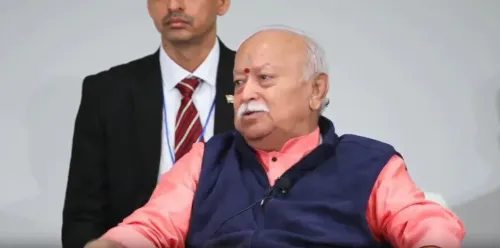
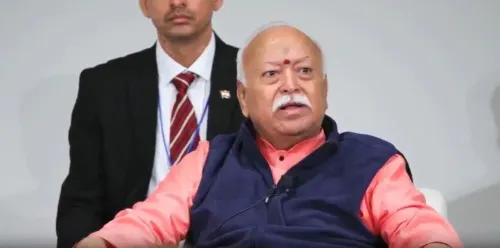
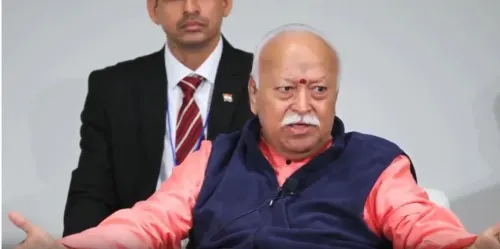
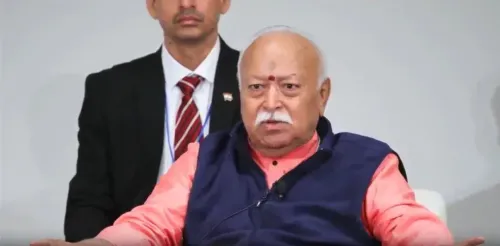
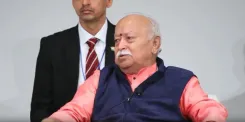
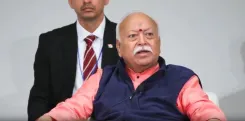
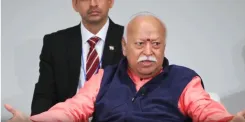
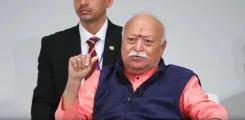
RSS Chief Bhagwat in New York: Practice, not knowledge, unites humanity
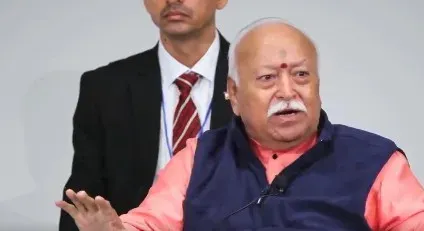
Synopsis
At a New York interfaith event, RSS Chief Mohan Bhagwat made a pointed distinction: the world doesn't lack wisdom about peace — it lacks the daily practice to live by it. Invoking Ramakrishna Paramahamsa's cross-faith spiritual experiments and his own struggle with a diabetic's sweet tooth, Bhagwat delivered a message that cuts across ideological lines: habit, not intellect, is what shapes humanity.
Key Takeaways
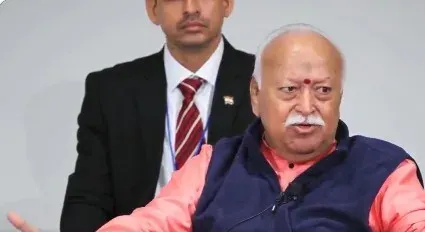
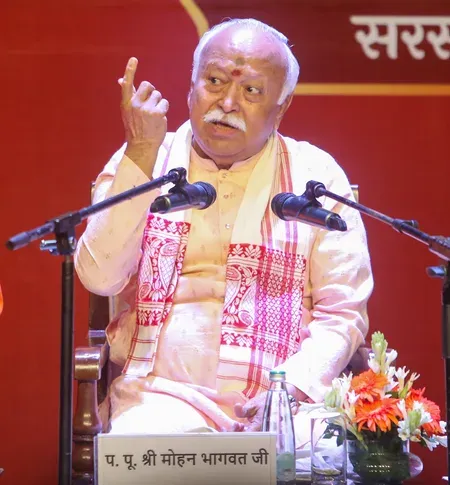
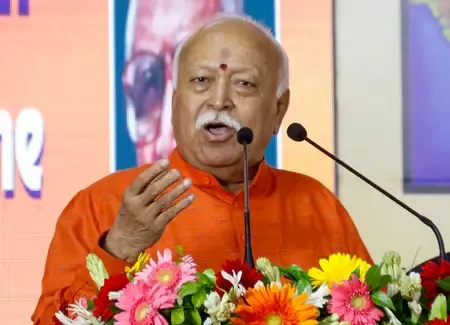
RSS Chief Mohan Bhagwat spoke at the 'One World, One Humanity' programme in New York on 30 August .
He argued that every tradition already holds the knowledge for peace — the challenge is converting that knowledge into sustained daily practice.
Bhagwat cited Ramakrishna Paramahamsa's practice of multiple faiths — including Islam and Christianity — as evidence that all paths lead to the same spiritual destination.
He referenced philosopher R.D.
Ranade's documented research showing strikingly similar mystical experiences across different religious traditions.
The RSS , founded in Nagpur in 1925 , marked its centenary in 2025 ; Bhagwat has led the organisation since 2009 .
Rashtriya Swayamsevak Sangh (RSS) Chief Mohan Bhagwat on 30 August argued that knowledge alone is insufficient to bridge religious and social divides, calling on people and religious leaders worldwide to embed service, love, and respect into daily practice. He was speaking at the 'One World, One Humanity' programme in New York.
The Core Argument
Bhagwat contended that every major tradition across the world already holds the wisdom needed to foster peace and unity. The gap, he said, lies not in what people know but in what they consistently do. 'The problem is not knowledge of human beings,' he told the gathering. 'In our knowledge, traditional knowledge, all over the world, every society in its tradition has this knowledge somewhere.'
He pressed further: 'But now we have to create a situation wherein this knowledge prevails. And this knowledge rules the human behaviour. Knowledge of goodness. Knowledge of love. That we have to do.'
Why Knowledge Alone Falls Short
To illustrate the gap between knowing and doing, the RSS chief drew on a personal example — his own diabetes. He acknowledged that despite knowing he should avoid sugar, he still found reasons to consume sweets. 'I know everything,' he said. 'But still, when that comes, I say, oh, once I find it, it is all right. I find excuses. I do it.'
He argued that human beings behave similarly with moral and spiritual guidance — they recognise the right message from religious teachers but yield to habit, temptation, and the pull of material gain. 'This is a matter not of educating them, intellect twice,' Bhagwat said. 'We have to instill the practice.'
Role of Ritual and Interfaith Practice
Bhagwat pointed to religious rituals as vehicles for building habits of generosity. 'Rituals of all religions teach the practice of giving,' he said. He cited Ramakrishna Paramahamsa — the 19th-century mystic and spiritual teacher of Swami Vivekananda — who reportedly practised multiple faiths, including Islam and Christianity, and concluded that all paths lead to the same destination.
'He practiced all the religions — those of Bharatiya origin and also Islam and Christianity,' Bhagwat said, adding that Ramakrishna's finding was 'not theory. Real experience.'
He also referenced philosopher and academic R.D. Ranade, who studied mystical traditions across faiths and cultures and documented strikingly similar spiritual experiences across different paths.
The Call to Religious Leaders
Bhagwat urged religious leaders to persist in their work even when visible progress is slow, warning that abandoning the effort could allow humanity to revert to conflict. He called for a radical reshaping of personal habit — strong enough to resist what he described as the lure of material happiness, influence, and superiority.
'Habit should be changed so radically and new habit should be so strong that it should fight this deflection of the lure of material happiness,' he said.
Context and Background
The Ramakrishna movement traces its spiritual roots to Ramakrishna Paramahamsa, whose teachings shaped Swami Vivekananda's landmark 1893 address in Chicago, which introduced Vedanta and yoga to a wider Western audience. Mohan Bhagwat has led the RSS since 2009; the organisation was founded in Nagpur in 1925 and marked its centenary in 2025. His New York address comes as interfaith dialogue gains renewed urgency amid rising global polarisation.
Point of View
He positions the RSS's civilisational outlook as universalist rather than sectarian, a framing that plays differently abroad than it does at home. The diabetes metaphor is disarming and effective, but the harder question — how the RSS itself institutionalises the 'practice' of pluralism within India — goes unaddressed. Speeches at interfaith forums are easy; the credibility test is conduct in domestic politics.
NationPress
30 Aug 2026
Frequently Asked Questions
What did RSS Chief Mohan Bhagwat say in New York?
Bhagwat said that knowledge alone cannot overcome religious and social divisions — what is needed is sustained practice that makes service, love, and respect habitual. He spoke at the 'One World, One Humanity' programme in New York on 30 August.
Why did Bhagwat invoke Ramakrishna Paramahamsa in his speech?
Bhagwat cited Ramakrishna Paramahamsa as an example of someone who did not merely study multiple faiths — including Islam and Christianity — but actually practised them, concluding from lived experience that all paths lead to the same spiritual goal. He used this to argue that unity requires practice, not just intellectual understanding.
What role did Bhagwat say rituals play in building unity?
Bhagwat argued that religious rituals across all faiths teach the habit of giving, and that this shared practice of generosity can serve as a foundation for human unity. He said instilling such habits is more effective than intellectual education alone.
Who is R.D. Ranade and why did Bhagwat mention him?
R.D. Ranade was a philosopher and academic who studied mystical traditions across different faiths and cultures, documenting that spiritual experiences across paths are 'strikingly similar.' Bhagwat cited his documented research to support the argument that different religions converge at the level of lived experience.
What is the RSS and how long has Bhagwat led it?
The Rashtriya Swayamsevak Sangh (RSS) is a Hindu nationalist volunteer organisation founded in Nagpur in 1925; it marked its centenary in 2025. Mohan Bhagwat has served as its chief since 2009.