Pradhan: Cabinet clears NIPU-2026 to boost domestic urea output
Synopsis
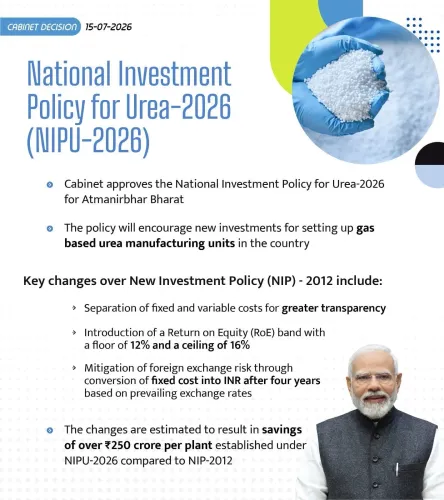
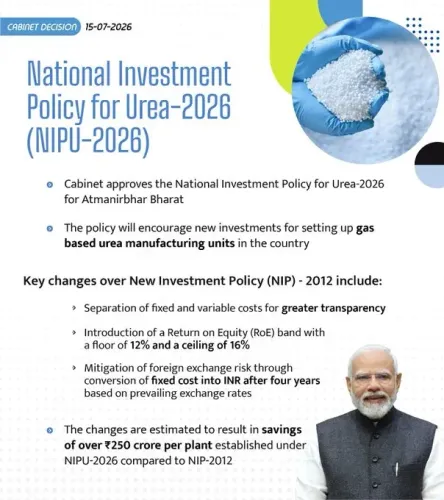
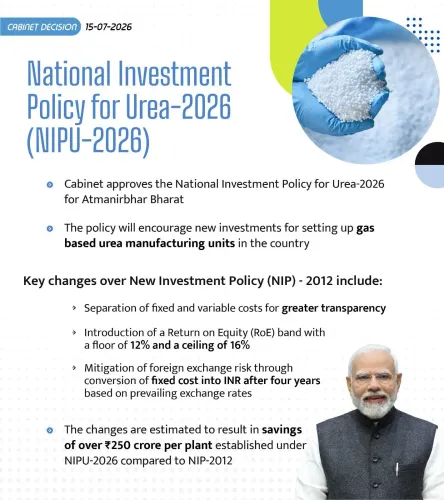
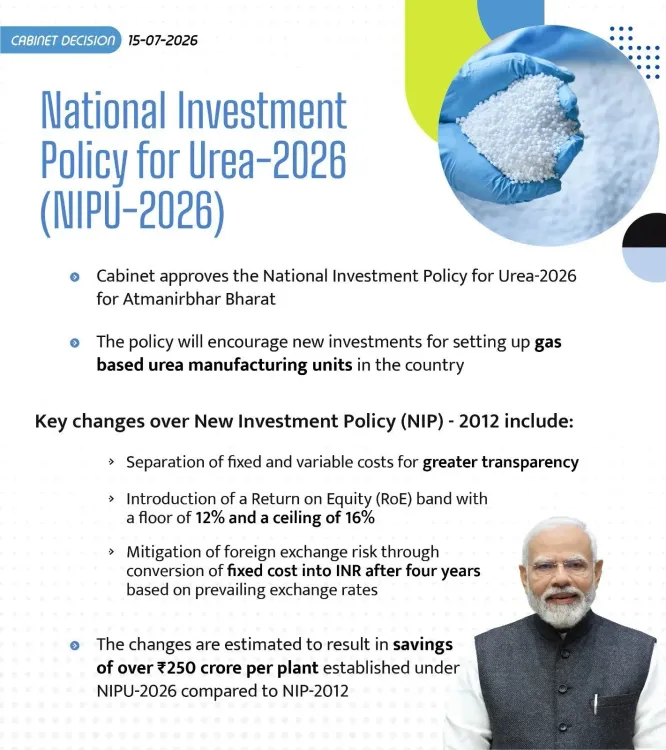
The Cabinet Committee on Economic Affairs, chaired by PM Narendra Modi, approved the National Investment Policy for Urea-2026 on 15 July 2026. The framework targets new gas-based urea plants, aims to cut import dependence, and promises savings exceeding ₹250 crore per plant — a major step in India's Aatmanirbhar Bharat agenda.
Key Takeaways
The Cabinet Committee on Economic Affairs , chaired by PM Narendra Modi , approved NIPU-2026 on 15 July 2026 .
The policy facilitates new gas-based urea plants and introduces a transparent, investor-friendly investment framework.
Estimated savings of over ₹250 crore are projected for every new plant established under the policy.
India currently imports roughly 30–40 per cent of its urea, exposing agriculture to global price volatility.
NIPU-2026 extends a policy lineage that includes the New Urea Policy 2015 and the revival of five closed public-sector plants approved in 2016.
The decision is positioned as a cornerstone of the Aatmanirbhar Bharat self-reliance initiative in agriculture inputs.
Union Education Minister Dharmendra Pradhan on Wednesday, 15 July 2026 announced that the Cabinet Committee on Economic Affairs (CCEA), chaired by Prime Minister Narendra Modi, has approved the National Investment Policy for Urea-2026 (NIPU-2026) — a framework designed to attract fresh private investment into domestic urea manufacturing and reduce India's dependence on imported fertiliser.
Context
Pradhan, a former Union Petroleum Minister with long-standing involvement in energy and agriculture-input policy, shared the Cabinet decision on X, calling it 'a decisive push to strengthen India's fertiliser security.' He noted that the policy would 'facilitate new gas-based urea plants, reduce import dependence, introduce a transparent and investor-friendly framework,' and deliver 'estimated savings of over ₹250 crore for every new plant established under the policy.'
The announcement is framed squarely within the Aatmanirbhar Bharat self-reliance initiative, which since its 2020 launch has sought to build domestic capacity across strategic sectors, including agriculture inputs.
Policy Backdrop
India imports roughly 30–40 per cent of its urea requirements, leaving the farm sector exposed to global price swings and foreign-exchange pressure. The government has pursued import substitution through successive policy instruments: the New Urea Policy 2015 introduced a uniform feedstock price for gas-based units, and in 2016 the Cabinet approved the revival of five closed public-sector urea plants at Gorakhpur, Barauni, Sindri, Talcher and Ramagundam.
The 2020 Aatmanirbhar Bharat package extended additional support for domestic fertiliser capacity, and revisions to the Nutrient Based Subsidy scheme in 2022 further incentivised indigenous urea production. NIPU-2026 is presented as the next step in this multi-year arc, specifically targeting new gas-based greenfield investments linked to the expanding national gas grid.
Stakeholders and Impact
Indian farmers stand to benefit most directly: a stable, domestically produced urea supply can insulate agriculture from the volatility that characterised global fertiliser markets during the 2021–22 commodity shock, when prices surged following supply disruptions in Europe and West Asia. The government's subsidy outgo — one of the largest line items in the Union Budget — is also expected to ease as import volumes decline.
For fertiliser manufacturers and potential investors, the policy's promise of a transparent, investor-friendly framework addresses long-standing concerns about pricing unpredictability and regulatory clarity. Gas-based plants are particularly relevant given India's expanding pipeline infrastructure, which lowers feedstock logistics costs compared with older naphtha-based facilities.
What's Next
The immediate watch-points include Cabinet notifications detailing eligible plant locations, competitive bidding timelines, and any revisions to subsidy outgo projections in the next Union Budget. Industry bodies representing fertiliser producers are expected to engage with the Ministry of Chemicals and Fertilisers on implementation guidelines in the weeks ahead.
If new greenfield gas-based plants are commissioned at scale under NIPU-2026, the policy could meaningfully shift India's urea import dependency ratio — a metric that successive governments have targeted but found difficult to move decisively.
Point of View
The Cabinet is signalling to private capital that the investment climate has been de-risked. Dharmendra Pradhan's role as the public face of the announcement is notable: as a former Petroleum Minister, he bridges the energy-feedstock and agriculture-input dimensions of the policy, lending it credibility beyond the education brief he currently holds. The real test will be whether the 'transparent and investor-friendly framework' translates into actual greenfield capacity before the next election cycle.
NationPress
16 Jul 2026
Frequently Asked Questions
Why does India need a new urea policy?
India imports roughly 30–40 per cent of its urea, making the farm sector vulnerable to global price volatility and increasing the government's subsidy burden. NIPU-2026 aims to build domestic production capacity through new gas-based plants linked to the national gas grid.
How much money will the government save under NIPU-2026?
According to the Cabinet announcement, savings of over ₹250 crore are estimated for every new urea plant established under the policy, though the precise mechanism will be detailed in implementation guidelines.
What is the connection between NIPU-2026 and Aatmanirbhar Bharat?
Aatmanirbhar Bharat, launched in 2020, is the Modi government's self-reliance initiative covering strategic sectors including agriculture inputs. NIPU-2026 is framed as part of this initiative, aiming to reduce dependence on imported urea and strengthen domestic fertiliser security.
What are gas-based urea plants and why do they matter?
Gas-based urea plants use natural gas as feedstock, which is cleaner and increasingly cost-competitive as India's pipeline network expands. The government has prioritised them since the New Urea Policy 2015 because they are more efficient than older naphtha-based facilities and better suited to India's growing gas infrastructure.