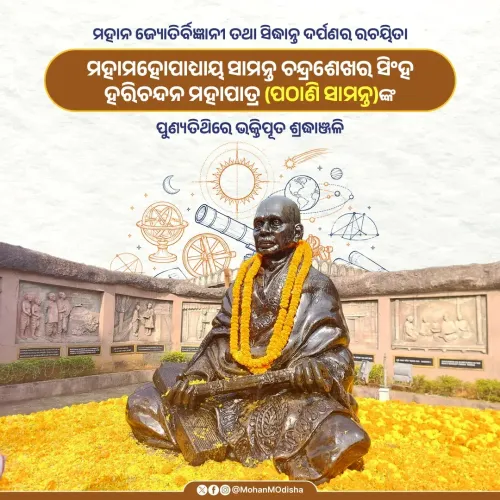
Pradhan pays tribute to astronomer Pathani Samanta on death anniversary
Synopsis
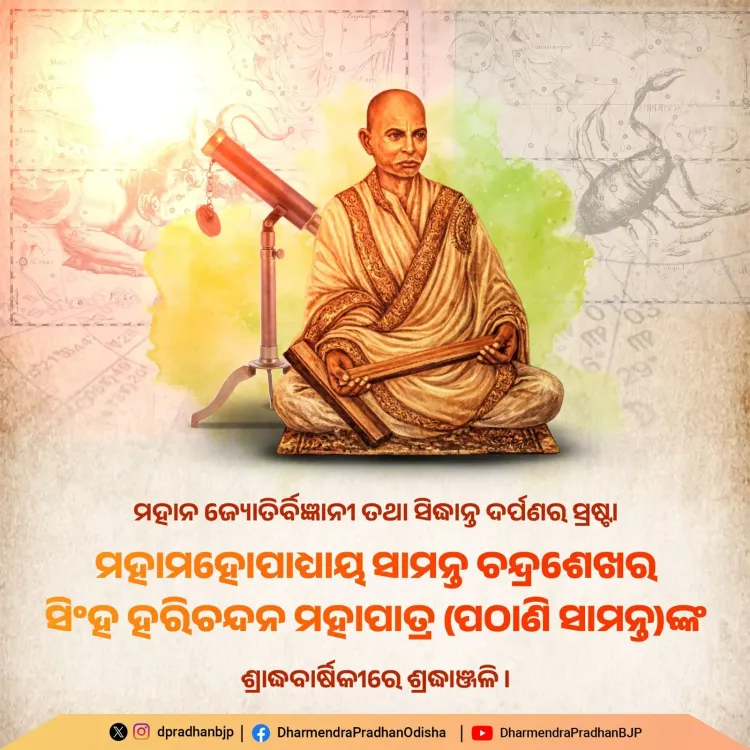
Union Education Minister Dharmendra Pradhan on June 11, 2026, paid tribute to 19th-century Odia astronomer Pathani Samanta on his death anniversary, honouring the creator of the Siddhanta Darpana and his pioneering contributions to Indian astronomical science.
Key Takeaways
Union Education Minister Dharmendra Pradhan posted a tribute in Odia on June 11, 2026 , marking the death anniversary of astronomer Pathani Samanta .
Pathani Samanta (1835–1904), born in Khandapada, Odisha , authored the Siddhanta Darpana , calculating planetary positions using traditional methods and no modern instruments.
He was awarded the title Mahamahopadhyaya , the highest academic honour of his era, by the colonial establishment.
Odisha instituted the Samanta Chandrasekhar Award in 1984 to honour scientific contributions in his memory.
The tribute aligns with the National Education Policy 's emphasis on integrating traditional Indian knowledge systems into mainstream education.
Pradhan, a senior BJP leader from Odisha, regularly marks regional scientific figures' anniversaries as part of a broader cultural outreach pattern.
Union Education Minister Dharmendra Pradhan on Thursday, June 11, 2026, paid homage to the 19th-century Odia astronomer Mahamahopadhyaya Samanta Chandrasekhar Singh Harichandan Mahapatra, widely known as Pathani Samanta, on his death anniversary, honouring the scholar's enduring contribution to Indian astronomy.
Posting in Odia on X, Pradhan offered shraddhanjali (reverential tribute) to the great astronomer and creator of the Siddhanta Darpana, describing him as a 'great astronomer and creator of the Siddhanta Darpana' — a landmark treatise on planetary calculations composed using traditional instruments without the aid of modern telescopes.
Context
Pathani Samanta was born in 1835 in Khandapada, Odisha, and passed away in 1904. Despite having no access to modern scientific instruments, he spent decades making naked-eye astronomical observations and produced the Siddhanta Darpana, a Sanskrit text that accurately calculated planetary positions using classical Indian methods. His work was recognised by the colonial scientific establishment of his time and earned him the title Mahamahopadhyaya, the highest academic honour of the era.
Pradhan, a senior BJP leader from Odisha who previously served as Union Petroleum Minister before taking charge of the Education Ministry, regularly marks the anniversaries of pre-modern regional scientists and scholars on social media, situating their legacy within the broader national conversation on India's indigenous knowledge systems.
Policy Backdrop
Odisha has commemorated Pathani Samanta's contributions since the 1950s, with memorials established at Khandapara and the Samanta Chandrasekhar Award instituted in 1984 to recognise outstanding contributions in science. His work has featured in state school curricula for decades, making him a familiar figure in Odia educational heritage.
At the national level, the National Education Policy (NEP) has placed renewed emphasis on documenting and integrating traditional Indian knowledge systems — including astronomy, mathematics, and medicine — into mainstream education. Figures such as Pathani Samanta represent precisely the kind of regional scientific legacy that this policy thrust seeks to elevate.
Stakeholders and Impact
For Odia students and heritage researchers, tributes from a Union Minister of Pradhan's stature amplify awareness of Pathani Samanta's work beyond Odisha's borders. Such acknowledgements, particularly from the Education Ministry, carry symbolic weight in signalling which historical figures may receive greater attention in national curricula and public science outreach.
Central ministers from Odisha have made a consistent practice of marking death and birth anniversaries of pre-modern scientists from the region via social media, a pattern that reinforces the political and cultural importance of regional identity within the national BJP framework.
What's Next
Observers of education policy will watch whether Pathani Samanta receives expanded coverage in forthcoming NCERT textbook revisions or features in astronomy outreach programmes tied to the NEP's traditional knowledge mandate. Odisha's state government and scientific institutions may also use the anniversary as an occasion to announce fresh commemorative or educational initiatives in his name. The continued visibility of figures like Pathani Samanta in ministerial communication underscores the growing institutional effort to bring India's pre-colonial scientific heritage into the national mainstream.
Point of View
Such acknowledgements carry policy undertones — they signal which historical figures could be foregrounded in NCERT revisions or NEP-linked science outreach. The gesture also serves a dual purpose: reinforcing Odia cultural pride while aligning with the Centre's broader agenda of documenting India's indigenous knowledge heritage. Whether these social media tributes translate into substantive curricular changes remains the key question for education watchers.
NationPress
25 Oct 2026
Frequently Asked Questions
Who was Pathani Samanta?
Pathani Samanta (1835–1904), full name Mahamahopadhyaya Samanta Chandrasekhar Singh Harichandan Mahapatra, was a pioneering Odia astronomer from Khandapada, Odisha, who authored the Siddhanta Darpana — a Sanskrit treatise on planetary calculations using traditional naked-eye observation methods.
What is the Siddhanta Darpana?
The Siddhanta Darpana is a classical Sanskrit astronomical text authored by Pathani Samanta that accurately calculated planetary positions and motions using traditional Indian methods, without the use of modern telescopes or instruments.
Why did Dharmendra Pradhan pay tribute to Pathani Samanta?
Pradhan paid tribute on Pathani Samanta's death anniversary, June 11, 2026, as part of his regular practice of honouring regional scientists and scholars from Odisha, and in line with the Education Ministry's focus on India's indigenous knowledge systems under the National Education Policy.
What awards or honours are associated with Pathani Samanta?
Pathani Samanta was awarded the title Mahamahopadhyaya by the colonial establishment. Odisha instituted the Samanta Chandrasekhar Award in 1984 to honour outstanding contributions in science in his memory, and memorials to him exist at Khandapara.
Is Pathani Samanta included in Indian school curricula?
Pathani Samanta has featured in Odisha state school curricula for decades. At the national level, the NEP's emphasis on traditional Indian knowledge systems has raised the possibility of expanded coverage of figures like him in future NCERT textbooks, though no confirmed revision has been announced.