Pradhan Pays Tribute to APJ Abdul Kalam on Death Anniversary
Synopsis
Union Education Minister Dharmendra Pradhan marked the death anniversary of Bharat Ratna Dr. APJ Abdul Kalam on 27 July 2026, honouring him as the People's President and linking his legacy of education and innovation to India's Viksit Bharat development vision.
Key Takeaways
Dharmendra Pradhan , Union Education Minister, paid tribute to Dr.
APJ Abdul Kalam on his death anniversary, 27 July 2026 .
Kalam served as India's 11th President (2002–2007) and was a pioneering aerospace scientist at ISRO and DRDO .
He was awarded the Bharat Ratna in 1997 , India's highest civilian honour.
Pradhan linked Kalam's legacy of education and innovation to the Viksit Bharat vision of a developed India.
The tribute reflects the government's broader effort to align NEP 2020 with Kalam's philosophy of curiosity-driven, innovation-focused learning.
Annual observances of Kalam's anniversary consistently reinforce government messaging on science, technology, and youth empowerment.
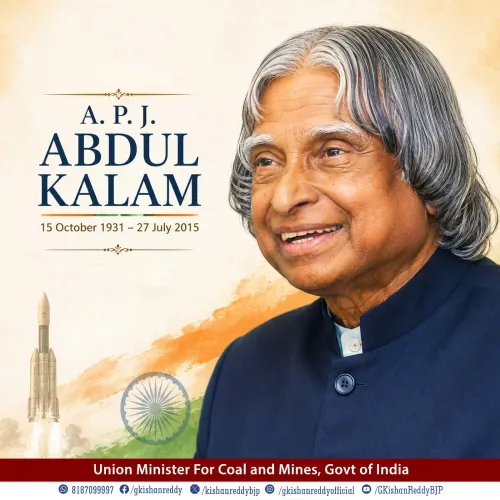
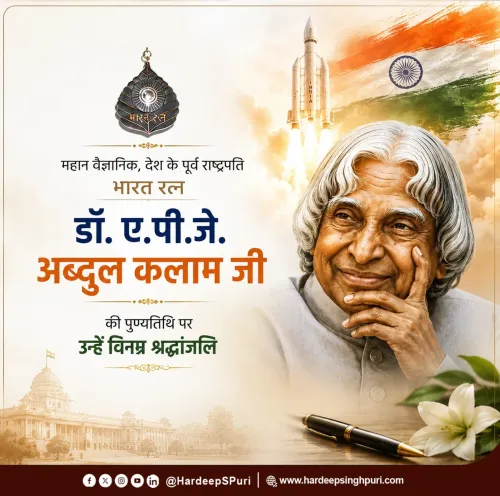
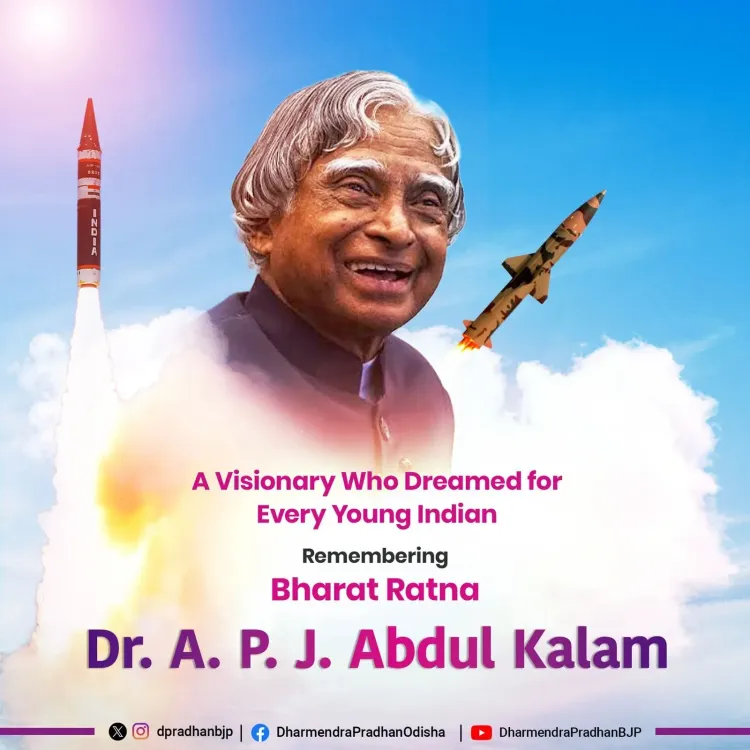
Union Education Minister Dharmendra Pradhan on Monday, 27 July 2026 paid tribute to former President and Bharat Ratna awardee Dr. A.P.J. Abdul Kalam on his death anniversary, honouring him as the 'People's President,' an eminent scientist, and an extraordinary teacher whose belief in education and youth continues to shape India's development journey.
Context
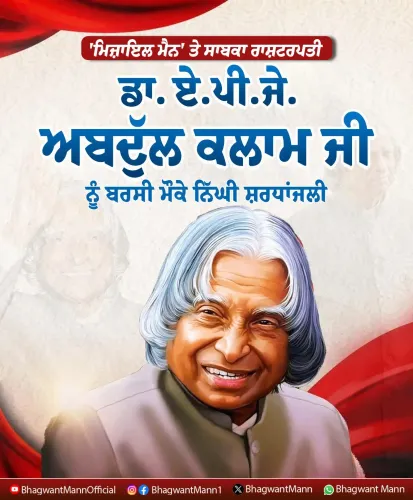
Dr. A.P.J. Abdul Kalam passed away on 27 July 2015, and the date is observed each year as a moment of national reflection on his enduring legacy. Pradhan's post described Kalam's 'unwavering belief in the power of education, innovation and youth' as a continuing light on India's path toward becoming a developed nation. The tribute was accompanied by an image shared on the minister's official X account.
Kalam served as the 11th President of India from 2002 to 2007 and was widely celebrated for his work as an aerospace scientist at ISRO and DRDO before assuming the country's highest constitutional office. He received the Bharat Ratna, India's highest civilian honour, in 1997.
Policy Backdrop
The tribute carries added resonance coming from the Education Ministry, which has positioned the National Education Policy (NEP) 2020 as a structural embodiment of Kalam's vision — centred on multidisciplinary learning, innovation, and skill development. NEP 2020 has sought to reorient India's education architecture away from rote learning toward applied, curiosity-driven inquiry, a philosophy Kalam championed through decades of public engagement with students and young scientists.
Annual observances of Kalam's death anniversary have consistently served as occasions for the government to reinforce its messaging around science, technology, and youth empowerment. Pradhan's framing — linking Kalam's legacy to the goal of a 'developed nation' — aligns with the official Viksit Bharat narrative that anchors India's long-term policy agenda through 2047.
Stakeholders and Impact
Kalam's legacy resonates most directly with students, educators, and young scientists across India, for whom he remains a symbol of possibility — a child of modest means from Rameswaram, Tamil Nadu, who rose to lead both the nation's space and missile programmes and its constitutional presidency. His books, public lectures, and interactions with schoolchildren have made him one of the most cited inspirational figures in Indian public life.
For the Education Ministry, invoking Kalam on this date is also a signal to the broader academic and scientific community that the policy direction on innovation and youth development retains its ideological moorings. Educators and institutions implementing NEP 2020 reforms are the immediate audience for such ministerial statements.
What's Next
Observers will watch for any concrete announcements tied to Kalam's anniversary — such as new innovation fellowships, science outreach programmes, or school-level initiatives — that translate ministerial tribute into policy action. Progress on the full rollout of NEP 2020, including innovation hubs in higher education institutions and updated school curricula, remains a key benchmark against which the government's stated commitment to Kalam's vision will be measured. Parliamentary and ministerial statements in the coming weeks may further elaborate on education reform priorities for the academic year ahead.
Point of View
The government signals ideological continuity between a beloved national icon and its own reform agenda. The explicit reference to a 'developed nation' is a deliberate echo of the Viksit Bharat 2047 framework, tethering Kalam's apolitical legacy to a ruling-party policy narrative. Such annual observances function as soft-power moments for the Education Ministry, reinforcing NEP 2020's innovation and youth pillars without requiring a new policy announcement. The pattern is consistent and calculated: national icons become anchors for policy legitimacy.
NationPress
25 Oct 2026
Frequently Asked Questions
When did APJ Abdul Kalam pass away?
Dr. APJ Abdul Kalam passed away on 27 July 2015 while delivering a lecture at the Indian Institute of Management, Shillong . His death anniversary is observed each year as a day of national tribute.
Why is Dharmendra Pradhan paying tribute to APJ Abdul Kalam?
As Union Education Minister , Pradhan paid tribute on Kalam's death anniversary to honour his legacy as a scientist, educator and former President, and to reinforce the government's commitment to education and innovation as pillars of national development.
What is APJ Abdul Kalam's connection to education?
Dr. Kalam was a passionate advocate for education throughout his life, regularly engaging with students and teachers. He believed education and scientific temper were the foundations of India's progress, a philosophy that continues to influence national education policy.
What is the Viksit Bharat vision mentioned in Pradhan's tribute?
Viksit Bharat is the Indian government's long-term vision to make India a fully developed nation by 2047 , the centenary of independence. Education, innovation and youth empowerment are central pillars of this framework.
What is the National Education Policy 2020 and how does it relate to Kalam's legacy?
NEP 2020 is a comprehensive reform of India's education system emphasising multidisciplinary learning, innovation and skill development — values closely associated with Kalam's philosophy. The Education Ministry has frequently cited his vision as an inspiration for the policy's direction.