Pralhad Joshi meets Canada envoy on NEP 2020 university entry
Synopsis
Minister Pralhad Joshi met Canada's High Commissioner and Trade Commissioner on 22 October 2026 to advance MoU implementation from PM Modi–PM Carney engagements, revitalise higher education ties, and facilitate Canadian university entry into India under NEP 2020.
Key Takeaways
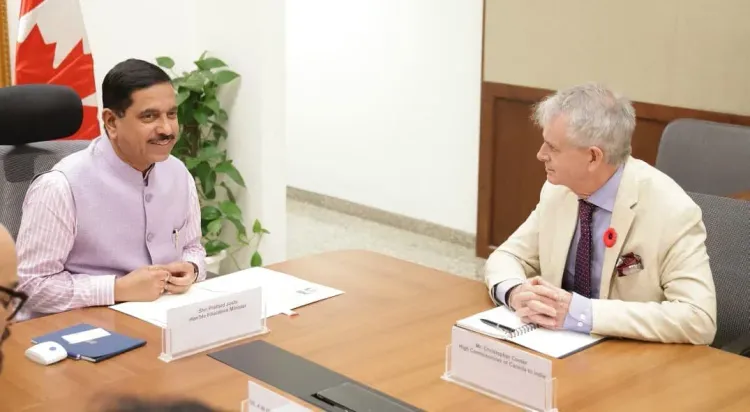
Pralhad Joshi met Christopher Cooter (Canada's High Commissioner) and Amy Antonini (Trade Commissioner) on 22 October 2026 in New Delhi.
Discussions focused on implementing MoUs signed during engagements between PM Narendra Modi and Canadian PM Mark Carney .
Facilitating Canadian universities' entry into India under National Education Policy 2020 was a key agenda item.
Priorities included revitalising higher education ties, expanding research partnerships, and boosting student mobility in both directions.
NEP 2020, approved in July 2020 , formally opened India to foreign university campuses for the first time.
Both sides reaffirmed commitment to deeper academic collaboration for students and researchers across both countries.
A concrete push to translate diplomatic goodwill into classroom reality — Union Consumer Affairs and New and Renewable Energy Minister Pralhad Joshi met Christopher Cooter, High Commissioner of Canada to India, and Amy Antonini, Trade Commissioner, on Thursday, 22 October 2026, for focused discussions on deepening India–Canada cooperation in education, research, and innovation.
MoUs from PM-level talks put on the implementation table
The meeting trained its sights on moving beyond announcements. Joshi said discussions centred on 'implementing the MoUs announced during the engagements between PM Narendra Modi and Canadian PM Mark Carney' — signalling that the political groundwork has been laid and the bureaucratic machinery must now follow through. That shift from intent to execution is precisely where bilateral education deals have historically stalled.
Higher education ties between India and Canada had gone through a turbulent patch in recent years, making the reaffirmation of 'revitalising' those links pointed rather than routine. Student mobility — the lifeblood of any academic partnership — was specifically flagged as a priority alongside expanding research partnerships.
Canadian universities and the NEP 2020 gateway
The most structurally significant item on the agenda was facilitating Canadian universities' entry into India under the National Education Policy 2020. NEP 2020, approved in July 2020, was a landmark shift: for the first time, India's policy architecture formally opened the door to foreign universities establishing full campuses on Indian soil rather than operating only through limited twinning or franchise arrangements.
That provision has since drawn interest from institutions across the United States, United Kingdom, and Australia — and now Canada is actively pursuing the pathway. For Canadian universities, India's enormous youth demographic and its growing middle class represent an expansion opportunity that is hard to ignore. For Indian students, domestic access to a globally recognised degree could change the calculus on whether to study abroad at all.
What the bilateral push means for students and researchers
Joshi underlined that both sides 'reaffirmed commitment to deeper academic collaboration and greater opportunities for students and researchers in both countries.' The framing is deliberately two-way — Indian researchers gain access to Canadian labs and funding networks, while Canadian institutions gain a foothold in one of the world's largest higher-education markets.
India has been systematically building similar cooperation frameworks with multiple developed nations under NEP 2020's internationalisation mandate. The Canada discussions fit a broader pattern, but they carry added weight given the diplomatic repair work the two countries have undertaken at the leadership level in recent months.
The real test now is the calendar — whether implementation timelines for the MoUs are set, whether a regulatory fast-track emerges for Canadian campus applications under NEP 2020, and whether student-exchange numbers move measurably in the next academic cycle. Agreements are only as good as the follow-through they generate.
Point of View
With education chosen as the least contentious arena to rebuild institutional trust. India's consistent use of NEP 2020 as a bilateral negotiating tool reveals a deliberate strategy: attract foreign universities to generate domestic competition and internationalise credentials without sending students — and foreign exchange — abroad. The emphasis on 'revitalising' ties rather than simply 'expanding' them is an acknowledgment of recent friction, and the two-way mobility framing is politically smart, offering Canadian institutions market access in exchange for Indian students getting easier pathways. Whether Canadian universities will clear India's regulatory bar for campus establishment will be the real measure of this meeting's success.
NationPress
22 Oct 2026
Frequently Asked Questions
What did Pralhad Joshi discuss with Canada's High Commissioner?
Minister Pralhad Joshi discussed implementing MoUs from PM Modi–PM Carney engagements, revitalising higher education ties, expanding research partnerships, boosting student mobility, and facilitating Canadian universities' entry into India under NEP 2020.
Can Canadian universities open campuses in India?
Yes. The National Education Policy 2020, approved in July 2020, formally permits foreign universities to establish campuses in India, and the Joshi–Cooter meeting specifically addressed a regulatory pathway for Canadian institutions.
What is NEP 2020 and how does it affect foreign universities?
The National Education Policy 2020 is India's landmark education framework approved in July 2020. It introduced provisions allowing accredited foreign universities to set up full campuses in India, a first in the country's education policy history.
Who is Christopher Cooter?
Christopher Cooter is the High Commissioner of Canada to India. He met Minister Pralhad Joshi on 22 October 2026 alongside Trade Commissioner Amy Antonini to advance India–Canada education and research cooperation.
What is the status of India–Canada student mobility?
India and Canada identified student mobility as a priority area requiring active expansion. The 22 October 2026 discussions aimed to build on MoUs from PM-level engagements to increase two-way movement of students and researchers.