Pralhad Joshi Meets South Africa's Education Ministers at BRICS 2026
Synopsis
Union Minister Pralhad Joshi met South Africa's education ministers at BRICS 2026, proposing to share India's NIPUN Bharat, SWAYAM, PARAKH and SAMARTH programmes and accelerate bilateral education agreements — a direct expression of NEP 2020's international cooperation mandate.
Key Takeaways
Pralhad Joshi held a bilateral meeting with South Africa's Minister of Basic Education Siviwe Gwarube and Deputy Minister Dr.
Dube-Ncube on 6 August 2026 at BRICS 2026.
Discussions covered basic and higher education, skilling, research, innovation and digital learning.
India offered to share four flagship programmes: NIPUN Bharat , PARAKH , SWAYAM and SAMARTH .
Both sides agreed to accelerate education agreements currently under negotiation.
The meeting aligns with NEP 2020 's explicit mandate for international academic exchanges and digital platform sharing.
India and South Africa have existing education cooperation frameworks under both BRICS and IBSA dialogues.
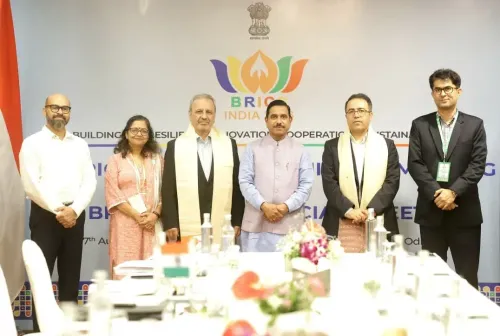
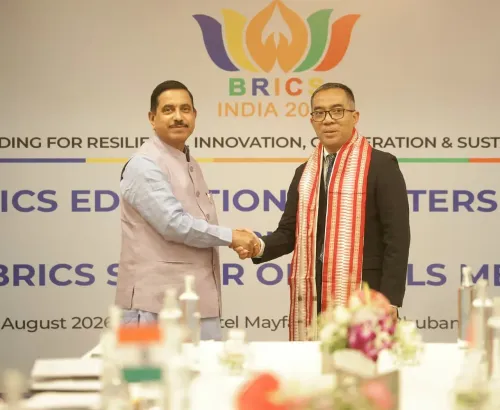
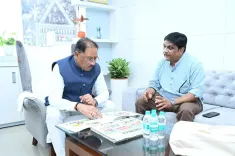
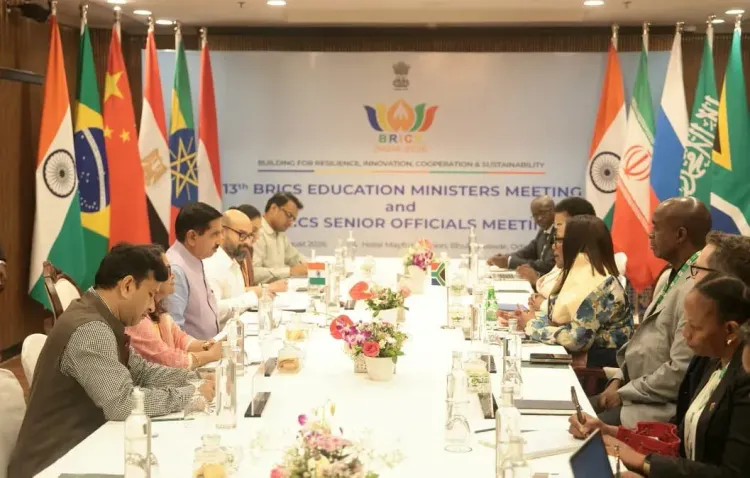
India's education diplomacy got a concrete push on Thursday, 6 August 2026, when Union Minister Pralhad Joshi sat down with South Africa's Minister of Basic Education Ms. Siviwe Gwarube and Deputy Minister of Higher Education and Training Dr. Dube-Ncube on the sidelines of #BRICS2026 — putting skilling, digital learning and foundational literacy squarely on the bilateral table.
The meeting, confirmed by Joshi on X, covered a wide sweep: basic and higher education, skilling, research, innovation and digital learning. Crucially, both sides explored the export of India's home-grown programmes — NIPUN Bharat, PARAKH, SWAYAM and SAMARTH — as models South Africa could learn from, and agreed to accelerate education agreements already under negotiation.
What India Put on the Table
NIPUN Bharat (National Initiative for Proficiency in Reading with Understanding and Numeracy) is India's flagship foundational literacy programme targeting children up to Grade 3. SWAYAM is the government's Massive Open Online Course platform, offering free courses from school level to postgraduate, with millions of enrolments. PARAKH is India's national assessment regulator under the National Education Policy 2020, and SAMARTH is an e-governance suite for higher education institutions. Together, they represent the tech-and-policy stack India has built over the past half-decade — and is now actively marketing as a development partnership asset.Why South Africa, Why Now
India and South Africa share overlapping education challenges: large youth populations, uneven foundational learning outcomes and the urgent need to scale digital infrastructure. The two countries have cooperated under both the BRICS framework and the IBSA (India-Brazil-South Africa) dialogue for years, with periodic updates to bilateral memoranda on education and skills. Using a BRICS margin meeting to advance those agreements is a well-worn Indian diplomatic playbook — convert summit energy into implementable instruments. NEP 2020 explicitly mandates international academic exchanges and the sharing of digital platforms with partner nations. Thursday's meeting is a direct expression of that mandate finding a live bilateral channel.Agreements in the Pipeline
Joshi noted that both sides would 'accelerate the education agreements under negotiation' — standard diplomatic language that signals existing draft texts are in circulation but not yet signed. The finalisation and eventual parliamentary scrutiny of those instruments will be the real measure of whether Thursday's conversation translates into durable cooperation. Academic exchange programmes and mutual recognition of qualifications — perennial BRICS education agenda items — are likely on that list. Two ministers from Pretoria, four Indian flagship programmes, and a BRICS deadline concentrating minds: the architecture for a meaningful India-South Africa education partnership is taking shape. Whether the agreements follow is the only question that matters now.Point of View
SWAYAM and PARAKH to South Africa is not incidental — it reflects a deliberate post-NEP 2020 strategy of positioning domestic education technology as a soft-power export, particularly within the Global South. BRICS margins have become a preferred venue for this, allowing India to bypass slower multilateral processes and lock in bilateral understandings quickly. The reference to 'agreements under negotiation' suggests institutional momentum exists, but the gap between ministerial intent and signed, ratified instruments remains the chronic weak point of India's education diplomacy. If those agreements close before the BRICS 2026 summit concludes, Thursday's meeting will be remembered as a turning point; if they stall, it joins a long list of promising bilateral conversations that faded quietly.
NationPress
6 Aug 2026
Frequently Asked Questions
What did Pralhad Joshi discuss with South Africa's education ministers at BRICS 2026?
Joshi met South Africa's Minister of Basic Education and Deputy Minister of Higher Education on 6 August 2026, discussing skilling, research, digital learning and the potential sharing of Indian programmes like NIPUN Bharat, SWAYAM, PARAKH and SAMARTH.
What is NIPUN Bharat and why was it mentioned in the India-South Africa talks?
NIPUN Bharat is India's national programme to ensure foundational literacy and numeracy for children up to Grade 3. It was proposed as a model South Africa could adopt or learn from, given shared challenges around early learning outcomes.
What is SWAYAM and how does it relate to the bilateral education talks?
SWAYAM is India's government-run Massive Open Online Course platform offering free courses from school to postgraduate level. It was highlighted as a scalable digital learning tool India is willing to share with partner countries like South Africa.
What education agreements between India and South Africa are under negotiation?
The exact texts are not public, but the agreements likely cover academic exchanges, mutual recognition of qualifications and skilling cooperation — standard items on the BRICS and IBSA education agendas between the two countries.
How does India's National Education Policy 2020 connect to this bilateral meeting?
NEP 2020 explicitly calls for international academic exchanges, research collaboration and sharing of digital learning platforms with partner nations, making Joshi's meeting with South African counterparts a direct implementation of that policy mandate.