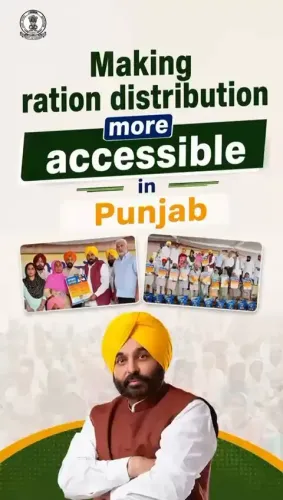
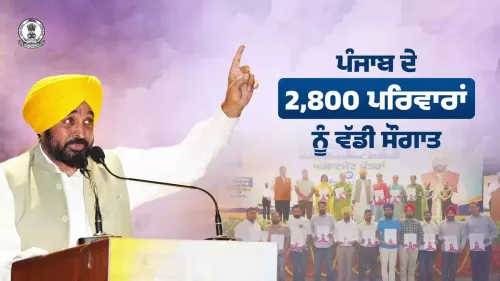
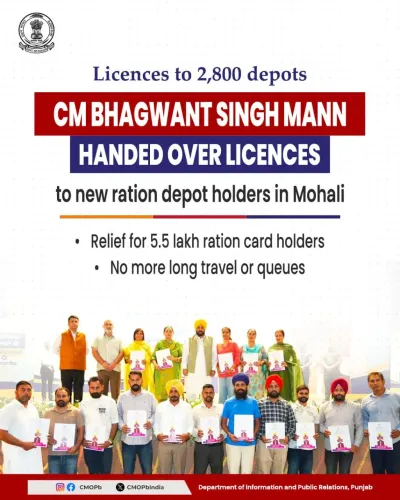
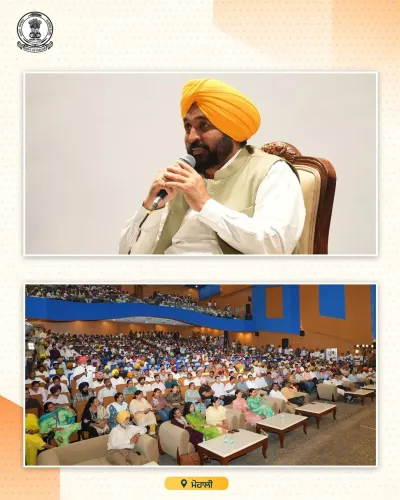
CM Bhagwant Mann to Issue 10 Lakh New Ration Cards in Punjab
Synopsis
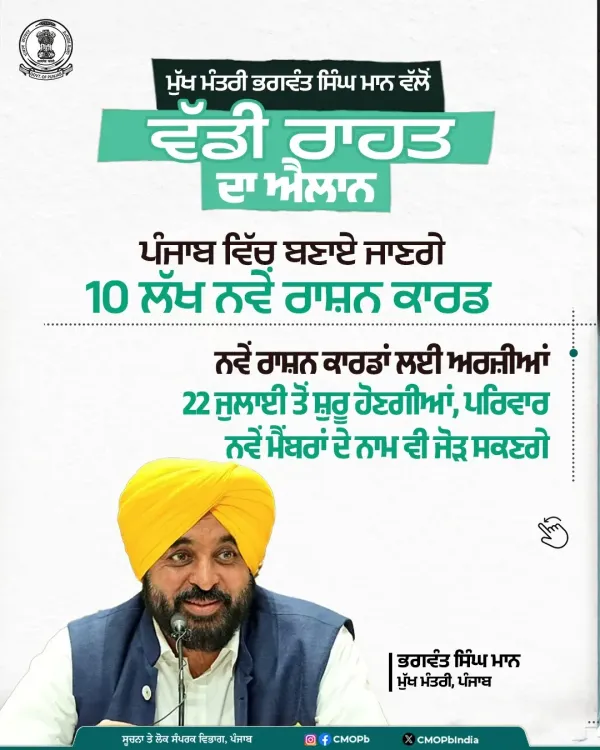
Punjab Chief Minister Bhagwant Mann has announced 10 lakh new ration cards to be issued under a transparent, technology-driven 'No Cash, No Farmaish' system, with applications opening 22 July 2026. Of these, 7 lakh cards will go to newly eligible families, prioritising the state's most vulnerable sections.
Key Takeaways
10 lakh new ration cards will be issued by the Punjab government under CM Bhagwant Singh Mann .
Applications open from 22 July 2026 for both new cards and addition of family members to existing cards.
7 lakh of the new cards are reserved for newly eligible families.
The drive operates on the 'Na Cash, Na Farmaish' principle — no bribery, no favouritism — using a technology-driven processing system.
Priority will be given to vulnerable sections of society , including economically marginalised households currently outside the PDS.
The initiative aligns with the national push to digitise and Aadhaar-seed ration-card databases to curb leakages.
The Chief Minister's Office of Punjab announced on Wednesday, 22 July 2026 that Chief Minister Bhagwant Singh Mann will issue 10 lakh new ration cards under a transparent, technology-driven system guided by the principle of 'Na Cash, Na Farmaish' (No Cash, No Favouritism), marking what the government described as a historic step to strengthen food security across the state.
Context
Announcing the initiative, CM Bhagwant Mann stated that applications for new ration cards — and for adding new members to existing family cards — will open from 22 July 2026. Of the 10 lakh total new cards to be issued, 7 lakh are earmarked for newly eligible families, with priority given to vulnerable sections of society. The government has framed the drive explicitly around eliminating corruption and local-level discretion from the welfare delivery chain.
Policy Backdrop
India's Public Distribution System (PDS) operates under the National Food Security Act, 2013, which guarantees legal entitlements to subsidised food grains for priority households. Several Indian states have pursued digitisation of ration-card databases and Aadhaar seeding to curb leakages and weed out ghost beneficiaries. Punjab's technology-driven approach aligns with this broader national effort to make welfare delivery less prone to intermediary interference.
The 'Na Cash, Na Farmaish' principle — meaning no bribe and no favour — signals the state's intent to process applications through an automated, rule-based system rather than through the discretion of local officials. The Aam Aadmi Party government under Mann, in power since 2022, has consistently positioned anti-corruption governance as a central plank of its administration.
Stakeholders and Impact
The primary beneficiaries are vulnerable households currently outside the PDS net — including daily-wage workers, landless labourers, and economically marginalised families. With 7 lakh cards reserved for newly eligible families, the expansion is among the larger single-round additions to Punjab's ration-card rolls in recent years. Existing cardholders seeking to add newborns or newly married members to their family units will also be able to apply from the same date.
The technology-driven processing system is designed to reduce the role of intermediaries — a persistent source of exclusion errors and bribery in PDS operations across Indian states. If implemented as announced, the move could bring hundreds of thousands of households into the formal food-security net for the first time.
What's Next
The immediate marker to watch is the commencement of the application window on 22 July 2026 and the volume of applications processed in the initial weeks. The state government's ability to prioritise the most vulnerable — and to maintain the technology-based system free from local-level leakage — will determine whether the 10 lakh target translates into genuine inclusion. Any state-level reporting on processing timelines and grievance redressal mechanisms will offer early signals of the initiative's effectiveness.
Point of View
Framing a routine PDS expansion as a corruption-free governance milestone. The 'No Cash, No Farmaish' branding is deliberate — it lets the administration contrast itself with legacy systems associated with middlemen and political patronage. Anchoring the rollout in technology and rule-based processing is sound policy, but the real test lies in implementation: digitisation alone has not eliminated exclusion errors in other states. Whether Punjab can demonstrate measurable improvement in inclusion rates will determine if this becomes a replicable model or remains a well-packaged announcement.
NationPress
21 Oct 2026
Frequently Asked Questions
How can I apply for a new ration card in Punjab in 2026?
Applications for new ration cards in Punjab open from 22 July 2026 under a technology-driven system announced by CM Bhagwant Mann . The process is designed to be corruption-free, operating on the 'No Cash, No Farmaish' principle.
How many new ration cards will Punjab issue?
Punjab will issue 10 lakh new ration cards in total, of which 7 lakh will go to newly eligible families, with priority given to vulnerable sections of society.
What does 'Na Cash, Na Farmaish' mean in the Punjab ration card scheme?
'Na Cash, Na Farmaish' means 'No Cash, No Favouritism' — the principle that no bribe should be paid and no political favour should be sought to obtain a ration card. The Punjab government is using this as the guiding ethos of its technology-based application system.
Who is eligible for the new Punjab ration cards?
Newly eligible families and vulnerable sections of society are the priority beneficiaries. Existing cardholders can also apply to add new family members — such as newborns or newly married members — from 22 July 2026 .
What is the National Food Security Act and how does it relate to Punjab's ration card drive?
The National Food Security Act, 2013 guarantees subsidised food grains to priority households through India's Public Distribution System . Punjab's expansion of ration cards is aimed at bringing more eligible families under this legal entitlement in a transparent, technology-driven manner.