CM Bhagwant Mann Revamps Punjab's Kisan Credit Card System
Synopsis
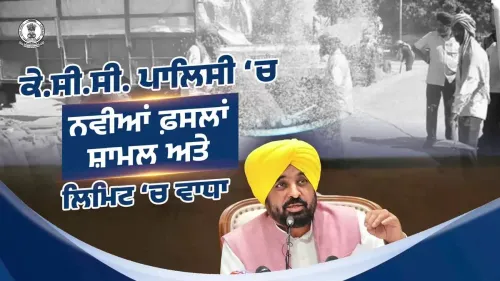
Chief Minister Bhagwant Mann on June 5, 2026 unveiled a major overhaul of Punjab's Kisan Credit Card system, raising crop-wise credit limits, cutting interest burdens, expanding coverage to allied sectors, and enabling digital fund access via UPI and ATMs for over 13 lakh farmers.
Key Takeaways
Chief Minister Bhagwant Mann announced a comprehensive overhaul of the Kisan Credit Card (KCC) system on June 5, 2026 .
The reforms are expected to benefit over 13 lakh farmers across Punjab .
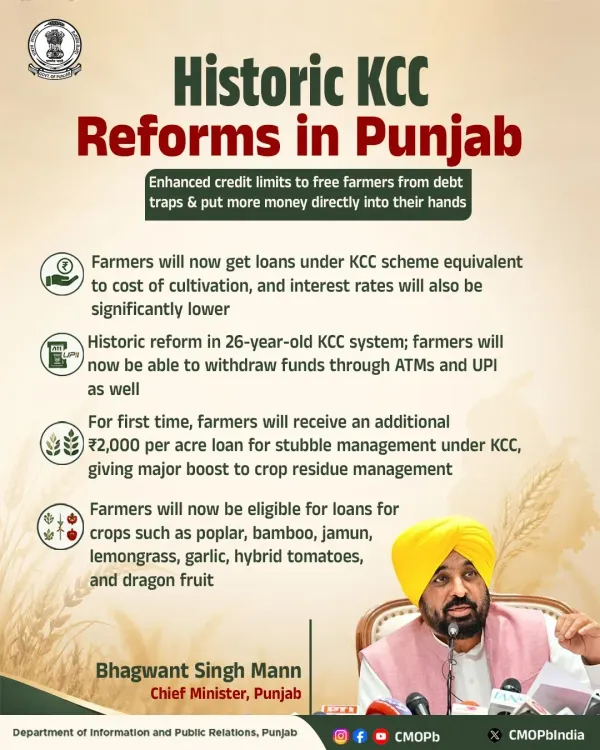
Crop-wise credit limits have been raised to align with actual cultivation costs, and interest burdens have been reduced.
Loan eligibility has been expanded to cover high-value crops and allied sectors .
Dedicated financial support for stubble management has been introduced, linking farm credit to environmental goals.
Farmers can now access funds via modern digital platforms including ATMs and UPI .
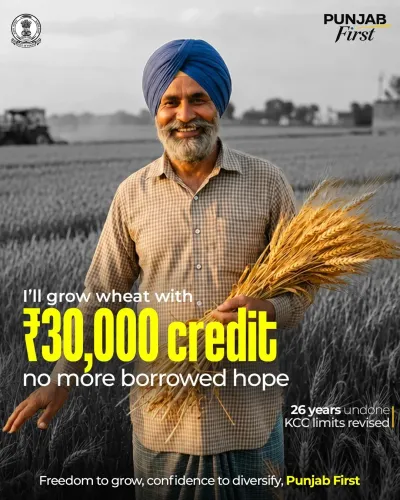
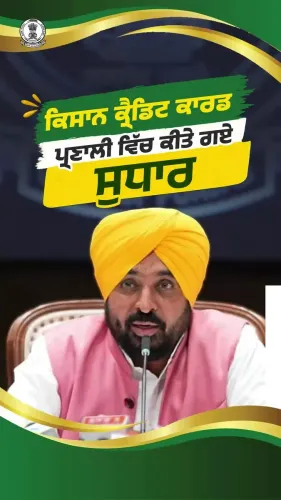
The Chief Minister's Office of Punjab announced on Friday, June 5, 2026, that Chief Minister Bhagwant Mann has unveiled a sweeping overhaul of the Kisan Credit Card (KCC) system, transforming a framework that has been in place for 26 years and is expected to benefit over 13 lakh farmers across the state.
Context
The revamped KCC policy significantly raises crop-wise credit limits in line with actual cultivation costs and lowers the interest burden on farmers. The reforms also expand loan eligibility to high-value crops and allied sectors, and introduce dedicated financial support for stubble management. Farmers will now be able to access funds through modern digital platforms including ATMs and UPI. The announcement describes the overhaul as 'one of the most far-reaching agricultural reforms undertaken in Punjab in recent decades,' citing the old framework's failure to keep pace with rising input costs and its role in leaving farmers 'dependent on inadequate institutional credit and vulnerable to private moneylenders.'Policy Backdrop
The Kisan Credit Card scheme was launched nationally in 1998 by NABARD to deliver short-term crop loans through institutional channels and reduce farmer reliance on informal lenders. In the nearly three decades since its introduction, credit limits under the scheme had not kept pace with the actual cost of cultivation, particularly in a state like Punjab — India's leading wheat-rice producing state — where input costs have risen sharply. Indian states have periodically revised KCC norms to align credit limits with current input costs and to integrate digital delivery channels. Punjab has also linked this round of farm credit reform to an environmental objective: dedicated financial support for stubble management, a measure aimed at curbing the seasonal crop-residue burning that contributes to air pollution across northern India.Stakeholders and Impact
Bhagwant Mann has led the Aam Aadmi Party government in Punjab since March 2022, with agriculture and rural welfare forming a central plank of the administration's stated agenda. The KCC overhaul directly targets Punjab's farming community, which has historically faced a structural gap between institutional credit availability and actual cultivation costs — a gap that has driven many farmers toward private moneylenders at higher interest rates. Beyond crop loans, the revised framework extends eligibility to allied sectors, broadening the base of formal credit access. The integration of digital payment infrastructure such as UPI is intended to make fund access more convenient and reduce dependence on physical bank visits, particularly for farmers in remote areas.What's Next
The practical impact of the overhaul will depend on the pace of state-level rollout and actual disbursement figures once the revised credit limits are operationalised by lending institutions. Coordination with central government programmes, including the modified Interest Subvention Scheme, will also be a factor in determining how quickly farmers see the benefit of lower interest burdens. If implemented as announced, the reforms represent a significant shift in Punjab's approach to institutional farm credit — moving from a static, decades-old framework toward a model that aligns credit with real costs, integrates digital access, and ties agricultural finance to environmental goals.Point of View
And its timing — mid-2026, ahead of a politically sensitive agricultural cycle — signals that the Mann government is seeking to convert structural rural grievances into tangible policy wins. By tying credit expansion to stubble management, the administration is attempting to resolve two persistent problems — farmer indebtedness and seasonal air pollution — through a single financial instrument. The digital integration component reflects a broader national trend of using UPI infrastructure to reach underserved rural populations, though the gap between policy announcement and actual disbursement has historically been significant in state-level credit schemes. Whether lending institutions can operationalise the revised limits at scale will determine if the reform delivers on its stated ambition.
NationPress
21 Oct 2026
Frequently Asked Questions
What changes has Punjab made to the Kisan Credit Card scheme in 2026?
Punjab Chief Minister Bhagwant Mann announced in June 2026 that the state's Kisan Credit Card framework has been overhauled to raise crop-wise credit limits in line with actual cultivation costs, reduce interest burdens, expand eligibility to high-value crops and allied sectors, introduce stubble management loans, and enable digital access via ATMs and UPI.
How many farmers will benefit from Punjab's KCC overhaul?
The revamped Kisan Credit Card policy is expected to benefit over 13 lakh farmers across Punjab, according to the Chief Minister's Office announcement.
What is the Kisan Credit Card scheme and when was it launched?
The Kisan Credit Card scheme was launched nationally in 1998 by NABARD to provide short-term institutional crop loans to farmers and reduce their dependence on informal moneylenders.
Why is Punjab linking farm credit to stubble management?
Punjab has introduced dedicated financial support for stubble management within the revised KCC framework to give farmers a viable alternative to burning crop residue, which is a major source of seasonal air pollution across northern India.
Can Punjab farmers now use UPI to access Kisan Credit Card funds?
Yes, the revised KCC framework announced by CM Bhagwant Mann enables farmers to access their credit through modern digital platforms including UPI and ATMs, reducing reliance on physical bank visits.