Punjab CMO: KCC expanded to dragon fruit, bamboo, poplar, lemongrass

Synopsis
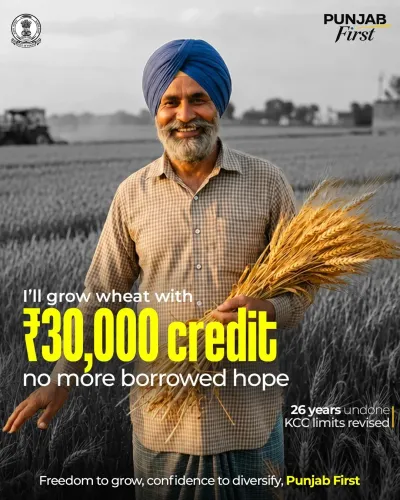
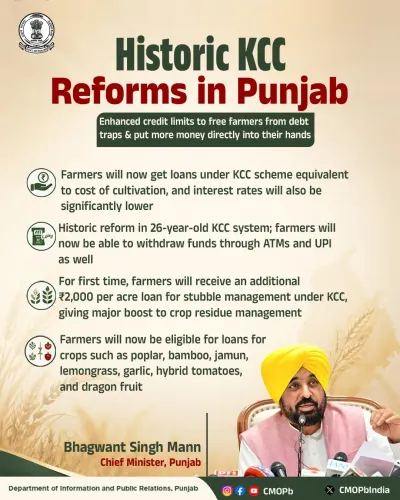
The Chief Minister's Office of Punjab announced major reforms to the Kisan Credit Card policy under CM Bhagwant Mann. Dragon fruit, bamboo, poplar and lemongrass have been brought under KCC for the first time, alongside wheat and paddy, with an increased loan limit aimed at expanding financial support for farmers pursuing high-value crops.
Key Takeaways
Punjab CMO announced major reforms to the Kisan Credit Card policy on 4 June 2026.
Dragon fruit, bamboo, poplar and lemongrass added to KCC coverage for the first time.
Traditional crops such as wheat and paddy remain covered under the revised policy.
The loan limit under KCC has been raised to expand financial support for farmers.
The move advances Punjab's long-running push for crop diversification away from the wheat-paddy cycle.
Detailed implementation guidelines for banks are awaited.
The Chief Minister's Office of Punjab on Thursday, 4 June 2026, announced that the state government, led by Chief Minister Bhagwant Mann, has carried out significant reforms in the Kisan Credit Card (KCC) policy. For the first time, modern and high-value crops such as dragon fruit, bamboo, poplar and lemongrass have been brought under the KCC ambit, alongside an upward revision of the credit ceiling for farmers.
In its post on X, the CMO stated that under Chief Minister Bhagwant Mann's leadership, 'important reforms have been made in the Kisan Credit Card policy', and that along with wheat, paddy and other traditional crops, the new high-value crops will now qualify for institutional credit. The office added that an increase in the loan limit will make 'greater financial assistance available to farmers for agriculture'. The post carried the hashtags #CMOPunjab and #ਮੁੱਖ_ਮੰਤਰੀ_ਦਫ਼ਤਰ_ਪੰਜਾਬ (Chief Minister's Office Punjab).
Context
The Kisan Credit Card scheme was introduced nationwide by the Government of India in 1998 to deliver timely short-term crop loans to farmers through cooperative banks, regional rural banks and scheduled commercial banks. Over the years, successive central and state revisions have widened the scheme to cover allied activities such as dairy, fisheries and animal husbandry.
Punjab, the country's grain bowl, has historically used KCC almost exclusively for the wheat-paddy cycle. Bringing crops like dragon fruit, bamboo, poplar and lemongrass under the card marks a notable break from that pattern and lines up state credit policy with the diversification push that has been on the agenda for more than a decade.
Policy backdrop
State governments in Punjab have periodically revised KCC norms since the early 2010s to encourage farmers to move away from water-intensive paddy. Groundwater depletion in the Malwa and Doaba belts, stagnant farm incomes and a heavy procurement-linked dependence on two crops have driven repeated calls for diversification.
High-value horticulture and agro-forestry crops have been promoted in pilot pockets — dragon fruit in parts of Hoshiarpur and Pathankot, poplar across the sub-mountain belt, and lemongrass as an aromatic crop suited to marginal land. Until now, however, institutional credit for these crops has typically required separate term-loan products rather than the simpler, revolving KCC line that paddy and wheat growers routinely access.
The CMO has not made public the revised loan ceilings or scale-of-finance norms for each newly notified crop, and operational guidelines for banks are expected to follow.
Stakeholders and impact
For Punjab's farmers, particularly small and marginal cultivators experimenting with non-traditional crops, the change could lower the cost and paperwork of accessing seasonal working capital. KCC loans are typically priced at concessional interest rates, with interest subvention from the Centre for prompt repayment, making them substantially cheaper than commercial agri-loans or informal credit.
District cooperative banks and scheduled commercial bank branches across Punjab will have to update their lending templates, scale-of-finance tables and field appraisal practices to assess yields and cash flows from crops they have rarely financed at scale. Farmer producer organisations and horticulture extension officers are likely to play a larger role in establishing benchmarks.
The move also aligns with broader national efforts to deepen agricultural credit beyond staples and reduce the share of non-institutional borrowing among cultivators.
What's next
Attention now shifts to the detailed implementation circulars expected from the state agriculture and cooperation departments, and from lead banks operating in Punjab. Enrolment data for the newly covered crops and disbursement figures over the coming kharif and rabi seasons will indicate whether the revised policy translates into a measurable shift in cropping choices.
If uptake is strong, the Punjab template could feed into wider conversations on aligning KCC products with crop diversification goals across other states grappling with similar agro-ecological stress.
Point of View
Bamboo, poplar and lemongrass is a credit-policy nudge tied directly to Punjab's larger diversification arc. For years, farmers have been told to move beyond paddy, but the financial plumbing — concessional, revolving working capital — has remained tilted towards staples. By rewiring the KCC envelope, the Bhagwant Mann government is attempting to fix a structural gap that earlier crop-shift campaigns left unaddressed. The real test will lie in how quickly bank branches and cooperative societies operationalise scale-of-finance norms for crops they have rarely underwritten.
NationPress
22 Oct 2026
Frequently Asked Questions
What changes has Punjab made to the Kisan Credit Card scheme?
Punjab has expanded the Kisan Credit Card to cover dragon fruit, bamboo, poplar and lemongrass alongside traditional crops like wheat and paddy, and has raised the loan limit available to farmers. The reforms were announced by the Chief Minister's Office on 4 June 2026.
Which new crops are now covered under KCC in Punjab?
Dragon fruit, bamboo, poplar and lemongrass have been brought under the Kisan Credit Card for the first time in Punjab. These are classified as modern and high-value crops, in addition to wheat, paddy and other traditional crops already covered.
Who announced the Punjab KCC policy reforms?
The Chief Minister's Office of Punjab announced the reforms in a post on X, attributing the decision to the state government led by Chief Minister Bhagwant Mann.
Why is Punjab expanding KCC to high-value crops?
The move is aimed at supporting crop diversification away from the water-intensive wheat-paddy cycle, which has contributed to groundwater depletion and stagnant farm incomes. Easier institutional credit for high-value crops is intended to make diversification financially viable.
When was the Kisan Credit Card scheme launched in India?
The Kisan Credit Card scheme was launched by the Government of India in 1998 to provide timely short-term crop loans to farmers through cooperative banks, regional rural banks and scheduled commercial banks.