Punjab's Five Cooperative Sugar Mills Win National Awards
Synopsis
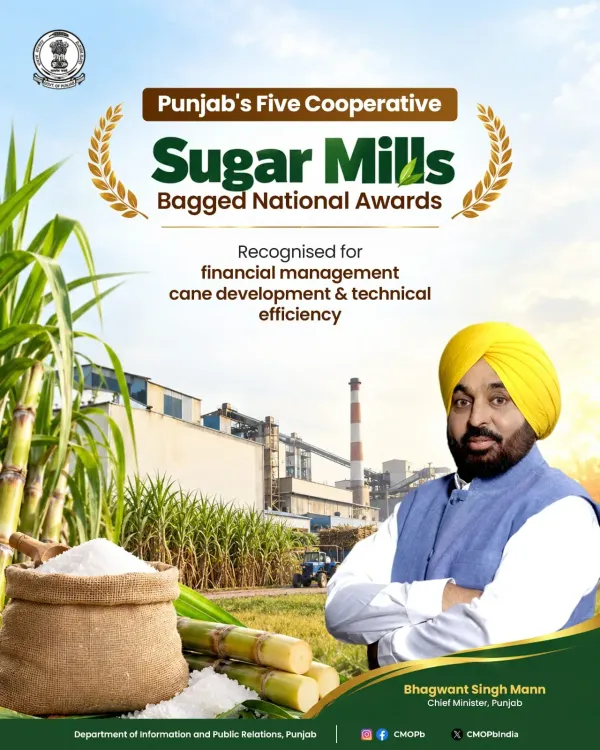
Punjab's five cooperative sugar mills won national awards at the National Cooperative Sugar Industry Conclave-2026 in New Delhi for financial management, cane development and technical efficiency, reflecting the state government's push to modernise the sugarcane sector.
Key Takeaways
All five of Punjab's cooperative sugar mills were recognised at the National Cooperative Sugar Industry Conclave-2026 in New Delhi .
Awards covered three categories: financial management , cane development , and technical efficiency .
The Bhagwant Mann government has prioritised modern techniques to raise sugarcane productivity, improve sugar recovery, and cut cultivation costs.
Punjab's cooperative sugar sector policy lineage dates to at least 2017 , focusing on varietal improvement, drip irrigation, and mill modernisation.
Sugarcane farmers supplying these mills stand to benefit through improved mill solvency and more reliable payment cycles.
Five state-run cooperative sugar mills in Punjab have walked away with national recognition at the National Cooperative Sugar Industry Conclave-2026 held in New Delhi — a sweep that the Chief Minister's Office of Punjab says is the direct result of a sustained push to modernise the state's sugarcane sector.
The awards span three critical performance pillars: financial management, cane development, and technical efficiency. According to the CMO, the government has been 'laying special emphasis on adopting modern techniques to increase sugarcane productivity, improve sugar recovery and reduce cost of cultivation' — a policy thrust that is now producing measurable, nationally benchmarked results.
What the national sweep signals for Punjab's sugar belt
Punjab's cooperative mill network has historically operated in the long shadow of the state's dominant wheat-rice economy. Sugarcane, while a smaller crop, is a critical income source for farmers across the state's cane-growing belts, and the mills that process it have long faced pressure from stagnating recovery rates and high cultivation costs. Winning across all three award categories at a national industry conclave is a signal that the operational gap between Punjab's cooperative mills and better-known sugar-belt peers is narrowing.
The Bhagwant Mann government, in office since March 2022, has framed cooperative sector reform as a priority alongside its agriculture agenda. Punjab's state agriculture policy has consistently identified sugarcane productivity, sugar recovery improvement, and cost reduction as the three levers that determine a cooperative mill's commercial viability — precisely the three dimensions the national awards cover.
The push: varietal improvement, mill modernisation, cost control
Successive Punjab governments going back to 2017 have promoted varietal improvement, drip irrigation adoption, and physical upgrades to mill infrastructure to arrest declining recovery rates. The cooperative mills — unlike private counterparts — carry additional obligations to cane farmers in their command areas, making financial health and technical efficiency doubly important: a mill that runs profitably can pay farmers on time and invest in next season's inputs.
The triple-category recognition at Conclave-2026 suggests these interventions are compounding. Better cane varieties lift yield per acre; modernised crushing equipment improves the sugar extracted per tonne of cane; tighter financial controls keep mills solvent enough to sustain those upgrades — a virtuous cycle the state has evidently been trying to engineer for nearly a decade.
What farmers and the sector are watching next
For the sugarcane farmers who supply these mills, the awards matter less as trophies and more as a proxy for mill reliability — timely payments, fair pricing, and investment in the farm-gate inputs that determine next season's crop. The next data point to watch is the Punjab Agriculture Department's cane productivity and recovery figures for the current season, alongside any fresh state budget allocations or technology-adoption agreements for the mills that did not feature in this round of recognition.
Five mills. Three award categories. One conclave. Punjab's cooperative sugar sector just announced it intends to be taken seriously.
Point of View
Independently benchmarked data point to showcase agricultural-sector governance ahead of future electoral cycles in Punjab. Cooperative mill performance sits at the intersection of farmer welfare and fiscal discipline — two themes AAP has made central to its Punjab narrative. The awards also fit a broader national pattern where state governments compete for cooperative-sector credibility as the Centre expands its own cooperative policy footprint. The real test, however, will be whether next season's productivity and recovery numbers match the trophy cabinet.
NationPress
24 Sept 2026
Frequently Asked Questions
Which Punjab cooperative sugar mills won national awards in 2026?
All five of Punjab's cooperative sugar mills were recognised at the National Cooperative Sugar Industry Conclave-2026 in New Delhi, winning awards across financial management, cane development and technical efficiency categories.
What is the National Cooperative Sugar Industry Conclave?
It is a national industry event focused on cooperative sugar sector performance, best practices and awards, bringing together state cooperative mills from across India.
What steps is the Punjab government taking to improve sugarcane productivity?
The Punjab government under Chief Minister Bhagwant Mann has emphasised modern cultivation techniques, varietal improvement, drip irrigation and mill modernisation to raise sugarcane yields, improve sugar recovery rates and reduce the cost of cultivation.
How does the cooperative sugar sector benefit Punjab's farmers?
Financially healthy and technically efficient cooperative mills can pay sugarcane farmers on time, offer fair pricing and invest in farm-gate inputs — directly improving income stability for cane-growing households across the state.
How long has Punjab been working on cooperative sugar mill reform?
Punjab's state agriculture policy has identified sugarcane productivity, sugar recovery and cost reduction as priority areas since at least 2017, with successive governments promoting mill modernisation and varietal improvement.