CM Bhagwant Mann hikes KCC limits for Punjab farmers

Synopsis
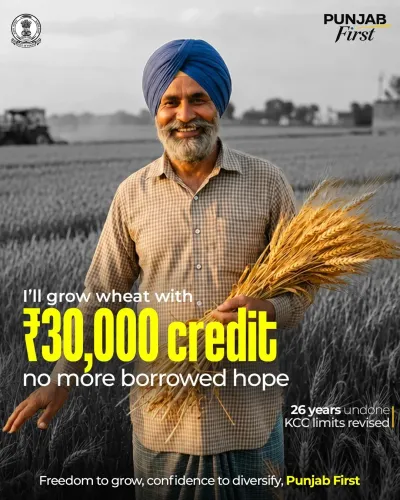
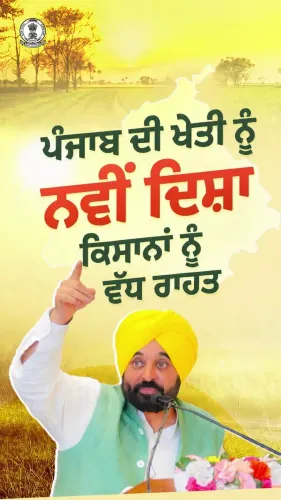
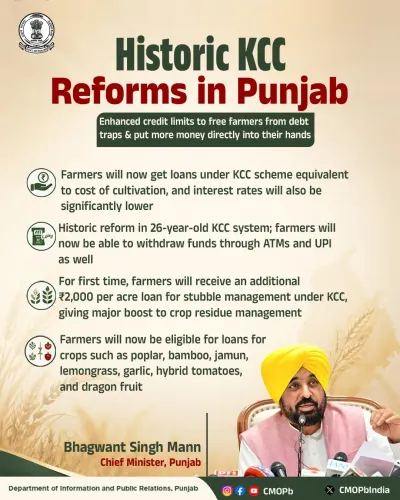
Chief Minister Bhagwant Mann has announced a major increase in Kisan Credit Card loan limits for wheat, paddy and other crops in Punjab, along with dedicated limits to support crop diversification and paddy stubble management, the Chief Minister's Office said on 4 June 2026.
Key Takeaways
CM Bhagwant Mann announced key decisions on the Kisan Credit Card scheme on 4 June 2026.
Loan limits raised significantly for wheat, paddy and several other crops.
Special, dedicated KCC limit fixed for diversified crops to push farmers away from the wheat-paddy cycle.
A separate limit earmarked for paddy stubble (parali) management.
The KCC scheme was launched nationally in 1998 by NABARD and the RBI.
Implementation will run through commercial, regional rural and cooperative banks in Punjab.
The Chief Minister's Office of Punjab on 4 June 2026 said Chief Minister Bhagwant Mann has announced significant decisions on the Kisan Credit Card (KCC) scheme, including a substantial increase in the crop loan limit for wheat, paddy and several other crops, along with dedicated limits for diversified crops and paddy stubble management. The Chief Minister disclosed the decisions during an interaction with the media in Chandigarh, framing the move as part of a wider effort to strengthen the state's farmers financially and make agriculture a profitable enterprise.
Context
In the post in Punjabi, the Chief Minister's Office stated that 'Punjab de annadaate' (Punjab's food providers) are at the centre of the new measures. According to the post, 'important decisions have been taken on the Kisan Credit Card to economically strengthen Punjab's farmers and make agriculture a profitable occupation.'
The post added that the loan limit has been raised significantly for wheat, paddy and several other crops, and that 'to promote crop diversification, a special limit has been fixed this time for various crops and for the management of parali (paddy stubble).' The exact revised loan ceilings were not specified in the post.
Policy backdrop
The Kisan Credit Card was rolled out nationally in 1998 by NABARD and the Reserve Bank of India to channel timely, low-cost institutional credit to farmers for cultivation, allied activities and consumption needs. KCC limits are periodically revised by state-level bankers' committees in consultation with agriculture departments, based on scale-of-finance calculations for each crop.
Punjab's agrarian economy remains heavily weighted toward the wheat-paddy rotation, a cycle that has been linked to groundwater depletion and to seasonal stubble burning. Successive state governments have used credit, subsidy and procurement levers to nudge farmers toward alternative crops such as maize, pulses, oilseeds and cotton, with limited large-scale uptake so far.
Stakeholders and impact
The primary beneficiaries are Punjab's farmers, particularly small and marginal cultivators who rely on KCC drawings for seed, fertiliser, diesel and labour costs each season. A higher per-acre limit can reduce the dependence of farm households on informal moneylenders, who typically charge far steeper rates than the subsidised KCC interest.
The earmarking of a separate limit for stubble management is notable: residue handling — through happy seeders, balers, super seeders and bio-decomposers — carries upfront costs that farmers often cite as a barrier to abandoning open-field burning after the paddy harvest. Tying credit to this activity links farm finance directly to an environmental objective the state has struggled to meet.
Commercial banks, regional rural banks and cooperative banks operating in Punjab will have to operationalise the revised ceilings at the branch level, including for the dedicated diversification and parali components flagged by the Chief Minister.
What's next
Attention will now turn to the formal circular spelling out the revised crop-wise limits, the interest-subvention structure and the conditions attached to the diversification and stubble-management sub-limits. The kharif sowing window, currently under way, will be the first practical test of how quickly bank branches translate the announcement into disbursals on the ground.
If uptake on the diversification and parali components is strong, the recalibrated KCC could become a template for blending farm credit with the state's twin imperatives of water conservation and cleaner air — a policy direction Punjab has signalled repeatedly but found difficult to scale.
Point of View
The state is trying to make the cheapest credit in a farmer's portfolio conditional on choices that align with its water and air-quality goals. The political logic is equally direct — a visible, pre-kharif announcement on farmer credit at a time when farm unions remain assertive. The real test, as always in Punjab, will be branch-level disbursal and whether diversified crops finally find a remunerative market to match the new credit line.
NationPress
18 Oct 2026
Frequently Asked Questions
What did CM Bhagwant Mann announce about the Kisan Credit Card?
CM Bhagwant Mann announced a significant increase in KCC loan limits for wheat, paddy and several other crops in Punjab, along with special dedicated limits for crop diversification and paddy stubble management.
When was the Punjab KCC limit hike announced?
The decisions were announced on 4 June 2026 by the Chief Minister's Office of Punjab, following the Chief Minister's interaction with the media.
What is the Kisan Credit Card scheme?
The Kisan Credit Card is a national scheme launched in 1998 by NABARD and the Reserve Bank of India to provide farmers timely, low-cost short-term credit for crop cultivation and allied needs through banks.
How will the new KCC limits help with stubble burning in Punjab?
A separate KCC sub-limit has been fixed for parali (paddy stubble) management, which can help farmers finance equipment and inputs needed to handle residue without burning it in the open.
Who will implement the revised KCC limits in Punjab?
Commercial banks, regional rural banks and cooperative banks operating in Punjab will implement the revised limits at the branch level, based on the state-level guidelines issued under the announcement.