Sitharaman: Kisan Credit Card limit raised to ₹5 lakh
Synopsis
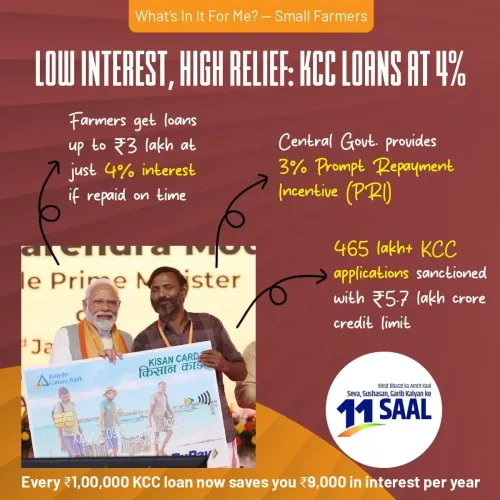
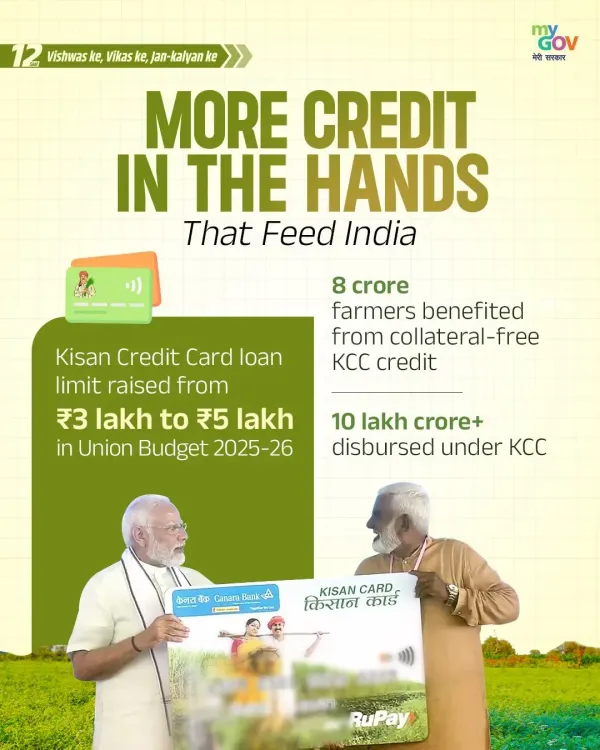
Union Finance Minister Nirmala Sitharaman announced the Kisan Credit Card loan limit has been hiked from ₹3 lakh to ₹5 lakh, with over ₹10 lakh crore disbursed under the scheme, marking twelve years of the government's agricultural credit push.
Key Takeaways
The Kisan Credit Card loan limit has been raised from ₹3 lakh to ₹5 lakh , expanding credit access for farmers.
Over ₹10 lakh crore has been disbursed under the KCC scheme, according to Finance Minister Sitharaman.
The announcement was made under the hashtag #12YearsOfKisanSamriddhi , marking twelve years of the government's agricultural welfare push.
The Kisan Credit Card scheme was launched in 1998 by NABARD to provide concessional short-term crop loans to farmers.
The revised limit is aimed at aligning credit availability with rising farm input costs and reducing dependence on informal moneylenders.
Cooperative banks and regional rural banks are key delivery channels for KCC loans and will implement the revised ceiling.
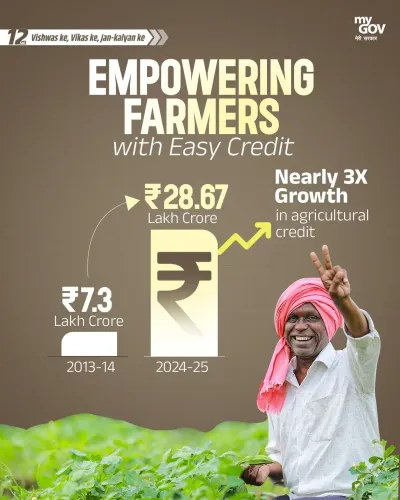
Union Finance Minister Nirmala Sitharaman on Thursday, June 11, 2026, highlighted a significant expansion of the Kisan Credit Card (KCC) scheme, announcing that the loan limit has been raised from ₹3 lakh to ₹5 lakh and that over ₹10 lakh crore has been disbursed under the scheme, widening affordable credit access for crores of farmers across India.
Context
Sitharaman's post, shared under the hashtag #12YearsOfKisanSamriddhi, marks what the ruling BJP is framing as twelve years of agricultural prosperity under the central government. The Finance Minister stated: 'More credit, more opportunities for our farmers,' underscoring the government's intent to position institutional credit as a driver of rural economic growth.
The Kisan Credit Card scheme was originally launched in 1998 by the National Bank for Agriculture and Rural Development (NABARD) to deliver timely short-term crop loans and term credit to farmers at concessional interest rates, replacing a fragmented system of agricultural lending.
Policy Backdrop
The KCC has undergone several enhancements since its inception. An interest subvention scheme was expanded from 2006-07 onward, and successive Union Budgets have set progressively higher annual agricultural credit targets. The revision of the loan ceiling from ₹3 lakh to ₹5 lakh is consistent with the government's stated rationale of aligning credit limits with rising farm input costs, including seeds, fertilisers, and equipment.
The broader policy thrust since 2014 has included digital KCC saturation drives aimed at bringing small and marginal farmers — who have historically depended on informal moneylenders at high interest rates — into the formal credit system. NABARD remains the apex institution overseeing the scheme's design, monitoring, and refinancing operations.
Stakeholders and Impact
The primary beneficiaries of the revised limit are India's estimated crores of KCC-holding farmers, particularly small and marginal cultivators who operate on thin margins and require reliable seasonal credit. Cooperative banks and regional rural banks, which are key delivery channels for KCC loans, are also directly affected as they recalibrate their lending portfolios.
The cumulative disbursement figure of over ₹10 lakh crore cited by the Finance Minister signals the scale of institutional agricultural credit flowing through this single instrument. Reduced dependence on informal credit is a key intended outcome, as moneylender rates can be several multiples of the concessional rates available under KCC.
What's Next
Disbursement progress and the on-ground impact of the revised ₹5 lakh ceiling are expected to be detailed in the forthcoming NABARD annual report. Any further revisions to credit targets or interest subvention rates may be announced during the next Union Budget session. The government's agricultural credit narrative is likely to remain central to its rural outreach ahead of state assembly elections in several farm-heavy states.
Point of View
Timed to a twelve-year governance milestone and designed to reinforce the BJP's agrarian credentials with a rural voter base. Raising the KCC ceiling to ₹5 lakh addresses a genuine structural gap — input costs have risen sharply — while the ₹10 lakh crore disbursement figure projects scale and delivery credibility. The move fits a consistent pattern of incremental but visible agricultural credit enhancements that the government has used to counter opposition narratives on farmer distress. Whether the limit revision translates into meaningfully higher uptake among marginal farmers will depend on ground-level banking penetration and awareness, which remain uneven across states.
NationPress
26 Oct 2026
Frequently Asked Questions
What is the new Kisan Credit Card loan limit in 2026?
The Kisan Credit Card loan limit has been raised to ₹5 lakh , up from the previous ceiling of ₹3 lakh , as announced by Finance Minister Nirmala Sitharaman.
How much has been disbursed under the Kisan Credit Card scheme?
Over ₹10 lakh crore has been disbursed under the Kisan Credit Card scheme, according to Finance Minister Nirmala Sitharaman's post on June 11, 2026.
What is the Kisan Credit Card scheme and who runs it?
The Kisan Credit Card (KCC) scheme was launched in 1998 by NABARD to provide farmers with timely, concessional short-term crop loans and term credit, replacing fragmented and often costly informal borrowing.
Who is eligible for a Kisan Credit Card?
Farmers — including small, marginal, and tenant cultivators — are eligible for a Kisan Credit Card . The scheme is delivered through cooperative banks, regional rural banks, and commercial banks empanelled with NABARD .
What does #12YearsOfKisanSamriddhi mean?
#12YearsOfKisanSamriddhi is a hashtag used by the BJP -led central government to mark twelve years of its agricultural welfare and rural prosperity initiatives, under which the KCC expansion is being highlighted.