Sitharaman Highlights PM-KISAN's ₹4.3 Lakh Crore Farmer Outreach
Synopsis
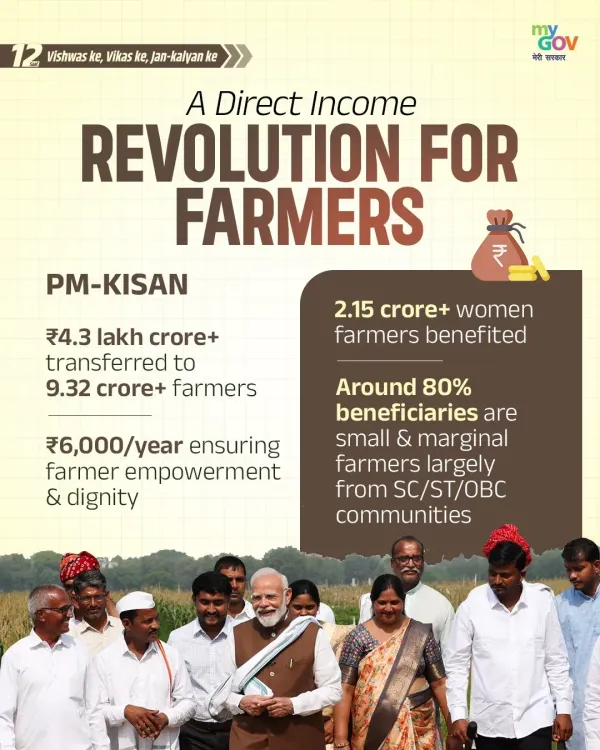
Union Finance Minister Nirmala Sitharaman marked PM-KISAN's twelfth anniversary on June 11, 2026, stating that over ₹4.3 lakh crore has been transferred to more than 9.32 crore farmers, including 2.15 crore women, through direct benefit transfers since the scheme's 2019 launch.
Key Takeaways
Finance Minister Nirmala Sitharaman posted on June 11, 2026 to mark 12 years of PM-KISAN under the hashtag #12YearsOfKisanSamriddhi.
Over ₹4.3 lakh crore has been disbursed to farmers under the scheme through Direct Benefit Transfers.
More than 9.32 crore farmers have received PM-KISAN benefits, including over 2.15 crore women farmers .
PM-KISAN provides ₹6,000 per year in three instalments to eligible landholding farmer families, launched in February 2019 .
The scheme targets small and marginal farmers and is part of the government's broader Direct Benefit Transfer framework to reduce leakages in welfare delivery.
Union Finance Minister Nirmala Sitharaman on Thursday, June 11, 2026, highlighted the cumulative reach of the Pradhan Mantri Kisan Samman Nidhi (PM-KISAN) scheme, citing direct benefit transfers of over ₹4.3 lakh crore to more than 9.32 crore farmers across India, as the programme marked twelve years of implementation under the hashtag #12YearsOfKisanSamriddhi.
Context
Sitharaman's post stated that PM-KISAN is 'ensuring dignity and prosperity for India's farmers through direct benefit transfers,' with over 2.15 crore women farmers counted among the beneficiaries. The milestone communication comes as the scheme completes a significant anniversary, with the government emphasising the programme's role in 'strengthening small and marginal farming families.'
PM-KISAN was launched in February 2019 under Prime Minister Narendra Modi as a central sector scheme providing a fixed annual income support of ₹6,000 to eligible landholding farmer families, disbursed in three equal instalments directly into beneficiary bank accounts via the Direct Benefit Transfer (DBT) mechanism.
Policy Backdrop
The scheme represents one of the largest direct cash-transfer programmes in the world by beneficiary count, designed specifically to supplement the income of small and marginal farmers and reduce their dependence on informal credit. Since its launch, PM-KISAN has been positioned as a flagship element of the Modi government's agrarian welfare architecture.
The DBT framework underpinning PM-KISAN has been a cornerstone of the government's anti-leakage strategy since 2014, aiming to ensure that welfare funds reach intended recipients without intermediary deductions. The agriculture sector has seen parallel interventions including enhanced Minimum Support Prices, expanded crop insurance under Pradhan Mantri Fasal Bima Yojana, and digital farmer registries aimed at improving targeting of smallholder support.
Stakeholders and Impact
The scheme's primary beneficiaries are small and marginal farmers — those holding less than two hectares of land — who constitute the majority of India's agricultural workforce. The inclusion of more than 2.15 crore women farmers in the beneficiary base is highlighted by the government as evidence of the programme's gender-inclusive design.
As Finance Minister, Sitharaman oversees the fiscal architecture that funds PM-KISAN's annual disbursements. Her amplification of the scheme's anniversary figures signals continued political and budgetary commitment to the programme at a time when rural income support remains a central concern for agricultural households facing input-cost pressures.
What's Next
Attention will now turn to the forthcoming Union Budget and whether allocations for PM-KISAN will be revised upward, either through an increase in the per-farmer annual transfer beyond ₹6,000 or through an expansion of eligibility criteria to cover a broader base of cultivators. Any announcement on the scheme's benefit revision would carry significant fiscal and political weight, given the scale of the programme and its direct link to rural household incomes across every state in India.
Point of View
Reinforcing the government's narrative of farmer-centric governance at a moment when rural distress and agricultural income remain politically sensitive. The emphasis on women beneficiaries reflects a broader BJP strategy of foregrounding gender inclusion within welfare programmes to broaden political appeal. By anchoring the message in cumulative fiscal numbers, the Finance Ministry is also making a case for the DBT model's effectiveness ahead of any potential revision in PM-KISAN's per-farmer payout. The twelve-year framing stretches the scheme's political credit beyond the 2019 launch, embedding it in a longer arc of agrarian reform under the Modi government.
NationPress
26 Oct 2026
Frequently Asked Questions
What is PM-KISAN and how much do farmers get?
PM-KISAN, or Pradhan Mantri Kisan Samman Nidhi, is a central government scheme that provides ₹6,000 per year in three equal instalments of ₹2,000 directly to eligible landholding farmer families through Direct Benefit Transfer.
How much has been disbursed under PM-KISAN so far?
According to Finance Minister Nirmala Sitharaman's post on June 11, 2026, over ₹4.3 lakh crore has been transferred to farmers under PM-KISAN since the scheme's launch.
How many farmers benefit from PM-KISAN?
More than 9.32 crore farmers have received PM-KISAN benefits, including over 2.15 crore women farmers, as cited in the Finance Minister's June 2026 post.
When was PM-KISAN launched?
PM-KISAN was launched in February 2019 by the central government under Prime Minister Narendra Modi as a direct income support scheme for small and marginal farmers.
Will PM-KISAN payment amount increase in the next budget?
No official announcement has been made, but the upcoming Union Budget is closely watched for any revision in the ₹6,000 annual transfer amount or changes to eligibility criteria under PM-KISAN.