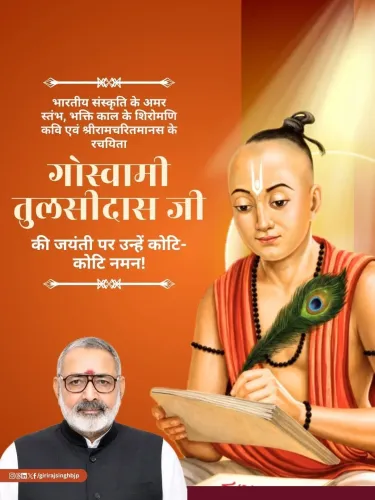
Giriraj Singh pays tribute to saint Meerabai on her Jayanti
Synopsis
Union Textiles Minister Giriraj Singh paid homage to the 16th-century Rajput poet-saint Meerabai on her Jayanti, hailing her devotion to Lord Krishna, her bhajans, and her legacy as a pillar of India's Bhakti movement.
Key Takeaways
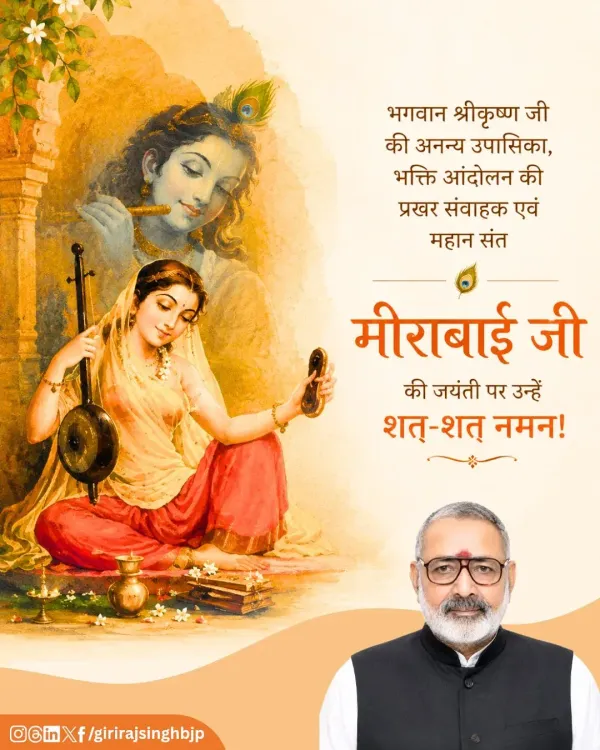
Union Textiles Minister Giriraj Singh posted a tribute to Meerabai on her birth anniversary on 26 October 2026 .
He described her as 'the devoted worshipper of Lord Krishna and a fierce bearer of the Bhakti movement.' Meerabai was a 16th-century Rajput princess from Rajasthan who composed hundreds of devotional bhajans for Lord Krishna.
Her work is considered a landmark of the Bhakti movement , which promoted personal devotion over ritual hierarchy across medieval India.
Senior BJP leaders regularly mark Bhakti-era saint anniversaries on social media, reflecting the party's emphasis on India's devotional heritage.
Meerabai Jayanti is observed with special fervour in Chittorgarh, Rajasthan and Vrindavan, Uttar Pradesh .
Centuries after she composed her immortal bhajans in devotion to Lord Krishna, Meerabai continues to draw reverence across India — and on Monday, 26 October 2026, Union Textiles Minister Giriraj Singh joined that long tradition, offering his homage to the 16th-century poet-saint on her birth anniversary.
In his post on X, Minister Singh wrote: 'भगवान श्रीकृष्ण जी की अनन्य उपासिका, भक्ति आंदोलन की प्रखर संवाहक एवं महान संत मीराबाई जी की जयंती पर उन्हें कोटिशः नमन!' — loosely translated as, 'A thousand salutations to the great saint Meerabai, the devoted worshipper of Lord Krishna and a fierce bearer of the Bhakti movement, on her birth anniversary.' He added that her life — shaped by 'unfathomable devotion, bhajans, and surrender' — stands as 'a unique example of love and spirituality' and 'a source of inspiration for all of us.'
Who was Meerabai — and why she endures
Meerabai was a Rajput princess born in the early 16th century in Rajasthan, whose life became one of the most radical spiritual statements of medieval India. She defied royal conventions and dedicated herself entirely to the worship of Lord Krishna, composing hundreds of bhajans — devotional songs — that remain alive in classical and folk music traditions to this day. Her verse crossed caste, class, and language barriers, making her a central figure in the broader Bhakti movement that swept across the Indian subcontinent between the 12th and 17th centuries.
That movement — which privileged personal, direct devotion to the divine over ritual hierarchy — produced figures like Kabir, Tukaram, and Surdas, but Meerabai stands apart as one of its few prominent women voices. Her songs survive in Rajasthani, Braj Bhasha, and Hindi, sung in temples, concert halls, and school classrooms across the country.
A political ritual with deep cultural roots
Senior BJP leaders have made a consistent practice of marking the birth anniversaries of Bhakti-era saints on social media — a pattern that reflects both personal faith and the party's broader cultural emphasis on India's devotional heritage. Giriraj Singh, a Lok Sabha MP from Begusarai, Bihar and a senior figure in the ruling establishment, has been a regular participant in such commemorations. These tributes carry no direct policy dimension but do reinforce a cultural vocabulary that resonates with a large section of the electorate.
Meerabai Jayanti is observed with particular fervour in Rajasthan — especially in Chittorgarh, where she spent significant years of her life — as well as in Vrindavan, Uttar Pradesh, the sacred city most associated with Krishna devotion.
Half a millennium on, Meerabai's question — 'Payo ji maine Ram ratan dhan payo' — still echoes. That is the rare currency no political cycle can mint or spend.
Point of View
Serving both as expressions of personal faith and as signals of the party's cultural-nationalist orientation. For Giriraj Singh, a senior leader whose base is in Bihar — itself a state with deep Bhakti and Vaishnava traditions — such commemorations reinforce a devotional vocabulary that travels well beyond caste and regional lines. Meerabai's particular appeal cuts across demographics: a rebellious woman, a royal who renounced power, a poet whose verses live in mass culture. Invoking her is politically uncomplicated and culturally resonant — which explains why her Jayanti rarely passes without prominent acknowledgement from across the political spectrum.
NationPress
26 Oct 2026
Frequently Asked Questions
Who was Meerabai and why is she celebrated?
Meerabai was a 16th-century Rajput princess from Rajasthan who became one of India's most revered poet-saints. She dedicated her life to the devotion of Lord Krishna and composed hundreds of bhajans that remain central to Indian classical and folk music. She is celebrated as a pioneering voice of the Bhakti movement.
When is Meerabai Jayanti celebrated?
Meerabai Jayanti marks the birth anniversary of the saint and is observed each year, with the date varying by the Hindu calendar. In 2026, Union Minister Giriraj Singh posted his tribute on 26 October.
What did Giriraj Singh say about Meerabai?
Giriraj Singh called Meerabai 'the devoted worshipper of Lord Krishna and a fierce bearer of the Bhakti movement' and said her life — shaped by unfathomable devotion, bhajans, and surrender — is 'a source of inspiration for all of us.'
Where is Meerabai Jayanti celebrated in India?
Meerabai Jayanti is observed with particular fervour in Chittorgarh, Rajasthan — where she spent formative years — and in Vrindavan, Uttar Pradesh, a sacred city closely linked to Lord Krishna's devotional tradition.
What is the Bhakti movement that Meerabai is associated with?
The Bhakti movement was a major religious and social movement in medieval India, spanning roughly the 12th to 17th centuries, that emphasised personal devotion to a chosen deity over ritual hierarchy and caste distinctions. Meerabai is one of its most celebrated figures, alongside Kabir, Tukaram, and Surdas.