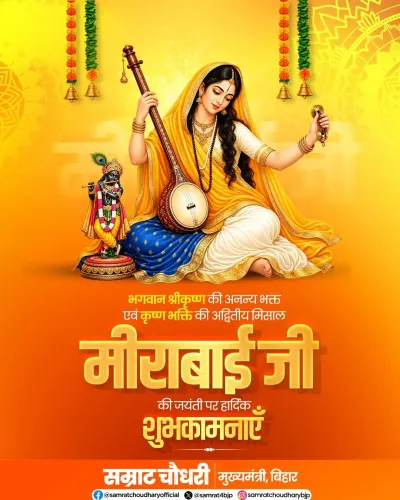
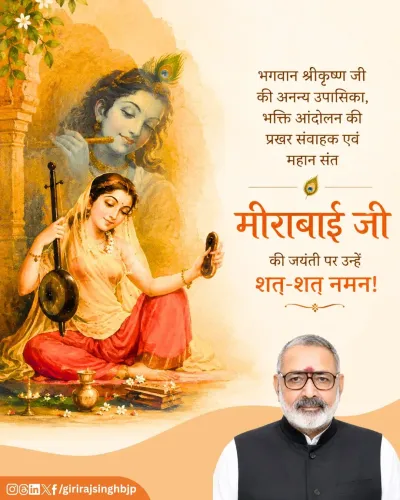
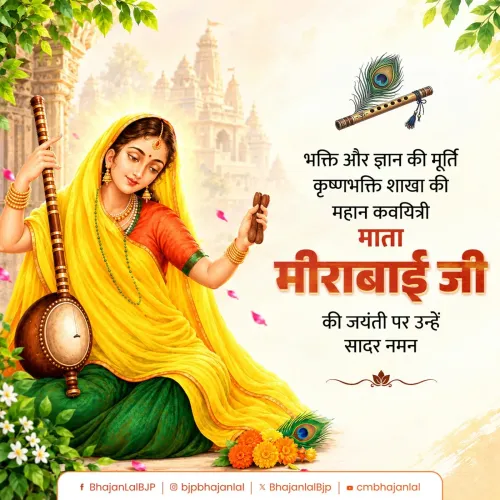
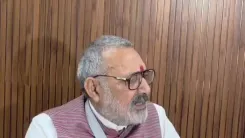
Shekhawat pays tribute to Mirabai on her Jayanti
Synopsis
Union Culture Minister Gajendra Singh Shekhawat marked Mirabai Jayanti by quoting her devotional verse on X, saluting the 16th-century Rajasthani poet-saint's Krishna bhakti legacy and the sacred soil of Rajasthan that gave her to the world.
Key Takeaways
Gajendra Singh Shekhawat , Union Minister of Culture and Tourism, posted a Mirabai Jayanti tribute on 26 October 2026 .
He quoted the bhajan line 'Aao Manmohana ji joun thaari baat' from Mirabai's own devotional canon.
Mirabai was a 16th-century Rajasthani princess-poet and central figure of the medieval Bhakti movement.
Her compositions in Braj Bhasha and Rajasthani remain living oral tradition sung across the subcontinent.
Sites linked to her life in Merta and Chittorgarh , Rajasthan, remain active pilgrimage destinations.
No new scheme or announcement was attached to the tribute; the post reflects the Ministry of Culture's routine Jayanti observances of Bhakti-era figures.
A verse that has echoed through Rajasthan's desert valleys for five centuries rang out again on Monday, as Union Culture and Tourism Minister Gajendra Singh Shekhawat marked the Jayanti of poet-saint Mirabai with a devotional couplet from her own timeless canon.
Shekhawat opened his tribute with the bhajan line — 'Aao Manmohana ji joun thaari baat' ('Come, O Manmohana, I await you') — a verse soaked in longing and surrender that Mirabai composed in her ecstatic devotion to Lord Krishna. He paired it with a salutation to 'the sacred soil of Rajasthan' that gave her to the world, offering what he described as repeated bows — baarambaar pranaam — to the saint's memory.
The 16th-century voice that never went silent
Mirabai, the 16th-century Rajasthani princess-poet, remains one of the most towering figures of the medieval Bhakti movement. Born into royalty, she renounced courtly life to compose hundreds of devotional padas — lyrical poems in Braj Bhasha and Rajasthani — addressed entirely to Krishna as her eternal beloved. Her compositions are sung at temple ghats, school assemblies, and classical concerts across the subcontinent to this day, a living oral tradition with no sign of fading.
Rajasthan claims her birthplace, and several sites associated with her life — from Merta, the town of her birth, to the Chittorgarh temple where she is said to have spent years in devotion — remain active pilgrimage destinations. Her story and verse have long been woven into the state's cultural identity.
Culture Ministry's steady observance of Bhakti heritage
Shekhawat's post is consistent with a broader pattern in which the Ministry of Culture — through its ministers and official channels — marks the Jayantis of medieval Bhakti-era figures as part of India's intangible heritage calendar. The ministry regards these observances as soft diplomacy for Indian civilisational continuity, celebrating figures whose influence crosses regional and linguistic lines.
No new scheme or cultural programme was announced alongside the tribute. But for the millions of Krishna devotees and Rajasthani cultural groups for whom Mirabai Jayanti is a moment of genuine reverence, a Union minister choosing a verse over a press release carries its own quiet weight.
Five hundred years on, Mirabai's waiting — and her poetry — show no signs of ending.
Point of View
Not archival, resource. For a Jodhpur MP, invoking a Rajasthani saint on her Jayanti also has an obvious constituency dimension — but the choice of verse, longing and surrender in equal measure, elevates it above mere political ritual.
NationPress
26 Oct 2026
Frequently Asked Questions
When is Mirabai Jayanti celebrated?
Mirabai Jayanti is observed on a date determined by the Hindu lunar calendar, typically falling in the month of Kartik or Shravan depending on regional tradition; the exact Gregorian date shifts each year.
Who was Mirabai and why is she important?
Mirabai was a 16th-century Rajasthani princess-poet and one of the most celebrated figures of the medieval Bhakti movement, renowned for her hundreds of devotional compositions addressed to Lord Krishna.
What verse did Shekhawat quote in his Mirabai tribute?
He quoted the opening line 'Aao Manmohana ji joun thaari baat' — a Mirabai bhajan expressing longing for Krishna — along with a second line about her complete absorption in devotion.
What is the connection between Mirabai and Rajasthan?
Rajasthan is regarded as Mirabai's birthplace; she is believed to have been born in Merta and spent years in devotion at temples in Chittorgarh , both of which remain active pilgrimage sites.
Why does India's Culture Ministry mark Bhakti-era Jayantis?
The Ministry of Culture treats the Jayantis of medieval Bhakti-era poet-saints as part of India's intangible cultural heritage calendar, using such observances to promote regional devotional traditions at the national level.