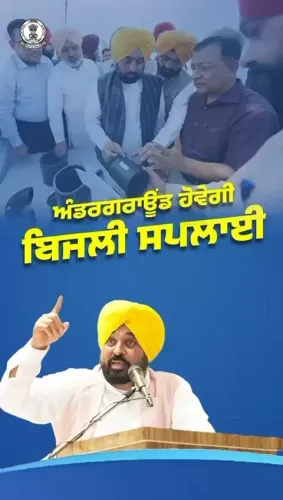
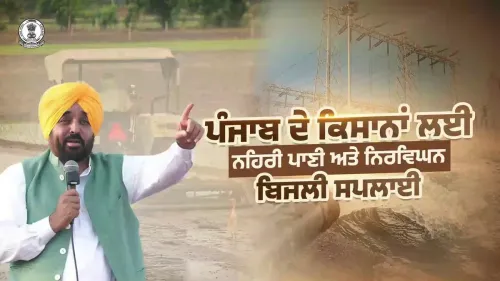
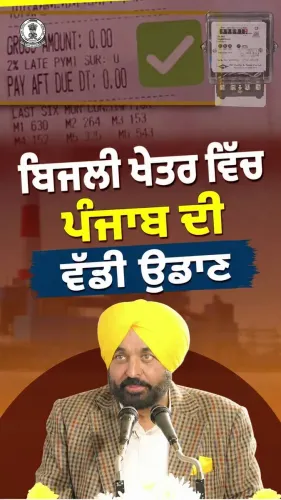
Punjab CM Bhagwant Mann Rolls Out 41 km Power Line Pilot
Synopsis
The Chief Minister's Office of Punjab announced a pilot project laying 41 km of new electricity lines and removing around 385 poles to modernise the state's power distribution network — a key infrastructure push under Chief Minister Bhagwant Mann's AAP government.
Key Takeaways
41 kilometres of new electricity lines are being laid under a state government pilot project.
Approximately 385 electricity poles are being removed to streamline the distribution network.
The project is framed as delivering better power infrastructure to every household in the targeted area.
The work is part of broader grid modernisation efforts by the Punjab State Power Corporation Limited under the Bhagwant Mann administration.
The pilot's success could determine the scale of grid upgrades in future state budgets or assembly sessions.
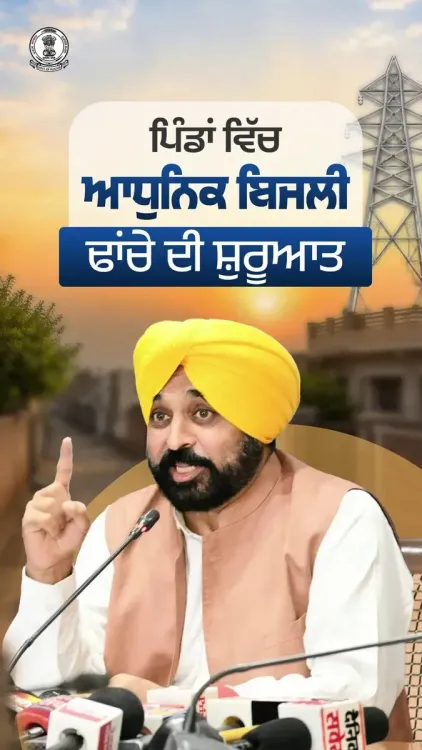
Forty-one kilometres of new power lines and nearly 385 electricity poles cleared from the ground — Punjab's Chief Minister's Office announced on Friday, August 7, 2026 that the state government is delivering a cleaner, more reliable electricity network to every household under a focused pilot project.
What the pilot project actually does
The initiative lays 41 kilometres of new electricity lines while simultaneously removing approximately 385 old poles — a two-pronged push that cuts visual clutter and, more importantly, reduces transmission losses that have long plagued Punjab's ageing distribution grid. The post, shared by the Chief Minister's Office of Punjab in Punjabi, frames this as a step toward a 'modern and efficient electricity system' (ਆਧੁਨਿਕ ਅਤੇ ਸੁਚਾਰੂ ਬਿਜਲੀ ਪ੍ਰਣਾਲੀ) reaching every home.
The work is being executed through the Punjab State Power Corporation Limited (PSPCL), the state body responsible for electricity distribution. Pole removal paired with fresh cabling is a standard modernisation technique — it consolidates overhead lines, improves load-bearing capacity, and makes fault detection faster after outages.
Inside the AAP government's power agenda
The pilot sits inside a broader electricity push that has defined Chief Minister Bhagwant Mann's administration since March 2022. The Aam Aadmi Party government's headline promise — up to 300 units of free electricity per month for households — created immediate pressure on the distribution network to handle rising consumption without buckling. Upgrading the physical infrastructure is the less visible but essential counterpart to that subsidy.
Punjab's power grid carries the dual burden of dense agricultural demand — tube-well connections run through the same network — and growing urban residential load. Incremental pilot projects like this one are designed to stress-test new configurations before a wider rollout, allowing engineers to measure actual loss reduction and reliability gains in a controlled stretch of the network.
What comes next for the grid upgrade
The pilot's results will likely inform whether the state allocates funds for district-wide replication in the next budget or assembly session. If transmission losses fall measurably on the 41 km stretch, the economic case for scaling up becomes hard to argue against — especially as the state balances the fiscal weight of its free-power scheme against the need to keep the grid solvent.
A modernised distribution backbone does not just mean fewer blackouts. It means the free electricity units the government promises can actually reach meters reliably — making infrastructure investment the quiet guarantor of the state's most visible welfare commitment.
Point of View
And framing them as a pilot signals the government is building an evidence base for larger capital allocation. The real test will be whether transmission loss data from this stretch is made public and used to justify district-wide expansion, or whether the announcement remains a one-off communications exercise ahead of the next budget cycle.
NationPress
7 Aug 2026
Frequently Asked Questions
What is the Punjab electricity pilot project announced in August 2026?
The Punjab government is laying 41 kilometres of new electricity lines and removing around 385 old poles under a pilot project aimed at modernising the state's power distribution network and improving supply reliability for every household.
Which agency is carrying out the power line work in Punjab?
The work is being carried out through the Punjab State Power Corporation Limited (PSPCL) , the state body responsible for electricity distribution across Punjab.
How does this relate to Punjab's free electricity scheme?
The Aam Aadmi Party government provides up to 300 units of free electricity per month to households. Upgrading the physical grid is essential to ensure those units reach consumers reliably without transmission losses eroding the benefit.
Will the pilot project be expanded to other parts of Punjab?
The government has not announced a specific expansion plan yet. The pilot's results are expected to inform future budget allocations and decisions in the state assembly regarding district-wide rollout.
Why are old electricity poles being removed as part of the project?
Removing ageing poles and replacing them with new cabling consolidates the distribution network, reduces transmission losses, improves load capacity, and makes fault detection faster — all of which translate to fewer and shorter power outages.