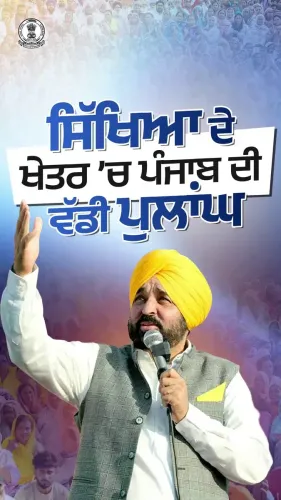
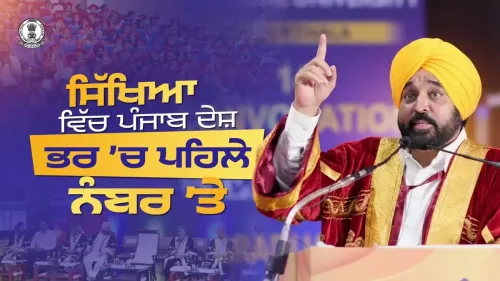
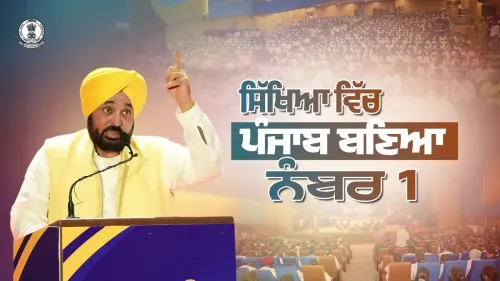
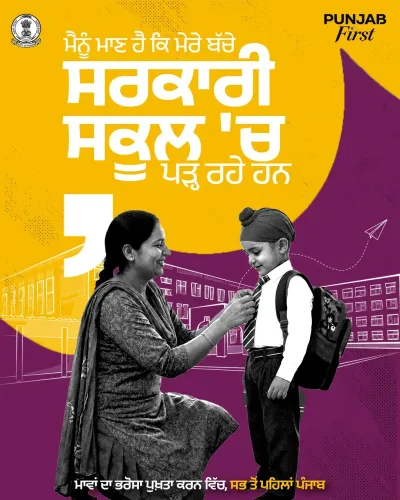
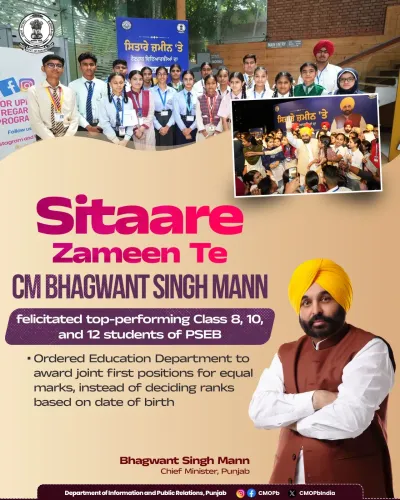
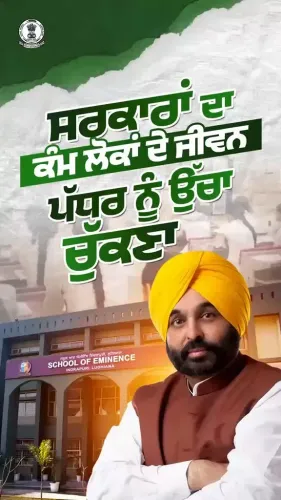
Punjab CM Bhagwant Mann: State jumps from 27th to 1st in primary education
Synopsis
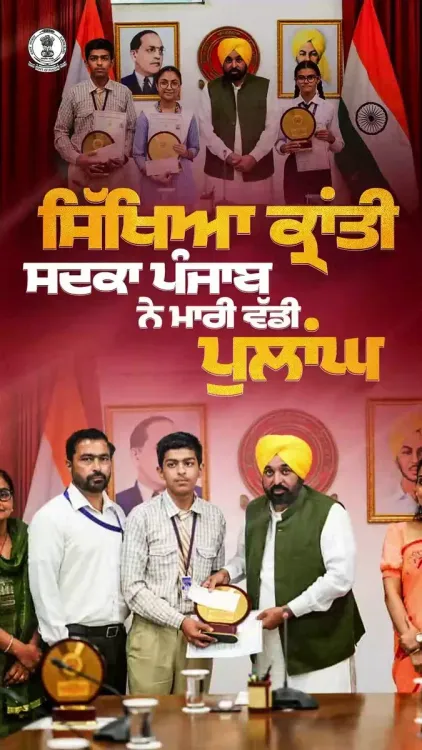
Chief Minister Bhagwant Mann has declared Punjab rose from 27th to 1st in national primary education rankings between 2021 and 2026, overtaking Kerala for the first time, crediting sustained reforms by the AAP government since 2022.
Key Takeaways
Punjab ranked 27th out of 28 states in primary education in 2021 and now claims 1st place nationally in 2026 .
Kerala , long India's education leader, has been displaced at the top for the first time by Punjab.
CM Bhagwant Mann attributed the rise to 'historic reforms' and sustained efforts by the Punjab government since taking office in March 2022 .
The Aam Aadmi Party has used Delhi's school-reform model as a template for Punjab's education overhaul.
The specific ranking source has not been publicly cited; independent surveys such as ASER and UDISE+ will be key to external validation.
From near the bottom of the national table to the very top — Punjab has claimed one of the sharpest education turnarounds in India's recent history. Chief Minister Bhagwant Mann, on Wednesday, 4 November 2026, declared that Punjab now ranks first among states nationally in primary education, overtaking Kerala for the first time ever — a state whose grip on India's education leadership has been near-unbroken for decades.
Speaking through the Chief Minister's Office of Punjab, Mann stated that in 2021, Punjab sat at 27th place out of 28 states in primary education rankings. Five years and one government later, the state has vaulted to first position in 2026 — displacing Kerala, long the gold standard for learning outcomes in India.The Kerala benchmark Punjab just cleared
For decades, Kerala has been synonymous with India's best education outcomes — high literacy, low dropout rates, strong foundational learning. For a northern state to displace it at the top of a national primary education ranking is not a routine statistical shuffle. It is the kind of result that resets expectations for what is achievable in states that have historically lagged on schooling metrics.
The Punjabi phrase used in the official post — 'ਨਵੀਂ ਮਿਸਾਲ ਕਾਇਮ ਕੀਤੀ ਹੈ' ('a new benchmark has been established') — signals that the government is positioning this not as a data point but as a defining legacy claim ahead of the electoral cycle.
The AAP education playbook, now running in Punjab
The Aam Aadmi Party has treated school reform as its most exportable political asset. Its Delhi government, from 2015 onwards, pursued a highly visible programme of infrastructure upgrades and structured teacher training that generated national and international attention. When AAP swept the Punjab assembly elections in March 2022, education reform was central to its mandate — and Delhi's model was the stated template.
What those reforms involved specifically in Punjab — curriculum changes, infrastructure spend, teacher accountability mechanisms — has not been detailed in the official statement. What the government has put on record is the headline: a 26-rank climb in five years.
What the numbers need next
The ranking claim is striking, and it will face scrutiny. National surveys such as UDISE+ (the Unified District Information System for Education) and the annual ASER (Annual Status of Education Report) are the standard independent benchmarks used to validate or contest state-level education performance. Neither has been cited in the official statement as the source of the 2026 first-place ranking.
Until the underlying dataset and methodology are public, the claim stands as the government's own assertion — a powerful one, but one that independent survey data will ultimately confirm or complicate. For now, it is the boldest education headline any northern Indian state has produced in recent memory.
Point of View
However, is a claim that will draw intense methodological scrutiny, since Kerala's advantage in education outcomes is structural and multi-decade. If validated by independent surveys, it would significantly strengthen AAP's governance credentials nationally ahead of future elections; if the data source proves to be narrow or contested, the headline could become a liability. Either way, it sharpens the federal conversation about whether rapid, politically-driven reform can close gaps that decades of policy failed to move.
NationPress
4 Nov 2026
Frequently Asked Questions
What rank did Punjab hold in primary education in 2021?
Punjab ranked 27th out of 28 states in primary education in 2021 , according to the Chief Minister's Office statement.
Which state did Punjab overtake to reach number one in education?
Kerala , traditionally ranked as India's top-performing state in education and literacy, was overtaken by Punjab for the first time to claim the first position in 2026 .
What education reforms did the Punjab government introduce?
The official statement does not detail specific reforms, but the AAP government modelled its approach on the school infrastructure upgrades and teacher training programmes it ran in Delhi from 2015 .
Which survey or index confirmed Punjab's number-one education ranking in 2026?
The Chief Minister's Office statement has not cited a specific survey. Independent national benchmarks such as UDISE+ and ASER are expected to provide external validation of the claimed ranking.
When did the AAP government take charge in Punjab and what was its education promise?
The Aam Aadmi Party won the Punjab assembly elections in March 2022 with education reform as a central campaign promise, pledging to replicate the school transformation it had led in Delhi.