Punjab CMO marks World Environment Day, highlights key threats
Synopsis
The Chief Minister's Office of Punjab observed World Environment Day on 5 June 2026, calling attention to climate change, deforestation, pollution, and biodiversity loss. The message aligns with the UN's annual global observance, established in 1972, and reflects the state government's public commitment to environmental awareness.
Key Takeaways
The Chief Minister's Office of Punjab posted a World Environment Day message on 5 June 2026 .
World Environment Day is an annual UN observance established by the General Assembly in 1972 following the Stockholm Conference.
The post identified climate change, deforestation, pollution, and biodiversity loss as key environmental challenges requiring action.
No new schemes, targets, or budget allocations were announced in the post.
Punjab's agricultural communities are among the most directly exposed to the environmental pressures named in the message.
Policy watchers will monitor whether substantive state-level environmental actions follow in the coming months.
The Chief Minister's Office of Punjab on 5 June 2026 marked World Environment Day, underlining the urgency of tackling climate change, deforestation, pollution, and biodiversity loss while calling for stronger environmental protection.
Context
World Environment Day is observed every year on 5 June and stands as the United Nations' principal vehicle for encouraging awareness and action for the protection of the environment. The day traces its origins to the 1972 Stockholm Conference, where the UN General Assembly passed a resolution establishing the annual observance. Over five decades, it has grown into one of the largest global platforms for public outreach on environmental issues.
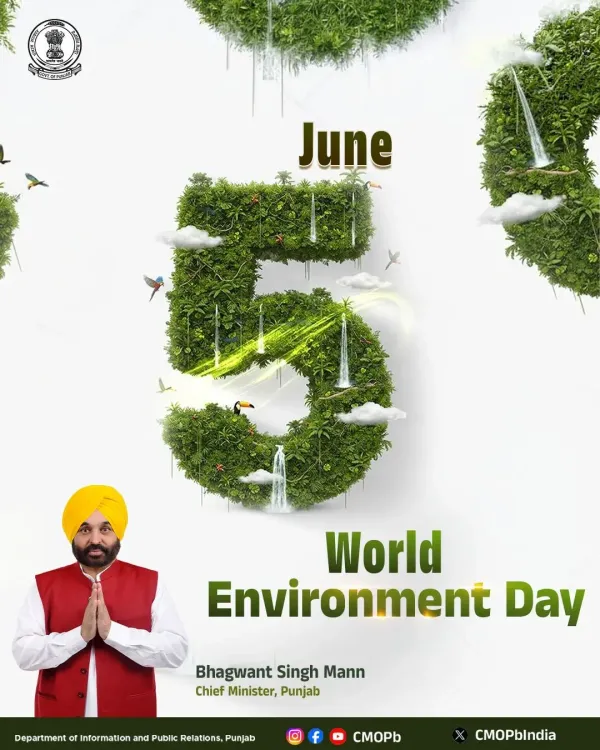
The CMO Punjab post stated: 'World Environment Day, observed annually on 5 June, underscores the need to address challenges such as climate change, deforestation, pollution, and biodiversity loss, while promoting environmental protection.' The message was accompanied by a graphic and shared under the hashtags #ਵਿਸ਼ਵ_ਵਾਤਾਵਰਣ_ਦਿਵਸ [World Environment Day in Punjabi] and #ਮੁੱਖ_ਮੰਤਰੀ_ਦਫ਼ਤਰ_ਪੰਜਾਬ [Chief Minister's Office Punjab in Punjabi].
Policy Backdrop
Indian state governments routinely use international environmental observance days to align official communication with global themes. Such posts from Chief Minister's Office accounts typically operate at the level of general awareness and solidarity rather than announcing new schemes, targets, or budget allocations. Punjab, as a predominantly agrarian state, faces particular environmental pressures including soil degradation, groundwater depletion, and seasonal air-quality crises linked to stubble burning.
The four challenges highlighted in the post — climate change, deforestation, pollution, and biodiversity loss — reflect the broad thematic pillars that the United Nations Environment Programme (UNEP) has consistently foregrounded in its annual World Environment Day campaigns since the observance's founding in 1972.
Stakeholders and Impact
Punjab's residents and its large agricultural communities are among the most directly affected by the environmental challenges named in the post. Farmers in the state have faced growing pressure over water-intensive cropping patterns and air pollution from crop residue burning, issues that intersect with climate adaptation, biodiversity, and public health. Messaging from the state's highest office on these themes carries symbolic weight for communities navigating these pressures.
Environmental advocacy groups and civil society organisations active in the state have long called for concrete policy follow-through beyond awareness communications, particularly on groundwater management and clean-air action plans. The post does not announce any new measures or schemes.
What's Next
Observers will watch whether the Punjab government follows its World Environment Day communication with substantive announcements — such as state-level environmental notifications, revised budget allocations for green initiatives, or coordination with central government schemes on climate adaptation and pollution control — in the weeks and months ahead. The annual observance often serves as a prompt for state administrations to table or accelerate pending environmental policy decisions.
Point of View
Air pollution, and climate stress, the choice to highlight all four major environmental challenges — rather than a single headline issue — signals an intent to project comprehensive environmental concern. However, the absence of any policy announcement means the communication remains aspirational rather than programmatic. The post's real significance will be determined by what, if any, concrete state-level action follows in the legislative or budgetary calendar.
NationPress
20 Oct 2026
Frequently Asked Questions
When is World Environment Day observed?
World Environment Day is observed every year on 5 June . It was established by the United Nations General Assembly in 1972 following the Stockholm Conference on the Human Environment.
What did the Punjab Chief Minister's Office say on World Environment Day 2026?
The Chief Minister's Office of Punjab posted a message on 5 June 2026 stating that World Environment Day underscores the need to address climate change, deforestation, pollution, and biodiversity loss while promoting environmental protection.
Did the Punjab government announce any new environmental scheme on World Environment Day 2026?
No new schemes, targets, or budget allocations were announced in the post. The communication was an awareness message marking the international observance.
Why is World Environment Day important for Punjab?
Punjab faces significant environmental pressures including groundwater depletion, air pollution from crop residue burning, and soil degradation — issues that directly intersect with the themes of climate change, pollution, and biodiversity loss highlighted on World Environment Day.
Who established World Environment Day?
The United Nations General Assembly established World Environment Day in 1972 as part of the outcomes of the Stockholm Conference, making it the UN's primary platform for global environmental awareness.