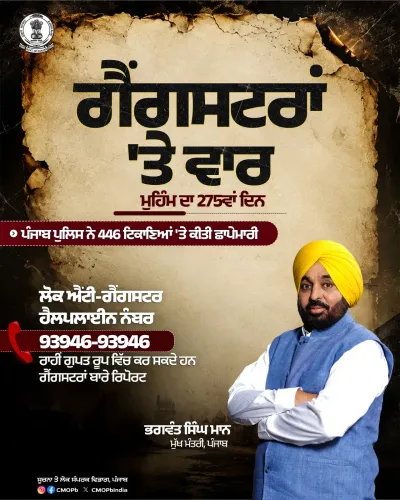
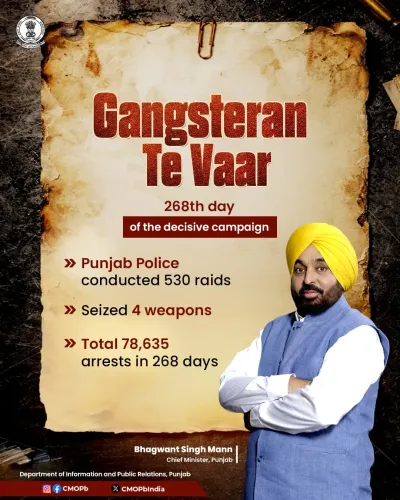
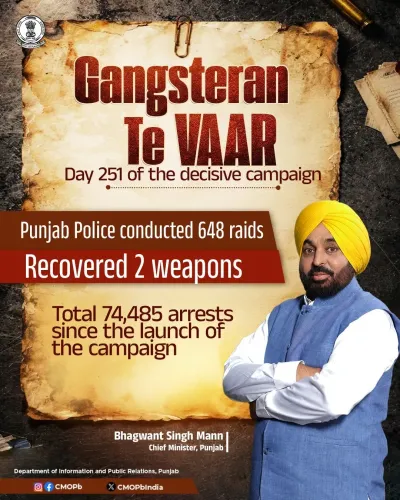
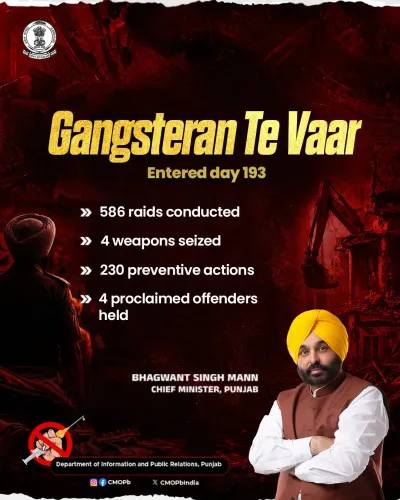
Punjab Police Hits Day 302 of 'Gangsteran Te Vaar', 85,084 Arrested
Synopsis
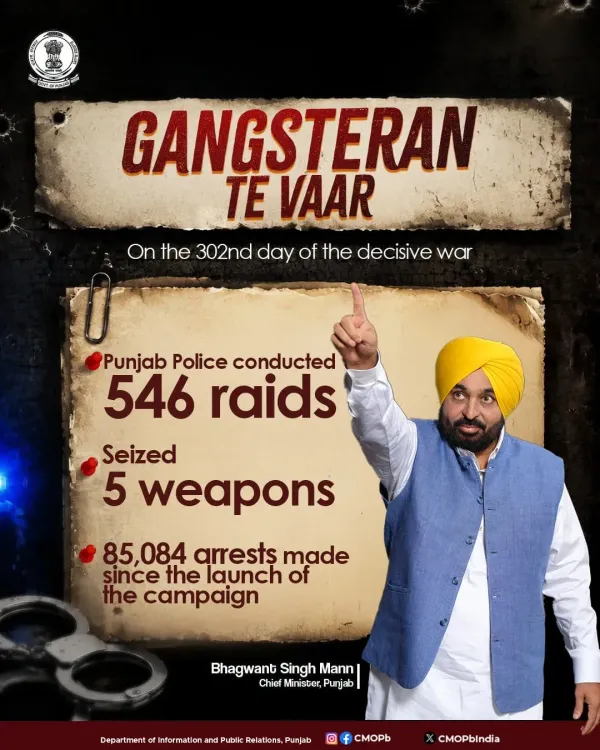
On Day 302 of 'Gangsteran Te Vaar', Punjab Police conducted 546 raids, recovered five weapons, and arrested more individuals, taking total campaign arrests to 85,084. The Chief Minister's Office of Punjab announced the update on 19 November 2026.
Key Takeaways
546 raids were conducted on Day 302 of the 'Gangsteran Te Vaar' campaign, targeting locations linked to gangster associates across Punjab.
Police recovered five weapons and made fresh arrests during the day's operations.
Total arrests since the campaign's launch have reached 85,084 .
The campaign was launched under the CM Bhagwant Mann -led AAP government, which took office in March 2022 .
Raids target pre-mapped locations — safe houses, associates, and support nodes — to disrupt gangster network infrastructure.
Daily public updates from the Chief Minister's Office of Punjab are a consistent feature of the campaign's transparency strategy.
Three hundred and two days in, and Punjab Police are not letting up. On Thursday, 19 November 2026, the Chief Minister's Office of Punjab announced that the state's flagship anti-gangster drive, 'Gangsteran Te Vaar', clocked another day of relentless action — 546 raids at identified and mapped locations linked to associates of gangsters across the state, fresh arrests, and the recovery of five weapons.
546 raids, five weapons, one more day on the board
The day's operations pushed the campaign's cumulative arrest tally to a staggering 85,084 since its launch. The raids were not random sweeps — they targeted pre-mapped locations connected to the broader ecosystem supporting gangster networks: safe houses, associates, and logistical nodes that keep organised crime operational. Recovering five weapons on a single operational day underlines that the campaign is still pulling hard intelligence off the ground, not simply running down old leads.
The Chief Minister Bhagwant Mann-led Aam Aadmi Party government has made the daily public update a signature feature of this campaign, treating each operational bulletin as both a law-enforcement report and a political signal to residents: the pressure on gangster networks is constant and transparent.
Why Punjab's gangster problem demanded a campaign of this scale
Punjab has grappled with organised crime, extortion networks, and gang-related violence for over a decade. Criminal syndicates operating across state and even international borders have used the state as a base for extortion, contract killings, and narcotics trafficking — often with cross-overs between gang activity and drug supply chains. Successive governments launched targeted operations, but the scale and consistency of 'Gangsteran Te Vaar' — now well past its 300th consecutive day — represents a sustained pressure model rather than a short-burst crackdown.
Since CM Bhagwant Mann took office in March 2022, law and order has been a defining political priority. The campaign's daily reporting cadence also serves an accountability function: it creates a public record that can be scrutinised in upcoming state assembly sessions when legislators press for overall crime statistics.
What 85,084 arrests signal about network disruption
An arrest count approaching 85,000 over roughly ten months does not mean 85,000 kingpins are off the streets. Many will be associates, logistics providers, and low-level enablers — but that is precisely the point. Dismantling a gangster network means stripping away the infrastructure: the drivers, the weapons handlers, the money movers, the tip-off sources. Each raid and arrest degrades the network's ability to reconstitute quickly. Whether that degradation is translating into measurable drops in gang-related violence and extortion calls will be the real measure of the campaign's legacy when periodic crime statistics are finally published.
Point of View
Publicly reported pressure — a governance model the AAP administration has leaned on heavily to demonstrate law-and-order credibility. At 85,084 total arrests over 302 days, the sheer volume signals a wide-net strategy targeting the ecosystem around gangsters, not just the principals. The critical question heading into Punjab's next assembly session will be whether this operational intensity has produced verifiable reductions in gang-related extortion and violence, or whether the numbers reflect quantity over systemic disruption. Either way, the daily reporting cadence has set a high accountability benchmark that future Punjab governments will find difficult to walk back.
NationPress
19 Nov 2026
Frequently Asked Questions
What is the 'Gangsteran Te Vaar' campaign in Punjab?
'Gangsteran Te Vaar' is a Punjab Police anti-gangster campaign launched under the CM Bhagwant Mann-led AAP government, targeting gangsters, their associates, and criminal support networks through daily raids, arrests, and weapons seizures across the state.
How many arrests have been made in Punjab's Gangsteran Te Vaar campaign?
As of Day 302 of the campaign on 19 November 2026, total arrests have reached 85,084 since the drive's launch.
How many raids did Punjab Police conduct on Day 302 of Gangsteran Te Vaar?
Punjab Police conducted 546 raids at identified and mapped locations linked to gangster associates on Day 302 of the campaign.
Who launched the Gangsteran Te Vaar campaign in Punjab?
The campaign was launched by the Punjab Police under the direction of the AAP government led by Chief Minister Bhagwant Mann, who took office in March 2022.
What weapons were recovered during Punjab Police raids on Day 302?
Punjab Police recovered five weapons during the operations conducted on Day 302 of the 'Gangsteran Te Vaar' campaign on 19 November 2026.