Punjab Police hits Day 251 of 'Gangsteran Te Vaar', 648 raids conducted
Synopsis
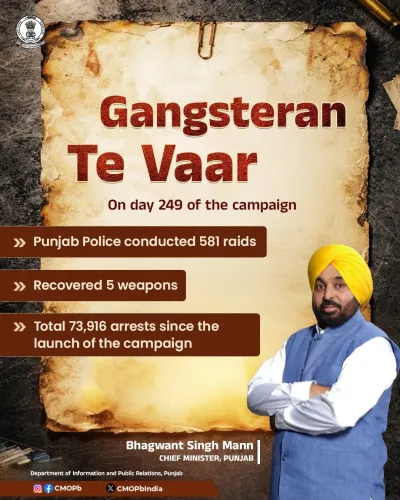
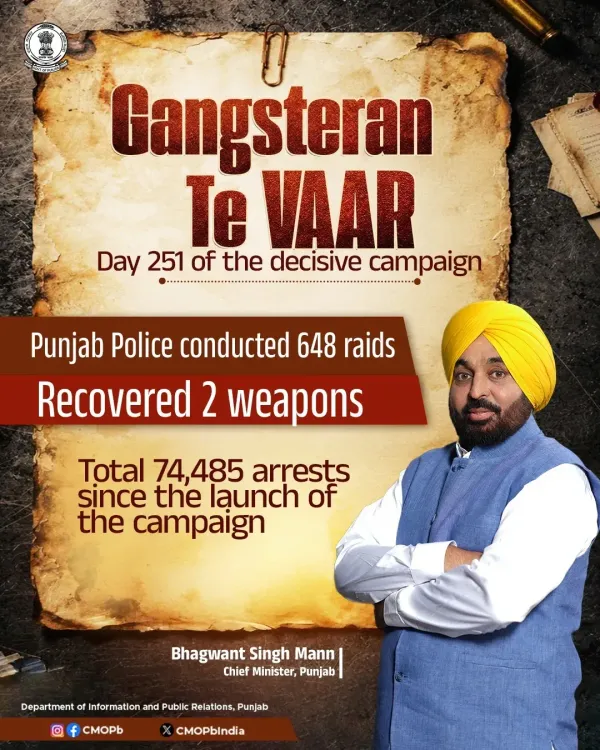
On Day 251 of 'Gangsteran Te Vaar', Punjab Police carried out 648 raids targeting gangster-linked locations across the state, recovered two weapons, and pushed total campaign arrests to 74,485, the Chief Minister's Office announced on September 29, 2026.
Key Takeaways
648 raids were conducted on Day 251 of the 'Gangsteran Te Vaar' campaign at mapped locations linked to gangster associates.
Two weapons were recovered during the Day 251 operations.
Total arrests since the campaign's launch have reached 74,485 .
The campaign has now run for 251 consecutive days , reflecting a sustained rather than episodic policing approach.
The drive is a flagship law-and-order initiative of Chief Minister Bhagwant Mann's AAP government, in office since March 2022.
Daily public updates on raid counts and arrest totals are a deliberate transparency feature of the campaign's communication strategy.
Two hundred and fifty-one days of sustained pressure — and Punjab Police is not letting up. The Chief Minister's Office of Punjab confirmed on Tuesday, September 29, 2026, that the ongoing anti-gangster drive, 'Gangsteran Te Vaar', extended its reach on Day 251 with 648 raids at locations linked to gangster associates across the state, yielding fresh arrests and the recovery of two weapons.
648 raids, two weapons, and a running total that keeps climbing
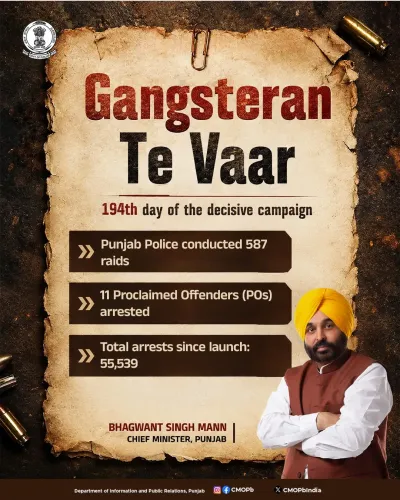
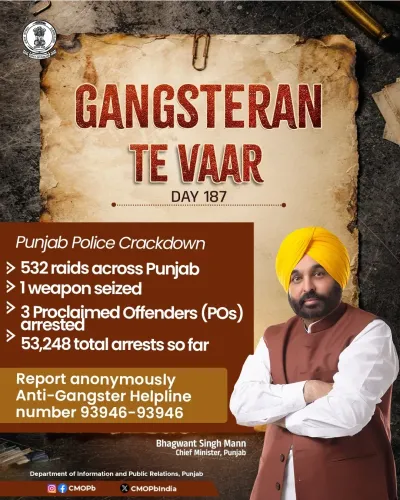
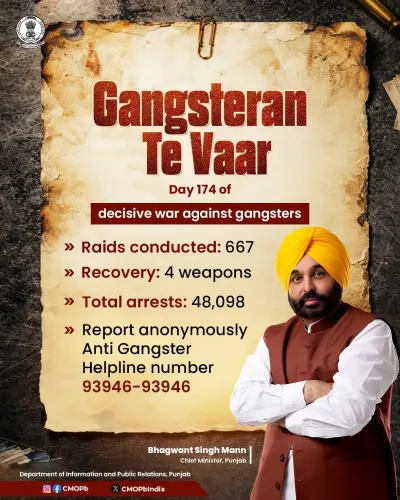
The single-day operation swept through identified and mapped locations tied to gangster networks, resulting in new arrests and bringing the campaign's cumulative arrest count to 74,485 since the drive's launch. Each daily update follows the same unrelenting cadence: raids, recoveries, arrests — a deliberate show of sustained institutional pressure rather than one-off crackdowns.
Weapons recovered on Day 251 are the latest addition to a growing inventory of seized arms that the campaign has steadily built over its eight-plus-month run. The CMO's post, tagged with #GangsteranTeVaar and #CMBhagwantMann, frames the day's action as part of a 'decisive' offensive — language that signals the administration intends no slowdown.
Why 'Gangsteran Te Vaar' matters beyond the daily scorecard
Punjab's confrontation with organised crime is not a new story. Gang violence, drug syndicates, and extortion networks escalated sharply through the 2010s and 2020s, drawing national attention and straining local communities. When the Aam Aadmi Party, led by Chief Minister Bhagwant Mann, came to power in March 2022, dismantling these networks was positioned as a central governance commitment — not a talking point.
'Gangsteran Te Vaar' operationalises that commitment through volume and consistency: mapping associate networks, raiding systematically, and publishing the numbers publicly every day. The daily transparency serves a dual purpose — accountability to Punjab residents and a psychological signal to criminal networks that no associate is invisible.
Eight months of pressure and what it tells us about the strategy
High-volume police operations of this kind are designed to disrupt criminal ecosystems at their edges — the associates, logistics chains, and safe-house networks that enable gang leaders to operate. With 74,485 total arrests logged across the campaign, the sheer scale suggests the Punjab Police is targeting breadth: cutting off the human infrastructure that sustains organised crime rather than pursuing only headline-grabbing arrests at the top.
Whether that strategy translates into durable reductions in gang activity will depend on how many of those arrests result in prosecutions — a metric the daily updates do not yet capture, and one that watchful Punjab residents will eventually demand.
Point of View
Though critics of high-volume arrest campaigns often question conversion rates into sustainable convictions. For Chief Minister Bhagwant Mann, maintaining the campaign's momentum past the 250-day mark signals institutional seriousness; the harder test will be whether Punjab's courts and prosecution machinery can absorb the caseload it generates. In a state with a complex history of organised crime, the campaign's longevity is notable — but longevity alone will not be the final measure of success.
NationPress
29 Sept 2026
Frequently Asked Questions
What is the 'Gangsteran Te Vaar' campaign in Punjab?
'Gangsteran Te Vaar' is an ongoing Punjab Police anti-gangster campaign launched under Chief Minister Bhagwant Mann's AAP government that conducts daily coordinated raids on locations linked to gangsters and their associates across the state.
How many arrests have been made under Gangsteran Te Vaar?
As of Day 251 of the campaign, a total of 74,485 arrests have been made since the drive's launch, according to the Chief Minister's Office of Punjab.
How many raids did Punjab Police conduct on Day 251?
Punjab Police conducted 648 raids on Day 251 of the 'Gangsteran Te Vaar' campaign, targeting identified and mapped locations linked to gangster associates across the state.
Who launched the Gangsteran Te Vaar campaign?
The 'Gangsteran Te Vaar' campaign is a Punjab Police initiative operating under the Bhagwant Mann-led AAP government, which took office in March 2022 with combating organised crime as a core governance priority.
What weapons were recovered on Day 251 of Gangsteran Te Vaar?
Punjab Police recovered two weapons during the Day 251 operations of the 'Gangsteran Te Vaar' campaign, as reported by the Chief Minister's Office on September 29, 2026.