Punjab Police Raids 512 Locations on Day 122 of Gangster Crackdown
Synopsis
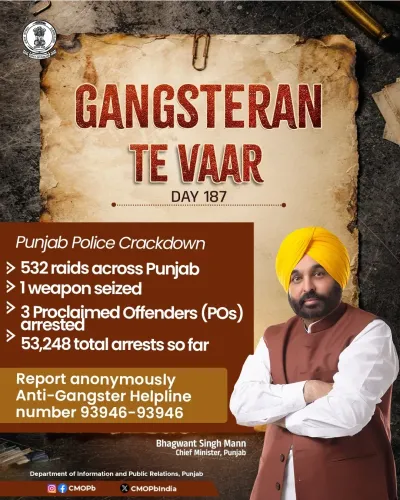
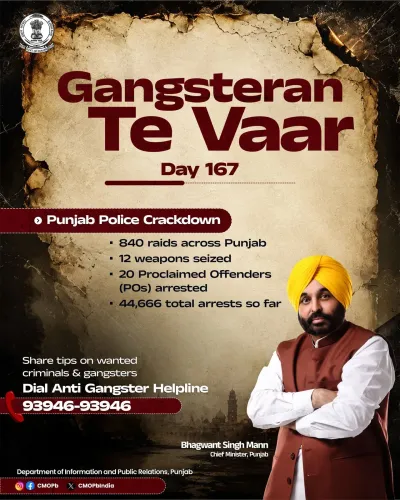
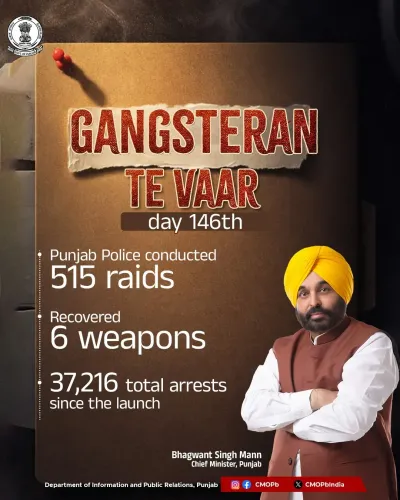
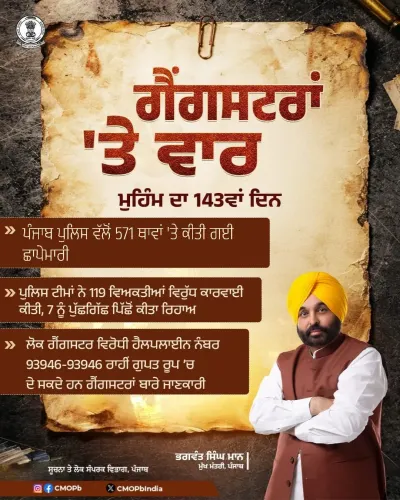
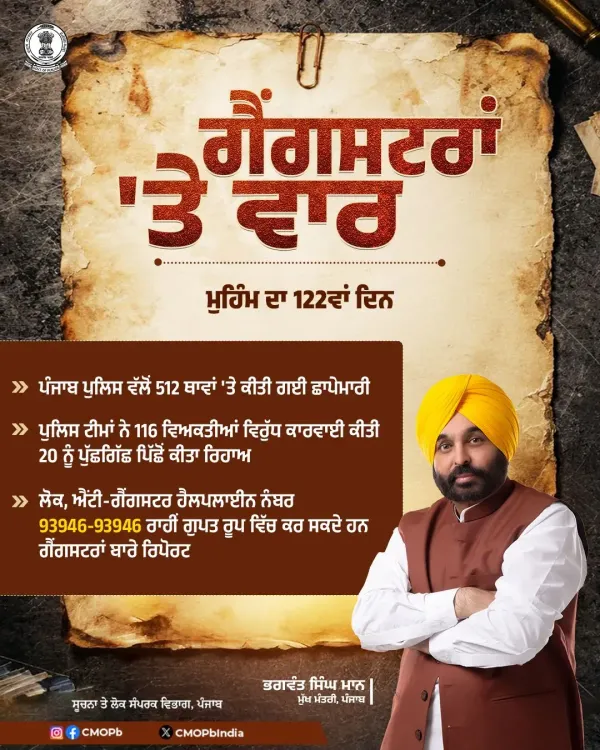
On Day 122 of Punjab's Gangstran Te Vaar campaign, police raided 512 mapped locations linked to gangster associates, arrested individuals carrying six weapons, and pushed the campaign's total arrest count to 31,208, the Chief Minister's Office announced on 23 May 2026.
Key Takeaways
512 raids were conducted simultaneously at pre-identified and mapped locations of gangster associates across Punjab on 22 May 2026 .
Six weapons were seized alongside fresh arrests made during the Day 122 operations.
The campaign's cumulative arrest tally has reached 31,208 since the Gangstran Te Vaar launch.
The Chief Minister's Office of Punjab publicised the update in both Punjabi and English, reflecting a consistent public-communications strategy.
The crackdown is a flagship initiative of Chief Minister Bhagwant Mann 's AAP government, which took office in March 2022 on a zero-tolerance platform against organised crime.
Raid sites were described as 'identified and mapped', indicating intelligence-led operations rather than random enforcement sweeps.
Punjab Police conducted simultaneous raids on 512 identified locations linked to gangster associates across the state on Saturday, 23 May 2026, as the Chief Minister's Office of Punjab announced the latest operational update of the ongoing Gangstran Te Vaar ('War on Gangsters') campaign, now in its 122nd day. The raids resulted in fresh arrests of individuals found in possession of six weapons, pushing the campaign's cumulative arrest tally to 31,208.
Context
The Chief Minister's Office of Punjab posted the update in both Punjabi and English, stating: 'ਸੂਬੇ ਵਿੱਚ ਚੱਲ ਰਹੀ ਫ਼ੈਸਲਾਕੁੰਨ ਮੁਹਿੰਮ' ('the decisive campaign underway in the state') has seen police teams fan out to pre-mapped locations of gangster networks. The 512 raid sites were described as 'identified and mapped', indicating intelligence-led targeting rather than random sweeps. Six weapons were recovered alongside the fresh arrests made on Friday, 22 May 2026.
The Gangstran Te Vaar campaign was launched by Punjab Police under the Aam Aadmi Party government led by Chief Minister Bhagwant Mann, who took office in March 2022 with an explicit zero-tolerance pledge against organised crime. The campaign has since become a flagship law-and-order initiative of the state administration.
Policy Backdrop
Punjab has historically grappled with organised gang violence, extortion networks, and arms proliferation, challenges often traced to cross-border smuggling routes and the state's entrenched drug trade. Successive governments have periodically mounted enforcement drives, but the current campaign is notable for its scale and the regularity with which operational data is being made public.
The Mann government framed the crackdown as integral to its broader governance agenda, linking gang networks to the drug supply chain and external criminal syndicates. The daily cadence of raid updates, circulated through the official CMO Punjab social media handle, reflects a deliberate communications strategy to signal sustained political will on law and order.
Stakeholders and Impact
The primary beneficiaries of a sustained crackdown are Punjab's civilian residents, particularly in districts historically affected by extortion calls, gang shootings, and drug-linked violence. The recovery of six weapons in a single day's operations, while incremental, contributes to a broader effort to reduce the illegal arms supply available to criminal networks.
Gangster associates — the immediate targets of the raids — represent the logistical and support layer of organised crime: safe-house providers, arms couriers, and financiers. By mapping and repeatedly raiding these locations, Punjab Police aims to degrade the operational capacity of gang leadership, many of whom are believed to be directing activities from outside India. The cumulative figure of 31,208 arrests since the campaign's launch underscores the volume of the enforcement effort.
What's Next
Analysts and civil-society groups will watch whether the high arrest numbers translate into successful prosecutions and long-term dismantling of gang hierarchies, or whether the networks reconstitute themselves over time. Punjab Police is expected to release periodic consolidated crime statistics that will offer a clearer picture of trends in gang-related incidents, extortion complaints, and illegal arms recoveries.
Any proposed amendments to state laws governing organised crime or preventive detention — tools that could give police longer-term custodial leverage over gang associates — would be a significant legislative signal. For now, the Gangstran Te Vaar campaign continues to serve as the government's most visible answer to the question of whether Punjab's law-and-order situation is genuinely improving under the AAP administration.
Point of View
Measurable anti-crime action in a state where gang violence has historically defined electoral narratives. A cumulative tally of over 31,000 arrests is a striking headline figure, but the true test will be whether conviction rates and long-term crime indices move in the same direction. The focus on 'identified and mapped' locations signals a shift toward intelligence-led policing, which, if sustained, could mark a structural departure from the reactive enforcement cycles of previous administrations. How Punjab's courts and prisons absorb this volume of cases will be a critical, if less publicised, part of the story.
NationPress
22 Sept 2026
Frequently Asked Questions
What is the Gangstran Te Vaar campaign in Punjab?
Gangstran Te Vaar, meaning 'War on Gangsters', is an ongoing Punjab Police campaign launched under Chief Minister Bhagwant Mann's AAP government to dismantle organised crime networks through intelligence-led raids on gangster associates, illegal arms recovery, and mass arrests across the state.
How many arrests have been made in the Gangstran Te Vaar campaign so far?
As of Day 122 of the campaign, the total number of arrests stands at 31,208, according to the Chief Minister's Office of Punjab's update posted on 23 May 2026.
How many raids did Punjab Police conduct on Day 122?
Punjab Police conducted 512 raids on Day 122 of the Gangstran Te Vaar campaign, targeting pre-identified and mapped locations linked to associates of gangsters across the state.
What weapons were recovered in the latest Punjab Police anti-gangster raids?
Six weapons were recovered during the Day 122 raids conducted on 22 May 2026, seized alongside the individuals arrested at the targeted locations.
Who is leading the anti-gangster campaign in Punjab?
The campaign is being conducted by Punjab Police under the political direction of Chief Minister Bhagwant Mann, whose Aam Aadmi Party government has made combating organised crime and the drug trade a central plank of its governance agenda since taking office in March 2022.