Punjab VB Books 1091 Corruption Cases, 242 Convicted Since 2022

Synopsis
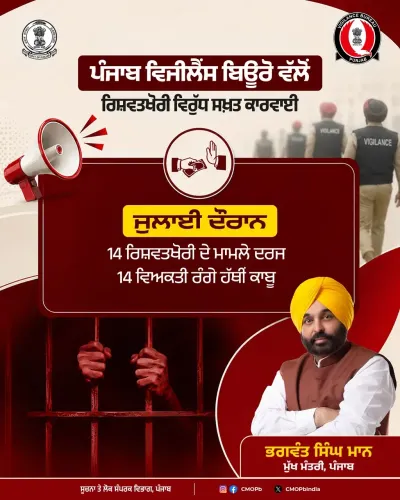
The Punjab Vigilance Bureau has registered 1,091 corruption cases and arrested 1,138 accused since March 2022, the CMO announced on 20 August 2026. Courts have convicted 242 accused in 150 cases, marking a significant enforcement milestone under the state's zero-tolerance anti-corruption policy.
Key Takeaways
1,091 corruption cases registered by the Punjab Vigilance Bureau between 16 March 2022 and 31 July 2026 .
1,138 accused persons arrested across those cases during the same period.
298 vigilance enquiries initiated in parallel, forming the upstream investigative pipeline.
Competent courts have convicted 242 accused in 150 corruption cases — a judicial outcome beyond mere arrests.
The data covers roughly 52 months of the Punjab Government's publicly declared zero-tolerance stance on corruption.
Subsequent quarterly vigilance reports and appellate outcomes from the 150 convicted cases will be the next key benchmarks.
More than four years into Punjab's declared war on graft, the numbers are now on the table — and they are substantial. The Chief Minister's Office of Punjab announced on Thursday, 20 August 2026 that the Punjab Vigilance Bureau (VB) has registered 1,091 corruption cases between 16 March 2022 and 31 July 2026, resulting in the arrest of 1,138 accused persons.
1,091 Cases, 1,138 Arrests — The Scoreboard So Far
The figures released by the CMO Punjab paint a picture of sustained institutional pressure. Alongside the registered cases, the VB also initiated 298 vigilance enquiries during the same period — the upstream investigative work that feeds the formal case pipeline. That dual track — enquiries running alongside active prosecutions — suggests the bureau has been operating on multiple fronts simultaneously, not simply reacting to complaints.
Crucially, the process has moved beyond arrests. Competent courts have convicted 242 accused in 150 corruption cases, a figure that separates this update from routine registration tallies. Convictions require evidence to hold up before a judge — a considerably higher bar than an FIR or even an arrest.
Zero Tolerance as a Governing Posture
When the current Punjab Government took office in March 2022, a publicly declared zero-tolerance stance on corruption was among its most prominent early commitments. The Punjab Vigilance Bureau — the state agency mandated to investigate misconduct and graft by public servants — became the institutional vehicle for that pledge. The data released today represents the bureau's cumulative output across roughly 52 months of that mandate.
Indian state governments periodically release aggregate vigilance statistics as a form of administrative accountability. What distinguishes this update is the inclusion of court-delivered conviction data alongside arrest figures — an acknowledgement that the metric that matters is not how many people are picked up, but how many are ultimately held accountable by the judiciary.
What the Conviction Rate Signals
With 242 convictions across 150 cases, the average case that reached a verdict secured more than one conviction — pointing to multi-accused matters where group corruption was prosecuted together. The 1,138 arrests against 1,091 cases similarly reflect cases with multiple accused. How many of the remaining cases are still sub-judice, and how appellate courts will treat the 150 convicted cases, will determine whether today's numbers hold or expand in the months ahead.
For Punjab residents — particularly public servants who interact with state machinery daily — the bureau's output is the most tangible measure of whether the government's anti-corruption rhetoric has translated into action. The next vigilance report will tell whether this trajectory is a plateau or a continuing climb.
Point of View
A harder and more credible benchmark. For a government that staked significant political capital on an anti-corruption identity at the time of its formation, the 150 convicted cases serve as the most defensible evidence of follow-through. The pattern also reflects a broader trend among Indian state governments of using vigilance statistics as governance communication, though the inclusion of court verdicts is less common and therefore more notable. The real test of the policy's depth will come when the remaining sub-judice cases are decided and when the bureau's enquiry pipeline translates into fresh prosecutions.
NationPress
5 Oct 2026
Frequently Asked Questions
How many corruption cases has the Punjab Vigilance Bureau registered since 2022?
The Punjab Vigilance Bureau registered 1,091 corruption cases between 16 March 2022 and 31 July 2026 , with 1,138 accused persons arrested during that period.
How many people have been convicted in Punjab corruption cases?
Competent courts have convicted 242 accused persons in 150 corruption cases registered by the Punjab Vigilance Bureau since March 2022.
What is Punjab's zero tolerance policy on corruption?
The Punjab Government adopted a publicly declared zero-tolerance stance on corruption when it took office in March 2022 , empowering the Punjab Vigilance Bureau to aggressively investigate and prosecute misconduct and graft by public servants.
What does the Punjab Vigilance Bureau do?
The Punjab Vigilance Bureau is the state agency mandated to investigate corruption, misconduct and related offences by public servants in Punjab. It registers cases, conducts vigilance enquiries and builds prosecutions for trial in competent courts.
How many vigilance enquiries has Punjab registered since 2022?
The Punjab Vigilance Bureau registered 298 vigilance enquiries between 16 March 2022 and 31 July 2026 , running parallel to the 1,091 formal cases.