Puri hails HPCL's 52nd year, HP Navya LPG cylinder launch
Synopsis
Union Petroleum Minister Hardeep Singh Puri on 16 July 2026 congratulated HPCL on its 52nd year and lauded the HP Navya launch — a 10 kg composite LPG cylinder with on-demand quick-commerce delivery and HP Pay digital booking — as a step toward a modern, inclusive energy ecosystem.
Key Takeaways
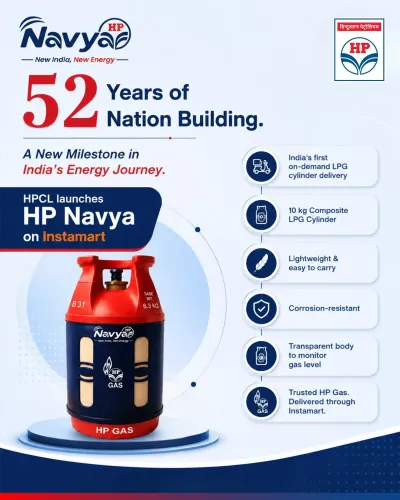
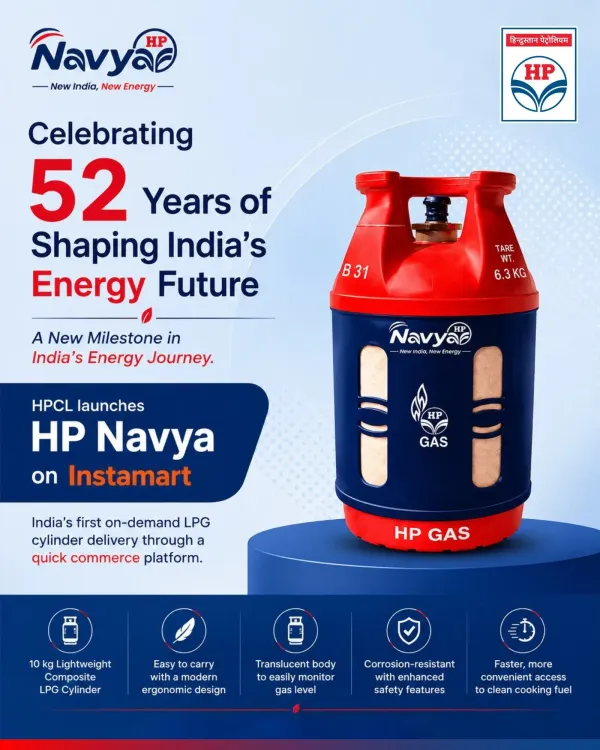
HPCL completed 52 years of service to the nation, marking the occasion with the launch of HP Navya , a 10 kg composite LPG cylinder .
HP Navya is positioned as combining safety, convenience, and technology for evolving consumer needs.
India's first on-demand LPG cylinder delivery via a quick-commerce platform was introduced alongside the product.
Digital booking through HP Pay complements the quick-commerce delivery channel.
The initiative aligns with national programmes including Digital India , Ease of Living , and the Viksit Bharat vision.
Union Petroleum Minister Hardeep Singh Puri linked the launch to the energy sector's broader commitment to inclusive access to clean cooking fuel.
Union Petroleum Minister Hardeep Singh Puri on Thursday, 16 July 2026 congratulated Hindustan Petroleum Corporation Limited (HPCL) on completing 52 years of service to the nation and praised the launch of HP Navya, a 10 kg composite LPG cylinder that the company describes as combining safety, convenience, and technology for modern consumers.
Context
In his post on X, Puri called the introduction of India's first on-demand LPG cylinder delivery through a quick-commerce platform — complemented by digital booking via HP Pay — 'a significant step towards building a modern, customer-centric and digitally enabled energy ecosystem.' He linked the initiative to the national vision of Digital India and Ease of Living, and to India's broader march towards Viksit Bharat.
HPCL, a major public sector oil marketing company under the Ministry of Petroleum and Natural Gas, was founded in 1974. Its 52nd foundation year marks a milestone in India's state-run petroleum sector, which has undergone significant structural and technological change over the past decade.
Policy Backdrop
The HP Navya launch builds on a long arc of policy reforms aimed at modernising LPG access in India. The PM Ujjwala Yojana, launched in 2016, extended LPG connections to below-poverty-line households, while the PAHAL direct benefit transfer scheme, introduced in 2013, sought to plug leakages in LPG subsidy delivery. Composite cylinder pilots by oil marketing companies during the 2010s laid the groundwork for products like HP Navya.
The Digital India programme, launched in 2015, has progressively drawn the energy sector into its orbit — from online bookings and digital payments to app-based refill tracking. The integration of quick-commerce delivery for LPG represents the latest iteration of this trend, moving last-mile fuel distribution closer to the on-demand model familiar to urban consumers through e-commerce.
Stakeholders and Impact
Urban and semi-urban LPG consumers stand to benefit most immediately from the on-demand delivery model and the lighter, safer composite cylinder format. The 10 kg form factor of HP Navya — smaller than the standard 14.2 kg steel cylinder — is expected to improve portability and handling, particularly for elderly users and smaller households.
For HPCL, the dual push of product innovation and digital channels represents a competitive positioning move within India's oil marketing sector, where rivals also operate LPG distribution networks. The HP Pay digital booking integration signals a shift toward app-driven customer engagement as a standard rather than an exception.
What's Next
Attention will now turn to whether other public sector oil marketing companies roll out comparable composite cylinder products and quick-commerce delivery tie-ups. Regulatory and safety standards for composite LPG cylinders — a relatively newer product category in India — may also come under parliamentary or bureau-level review as adoption scales. Minister Puri closed his message by wishing 'Team HPCL continued success in driving customer-centric innovations for a stronger and energy-secure India,' signalling the ministry's intent to sustain momentum on this front.
As India's energy sector continues to digitise and diversify its delivery models, initiatives like HP Navya could serve as a template for integrating consumer-technology platforms with essential public infrastructure — a convergence that will define the next phase of the country's clean cooking fuel journey.
Point of View
The move to integrate LPG with quick-commerce platforms marks a deliberate pivot from welfare-access framing toward consumer-convenience framing — a shift that broadens the political constituency for clean cooking fuel policy beyond BPL households to urban middle-class consumers. Whether the quick-commerce model can scale beyond metro areas will be the real test of the initiative's inclusive credentials.
NationPress
15 Oct 2026
Frequently Asked Questions
How can I book HP Navya LPG cylinder online?
HP Navya can be booked digitally through HP Pay , HPCL's digital payment and booking platform, and is also available for on-demand delivery through a quick-commerce platform — described as India's first such LPG delivery service.
Why did Hardeep Singh Puri congratulate HPCL today?
Union Petroleum Minister Hardeep Singh Puri congratulated HPCL on completing 52 years of service to the nation on 16 July 2026 , coinciding with the launch of the HP Navya composite LPG cylinder.
What is the difference between HP Navya and a regular LPG cylinder?
Unlike the standard 14.2 kg steel LPG cylinder, HP Navya is a lighter 10 kg composite cylinder, making it easier to handle and transport, with added features for safety and digital integration.
What is Viksit Bharat and how does HP Navya relate to it?
Viksit Bharat is the Indian government's vision for a developed India, and Minister Puri cited the HP Navya launch as an example of the energy sector's contribution to this goal through innovation, digital transformation, and inclusive access to clean energy.