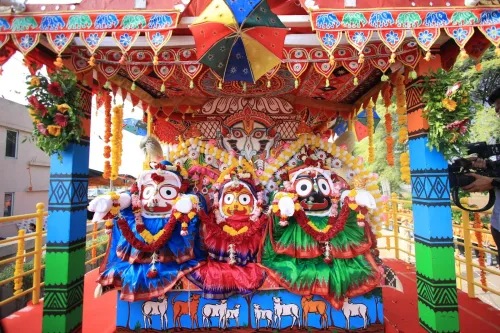
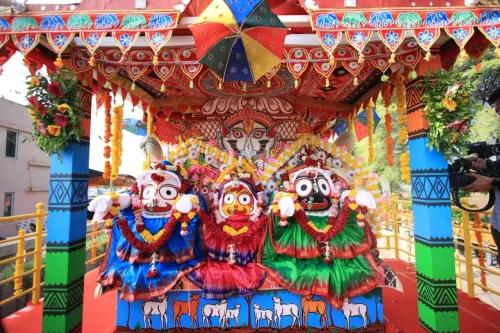
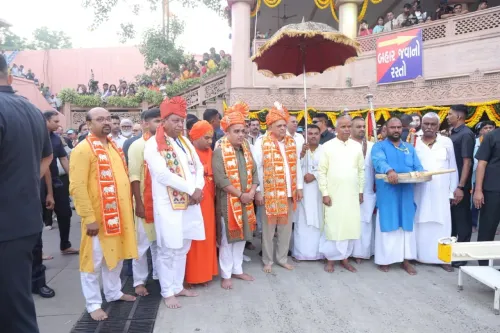
CM Bhupendra Patel performs Pahind ritual at 149th Ahmedabad Rath Yatra

Synopsis
Gujarat Chief Minister Bhupendra Patel performed the traditional Pahind Vidhi on 16 July 2026, flagging off Ahmedabad's 149th Rath Yatra on Ashadhi Bij and praying for the prosperity and health of all Gujarat and India.
Key Takeaways
CM Bhupendra Patel performed the Pahind Vidhi — the ceremonial chariot-sweeping ritual — at the 149th Ahmedabad Rath Yatra on 16 July 2026 .
The event was held on Ashadhi Bij , the traditional Hindu calendar date marking the commencement of the Rath Yatra season.
The Chief Minister described the occasion as a triveni sangam of faith, devotion, and belief, calling it a 'supreme fortune.' He offered prayers for happiness, prosperity, good health, and continuous progress for citizens of Gujarat and the entire nation.
The Ahmedabad Rath Yatra is among the largest Jagannath processions in India outside Puri, Odisha , drawing lakhs of devotees annually.
The 150th edition in 2027 will mark a major milestone for one of western India's most prominent religious processions.
Gujarat Chief Minister Bhupendra Patel on Thursday, 16 July 2026 performed the traditional Pahind (chariot-sweeping) ritual at Ahmedabad, formally flagging off the 149th Rath Yatra of Lord Jagannath on the auspicious occasion of Ashadhi Bij. The Chief Minister described the moment as a rare privilege and offered prayers for the well-being of all citizens of Gujarat and the nation.
Context
Posting on X with the salutation 'Jai Jagannath' ('Victory to Lord Jagannath'), CM Patel wrote that he was blessed with the 'supreme fortune' of performing the Pahind Vidhi — the ceremonial sweeping of the chariot's path — and setting the chariot of Lord Shri Jagannathji in motion. He called the gathering a 'wonderful confluence of faith, devotion, and belief' — a triveni sangam of shraddha, aastha and bhakti. Bowing at the feet of the deity, he invoked blessings for happiness, prosperity, good health, and continuous progress for Gujarat and the entire country.
Policy Backdrop
The Ahmedabad Rath Yatra is one of the largest religious processions in India outside Puri, Odisha, and is traditionally accorded state patronage by the Gujarat government. The Pahind Vidhi — in which a senior state dignitary sweeps the road before the chariot with a gold-handled broom — is a centuries-old tradition that signals the formal commencement of the procession. Incumbent chief ministers of Gujarat have historically participated in this ritual, underscoring the event's civic and cultural significance alongside its religious character.
The Ashadhi Bij date on the Hindu calendar — the second day of the bright fortnight of the month of Ashadha — marks the traditional start of the Rath Yatra season across India. In Ahmedabad, the procession originates from the Jagannath Temple in the Jamalpur area of the walled city and winds through major localities, drawing lakhs of devotees each year.
Stakeholders and Impact
The 149th edition of the Ahmedabad Rath Yatra draws participation from lakhs of devotees across Gujarat and neighbouring states, making it a major event for both the state administration and the city's civic machinery. Security, traffic management, and crowd-control arrangements are typically coordinated by the Ahmedabad Municipal Corporation, the Gujarat Police, and central security agencies. The event also generates significant economic activity for local artisans, flower vendors, and small traders along the procession route.
For the BJP-led state government, the Rath Yatra carries political as well as cultural weight, serving as a high-visibility occasion where the Chief Minister's participation reinforces the ruling party's emphasis on cultural heritage and public religiosity.
What's Next
The chariot procession is expected to traverse its traditional route through Ahmedabad over the course of the day before returning to the Jagannath Temple. With the 150th Rath Yatra due in 2027, state authorities are likely to begin planning for that milestone edition, which would carry added ceremonial significance as a centenary-and-a-half landmark for one of western India's most prominent religious processions.
Point of View
As one of Gujarat's most widely attended public gatherings, offers incumbents a rare platform that transcends partisan lines, reaching devout communities across caste and class. With the 150th edition approaching in 2027, the current government will likely seek to frame that milestone as a legacy moment, intensifying state involvement over the next year. The Chief Minister's post — invoking collective well-being rather than political achievement — signals a deliberate choice to position the occasion as a moment of civic unity rather than partisan celebration.
NationPress
15 Oct 2026
Frequently Asked Questions
What is the Pahind Vidhi in Rath Yatra?
The Pahind Vidhi is a traditional ceremonial ritual in which a senior state dignitary sweeps the road in front of Lord Jagannath's chariot with a gold-handled broom before the procession begins, symbolising humble service to the deity.
When was the 2026 Ahmedabad Rath Yatra held?
The 149th Ahmedabad Rath Yatra was held on 16 July 2026 , coinciding with the auspicious occasion of Ashadhi Bij .
Who performed the Pahind Vidhi at the 2026 Ahmedabad Rath Yatra?
Gujarat Chief Minister Bhupendra Patel performed the Pahind Vidhi, formally flagging off the 149th Rath Yatra in Ahmedabad.
What is Ashadhi Bij?
Ashadhi Bij is the second day of the bright fortnight of the Hindu month of Ashadha. It is the traditional date on which the Rath Yatra procession is held each year, both in Ahmedabad and at the main shrine in Puri, Odisha.
How significant is the Ahmedabad Rath Yatra?
The Ahmedabad Rath Yatra is one of the largest Jagannath chariot processions in India outside Puri, Odisha, drawing lakhs of devotees annually. The 2026 edition was the 149th in the city's history.