Puri hails India's space, semiconductor leap under Modi
Synopsis
Union Petroleum Minister Hardeep Singh Puri declared on 8 August 2026 that India's youth are now building rockets and launch vehicles, and that semiconductor production has begun in India — citing PM Modi's Atmanirbhar Bharat programme as the driving force behind the country's leap into elite technology territory.
Key Takeaways
Union Petroleum Minister Hardeep Singh Puri posted on 8 August 2026 highlighting India's advances in space and semiconductors.
India's 2020 space sector liberalisation opened rocket manufacturing and launches to private companies for the first time.
The India Semiconductor Mission , approved in 2021 with a Rs 76,000 crore outlay, underpins the country's chip manufacturing ambitions.
Puri stated that semiconductor production has begun in India, a claim that would place the country among a small global club.
Both developments are framed under PM Narendra Modi's Atmanirbhar Bharat ('self reliant India') programme.
Key milestones to track: commissioning of approved semiconductor fabs and first private sector orbital launches from Indian soil.
Once asked if it could, India is now showing the world it already has. Union Petroleum Minister Hardeep Singh Puri on Saturday, 8 August 2026 invoked a sharp generational contrast — from a nation that faced sceptical questions about its ambitions to one whose youth are building rockets, assembling launch vehicles, and entering a semiconductor manufacturing club that barely a handful of countries belong to.
Posting in Hindi, Puri wrote: 'जहाँ कभी भारत से पूछा जाता था — "क्या भारत यह कर पाएगा?"' — ('Where once India was asked, "Can India do this?" — today the youth of that very India are answering the world with proof of their capability.')
From scepticism to launch pads
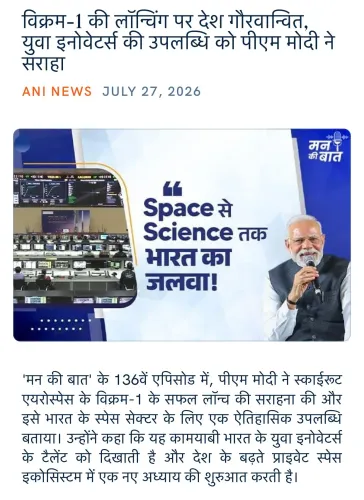
The space sector shift Puri points to has a clear policy origin. In 2020, the government liberalised the space sector, formally opening rocket design, manufacturing, and launch to private players for the first time. What followed was a generation of Indian startups stepping onto a stage previously occupied only by ISRO — the Indian Space Research Organisation, which has operated since the 1960s and built India's interplanetary credentials over decades. Today, private firms are not just designing components — they are assembling full launch vehicles, a capability that places India in a very short list of nations with end to end, indigenously driven space competence.
Semiconductor production: the 'impossible' made possible
Puri's second claim is the bolder one. He states that semiconductor production has begun in India — a milestone that, if confirmed at scale, would mark a turning point in one of the world's most strategically sensitive supply chains. The India Semiconductor Mission, approved in 2021 with a Rs 76,000 crore outlay, was designed precisely to build this ecosystem: chip design, packaging, and eventually fabrication. The programme targets a sector where import dependence has long been a strategic vulnerability, and where entry barriers — in capital, technology, and talent — kept most nations out entirely.
The minister framed both breakthroughs as expressions of a broader national confidence, crediting Prime Minister Narendra Modi's leadership and the Atmanirbhar Bharat ('self reliant India') programme for the transformation. 'A new India, full of self belief, is moving forward,' he wrote.
Why the Rs 76,000 crore bet matters now
The stakes are not abstract. Global semiconductor shortages between 2021 and 2023 exposed how dangerously concentrated chip manufacturing had become — a lesson that accelerated government backed fab programmes from the United States to the European Union to Japan. India's entry into this race, backed by a six figure crore public investment and a liberalised space policy, positions it to compete in two sectors that will define economic and defence power through the 2030s. The next markers to watch: the commissioning of approved semiconductor fabs and the first private sector orbital launches from Indian soil.
The question the world once posed to India has, it seems, become its own answer.
Point of View
000 crore semiconductor bet and space liberalisation are genuine policy moves, but the claim that commercial semiconductor production has 'begun' will face scrutiny, since the commissioned fabs have not yet reached full operational status per publicly available information. The post reflects the government's strategic priority of anchoring India in dual use technology sectors where geopolitical leverage is increasingly tied to indigenous capability.
NationPress
22 Sept 2026
Frequently Asked Questions
Has India started semiconductor manufacturing?
Union Minister Hardeep Singh Puri stated on 8 August 2026 that semiconductor production has begun in India. The India Semiconductor Mission, backed by a Rs 76,000 crore government outlay approved in 2021, is the policy framework driving this effort, though the full commissioning status of approved fabs is subject to ongoing development.
What is the India Semiconductor Mission?
The India Semiconductor Mission is a central government programme approved in 2021 with an outlay of Rs 76,000 crore to build an end to end semiconductor ecosystem in India, covering chip design, packaging, and fabrication, aiming to reduce the country's heavy dependence on imported chips.
Can private companies launch rockets in India?
Yes. The Indian government liberalised the space sector in 2020, formally permitting private companies to design, manufacture, and launch rockets and satellites, opening a field previously exclusive to ISRO.
What is Atmanirbhar Bharat and how does it relate to space and semiconductors?
Atmanirbhar Bharat, meaning 'self reliant India,' is PM Narendra Modi's flagship programme to reduce import dependence and build indigenous capability across strategic sectors. Space liberalisation and the India Semiconductor Mission are two of its most significant technology sector pillars.
What did Hardeep Singh Puri say about India's youth and technology?
Puri wrote in Hindi that where India was once asked 'Can India do this?', today India's youth are answering the world by building rockets, assembling launch vehicles, and achieving milestones in space and semiconductors that only a handful of countries have managed.